Prince Patrick Island
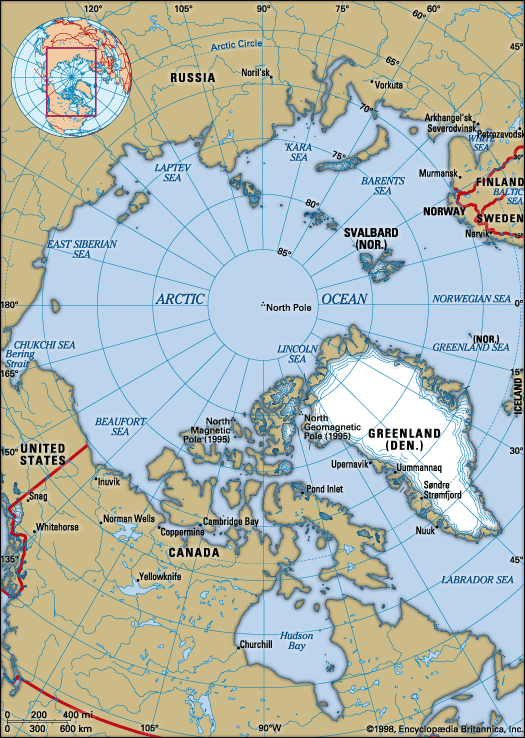
Prince Patrick Island is the westernmost island of the Parry Islands, located in the Arctic Ocean within the Northwest Territories of Canada.
What is Prince Patrick Island?
Prince Patrick Island is the westernmost island of the Parry Islands, located in the Arctic Ocean within the Northwest Territories of Canada.1
Spanning approximately 6,119 square miles (15,848 square km), the island is characterized by a sandstone plateau that rises to 810 feet (250 metres) in the southeast, surrounded by a low, irregular coastline. It is separated from Melville Island by the Kellett and Fitzwilliam straits and from Banks Island by the M’Clure Strait.1
The island was discovered in 1853 by the British explorer Francis Leopold McClintock and was named in honor of Prince Arthur William Patrick, the third son of Queen Victoria.1
What are the Parry Islands?
The Parry Islands are an archipelago located in the Arctic Ocean within the Canadian territories of Nunavut and the Northwest Territories.2
As part of the Queen Elizabeth Islands, the archipelago is situated south and west of Ellesmere Island. The major islands that comprise the group include:2
- Devon Island
- Cornwallis Island
- Bathurst Island
- Melville Island
- Prince Patrick Island2
Who was Sir Francis McClintock?
Sir Francis Leopold McClintock (1819–1907) was a distinguished British naval officer and explorer renowned for his pivotal role in Arctic exploration. He is most famous for discovering the fate of the lost Sir John Franklin expedition, which had vanished during its 1845 attempt to navigate the Arctic.3
After participating in three earlier search efforts, McClintock commanded the Fox—a vessel funded by Franklin’s widow—between 1857 and 1859. During this mission, he recovered critical evidence, including a written record of the expedition and remains of the crew near King William Island.3 His earlier work was also highly influential; during his 1850–51 and 1852–54 expeditions, he pioneered improvements in sledge travel that significantly advanced the feasibility of Arctic exploration. Additionally, in 1853, he discovered Prince Patrick Island, which he named after Prince Arthur William Patrick. Following the publication of his narrative, The Voyage of the “Fox” in the Arctic Seas, he was knighted in 1860.31
What is the climate like in the Canadian Arctic?
The Canadian Arctic is characterized by a polar continental climate, dominated by Arctic and polar air masses that result in perennially cold or cool conditions.45
Temperature and Seasons
The region experiences long, intensely cold winters and short, cool summers. Subfreezing temperatures can persist for 8 to 10 months of the year, with temperatures frequently dropping below 0 °F (−18 °C) for 5 to 7 months. In the Canadian Arctic, mean January temperatures typically range from −30 to −20 °F (−34 to −29 °C), with extreme winter lows reaching between −65 and −50 °F (−54 and −46 °C).45
Summer temperatures are more uniform, though they remain cool; even in July, average temperatures generally do not rise above 50 °F (10 °C). The frost-free season is extremely limited, often lasting fewer than 60 days, and frost or snow can occur during any month of the year.564
Precipitation and Conditions
Precipitation in the Canadian Arctic is generally light. Annual totals are often low, particularly in the far north, where the region is considered a polar desert. Precipitation typically consists of 2 to 4 inches (50 to 100 mm) of summer rain and 30 to 60 inches (760 to 1,500 mm) of winter snow. In areas near the eastern Arctic, strong, persistent northwest winds contribute to high windchill, creating stormy winter conditions with rapidly changing temperatures.45
Sources
- Prince Patrick Island — Encyclopædia Britannica
- Parry Islands — Encyclopædia Britannica
- Sir Francis Leopold McClintock — Encyclopædia Britannica
- North America - The Arctic zone — Encyclopædia Britannica
- Arctic - Climate of the Arctic — Encyclopædia Britannica
- Northwest Territories - Land — Encyclopædia Britannica
- sea ice - The emerging impacts of recent changes to sea ice — Encyclopædia Britannica
Published on · 3 min read