Purple Passion Fruit
Purple passion fruit (Passiflora edulis) is an evergreen climbing vine native to South America, specifically Paraguay, southern Brazil, and northern…
What is Purple passion fruit?
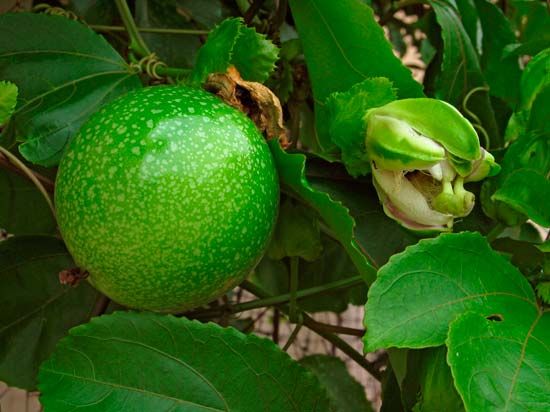
Purple passion fruit (Passiflora edulis) is an evergreen climbing vine native to South America, specifically Paraguay, southern Brazil, and northern Argentina. It belongs to the passion flower family (Passifloraceae) and is widely cultivated in tropical regions for its edible fruit.12
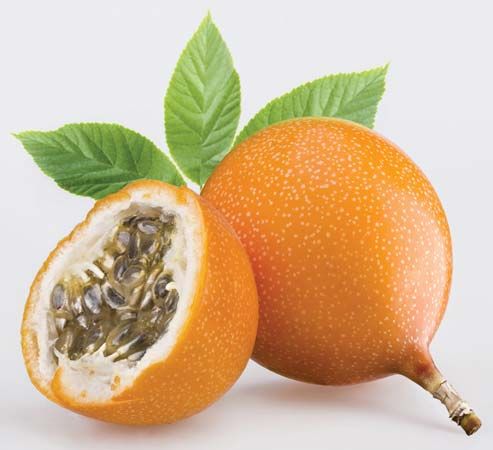
The fruit is ovoid, typically measuring about 5 cm (2 inches) across with a rough, purple rind, though a yellow-fruited variety also exists. Inside, it contains numerous seeds surrounded by a juicy, orange-colored aril. Known for an intensely sharp flavor reminiscent of pineapple, mandarin, and orange, it is a popular ingredient in desserts, beverages, and fragrances.1
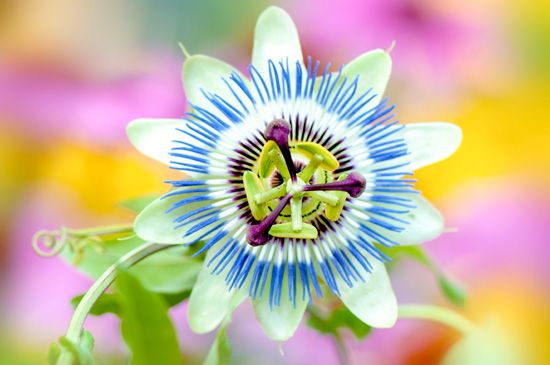
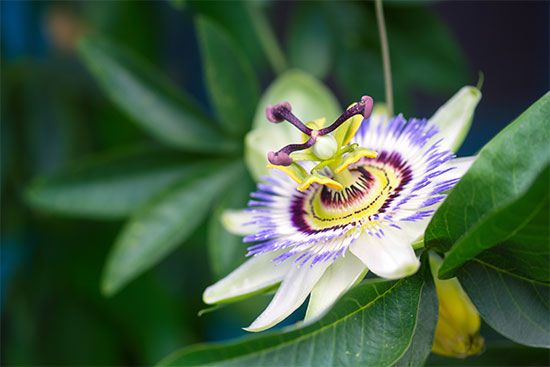
The name “passion fruit” stems from Christian missionaries who interpreted the unique structure of the plant’s flowers as symbols of the Passion of Jesus Christ, with various parts representing the crown of thorns, the wounds of the crucifixion, and the Apostles.1
How did the passion flower get its name?
The name “passion flower” originated with Christian missionaries who observed that the unique structure of the passion flower blossom symbolized the Passion of Jesus Christ—the events surrounding his final hours and Crucifixion.41
Missionaries interpreted specific parts of the flower as religious symbols:41
- Corona: The threadlike filaments were seen to represent the crown of thorns.41
- Stamens: The five stamens were associated with the five wounds of Christ.41
- Styles: The three styles, ending in buttonlike stigmas, were thought to resemble the nails used to pin Jesus to the cross.41
- Sepals and Petals: The five sepals and five petals were interpreted as representing 10 of the Apostles, excluding Judas Iscariot and St. Peter.41
This symbolic association, which first appeared in historical records around 1633, serves as the basis for the common name of the entire genus Passiflora.45
What are the main differences between purple and yellow passion fruit?
Both purple and yellow passion fruit are varieties of the same species, Passiflora edulis. While they share the same botanical classification, they are distinguished primarily by their physical appearance and cultivation:13
- Purple Passion Fruit (Passiflora edulis): This is the standard form of the species. It is characterized by a rough, purple rind and is widely cultivated in tropical and subtropical regions for its intensely flavored, aromatic fruit.36
- Yellow Passion Fruit (Passiflora edulis flavicarpa): This is a specific yellow-fruited form of the same species.3
Beyond these two varieties, the Passiflora genus includes many other species often referred to as passion fruit, which differ significantly in appearance and use. For example, the giant granadilla (P. quadrangularis) produces a long yellow fruit that is sometimes eaten as a vegetable when immature, while other species like the yellow granadilla (P. laurifolia) are distinct from the P. edulis varieties.62
How do climbing vines use tendrils to grow?
Climbing vines utilize tendrils—slender, threadlike organs—to anchor and support their stems as they grow. These structures, which can be modified leaves, leaflets, or stem branches, are highly sensitive to touch, a response known as thigmotropism.78
When a tendril brushes against an object, it reacts by curving toward the point of contact. If the object’s shape allows, the tendril wraps around it, clinging firmly as long as the stimulation persists. Some tendrils also feature terminal enlargements that flatten and secrete an adhesive to cement the plant to a surface.7
Once the tendril has successfully attached, it undergoes a structural change: it develops strong mechanical tissue called sclerenchyma. This hardening process renders the tendril robust enough to support the weight of the growing plant, allowing it to climb effectively toward light or better growing conditions.7
Sources
- passion fruit — Merriam-Webster
- Passifloraceae — Encyclopædia Britannica
- Purple passion fruit — Encyclopædia Britannica
- passion flower — Encyclopædia Britannica
- passionflower — Merriam-Webster
- Malpighiales - Passifloraceae — Encyclopædia Britannica
- Tendril — Encyclopædia Britannica
- Did you know? — Merriam-Webster
- Locomotion - Climbing — Encyclopædia Britannica
Published on · 3 min read