Queenston Delta
The Queenston Delta was a massive wedge of sedimentary rock that formed during the Late Ordovician Period, approximately 461 to 444 million years ago.
What is Queenston Delta?
The Queenston Delta was a massive wedge of sedimentary rock that formed during the Late Ordovician Period, approximately 461 to 444 million years ago.1
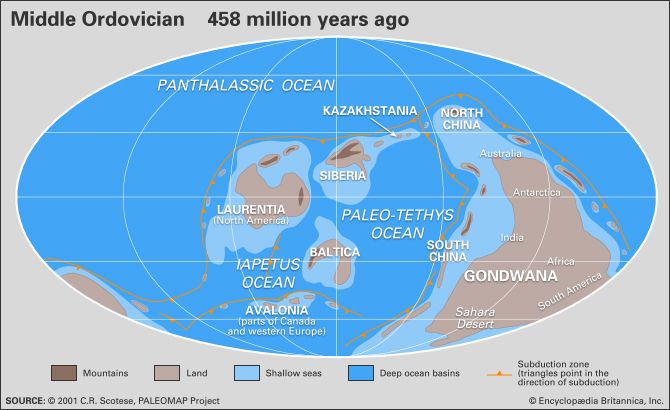
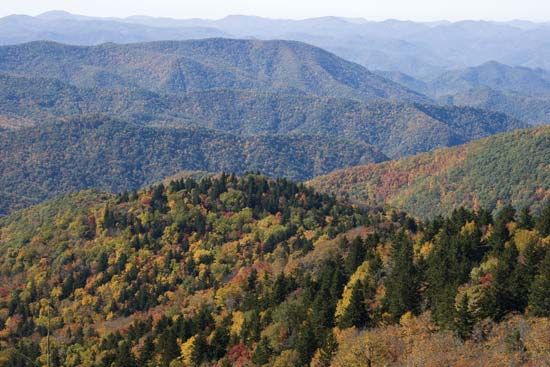
This geological feature was created by the erosion of rising highlands in the region of the present-day Appalachian Mountains. The Taconic orogeny—a series of mountain-building collisional events—supplied vast amounts of sediment that were transported westward by streams, spreading as far as present-day Lake Huron.123
The delta is named after the Queenston Shale, a reddish shale formation that accumulated along the landward front of the advancing delta. While these landward sediments were oxidized, resulting in their characteristic red color, other shales that accumulated in underwater, oxygen-depleted environments remained gray. Today, these deposits are found across an extensive area of northeastern North America, with the thickest accumulations located in New York, Pennsylvania, and Quebec.13
What is the Taconic Orogeny and how did it build mountains?
The Taconic orogeny was the first of three major mountain-building events that formed the Appalachian Mountains in eastern North America. Occurring during the Ordovician Period, this process was not a single event but consisted of at least three distinct episodes.4
How the Mountains Were Built
The Taconic orogeny was driven by the oblique collision of a terrane—a crustal block or formation of related rocks—with the eastern edge of the North American continent, known as Laurentia. Specifically, between approximately 470 and 460 million years ago, a volcanic island arc collided with and deformed the Appalachian margin.45
This tectonic activity resulted in several significant geological changes:
- Crustal Deformation: The collision caused intense folding, faulting, and regional metamorphism.4
- Igneous Activity: The event triggered igneous intrusions throughout the northern and southern Appalachians.4
- Basin Formation: The flexure of the North American crust during these collisions created deep sedimentary basins. These basins captured vast amounts of eroded material, such as the Queenston Delta in New York and the Blount Group in Tennessee.4
- Regional Uplift: The tectonic pressure caused distant effects, including the gentle uplift of features like the Cincinnati Arch and the Nashville Dome.4
How do geologists use sedimentary rocks to reconstruct ancient environments?
Geologists reconstruct ancient environments by analyzing the physical, chemical, and biological characteristics of sedimentary rocks. This practice relies on the principle of uniformitarianism, which posits that the geologic processes observed today—such as erosion, transport, and deposition—have operated in the same manner throughout Earth’s history. By observing modern environments, geologists can interpret the “key to the past” preserved in the rock record.67
Key methods for environmental reconstruction include:
- Sedimentary Structures: Features such as cross-bedding, ripple marks, and graded beds provide evidence of the energy and direction of the currents (water or wind) that deposited the sediment.8
- Textural Analysis: The size, sorting, and roundness of grains help identify the depositional setting. For example, well-sorted, rounded grains often indicate high-energy environments like beaches or desert dunes, while poorly sorted, angular grains suggest rapid deposition in areas like alluvial fans or glacial margins.9
- Fossil Content: Fossils act as environmental indicators. The presence of specific organisms, such as coral that requires warm, shallow water, allows geologists to infer the climate and water conditions of the ancient site.108
- Facies Analysis: Geologists study sedimentary facies—the lateral and vertical changes in rock types—to map how environments like shorelines or deep-sea basins shifted over time.11
By integrating these data, geologists can map paleogeography, documenting the evolution of mountain systems, oceans, and ancient life-forms.6
What are some other major geologic events that shaped North America?
Beyond the Taconic orogeny, North America’s geological history has been shaped by numerous transformative events. These include several other major mountain-building episodes (orogenies) and significant tectonic shifts:
- Acadian Orogeny (450–410 million years ago): Following the Taconic event, additional volcanic arcs and continental fragments were accreted to the Appalachian margin, further building the mountain range.512
- Ellesmerian Orogeny (380–360 million years ago): This event deformed the Franklinian margin in the Arctic, as northern extensions of the Caledonian orogenic belt were sheared westward toward Ellesmere Island.5
- Antler Orogeny (380–360 million years ago): Occurring roughly contemporaneously with the Ellesmerian orogeny, this event involved the accretion of volcanic arcs to the western margin of the continent, from California to Alaska.5
- Alleghenian Orogeny (330–250 million years ago): This major collision between Laurentia and Gondwana finalized the formation of the Pangaea supercontinent and produced extensive thrust faults and folds across the southern Appalachians.512
- Laramide Orogeny (Late Cretaceous to Paleogene): This polyphase event created the modern Rocky Mountains through a series of vertical uplifts and thrust faults, resulting in the formation of deep intermontane basins.1314
- Cenozoic Crustal Extension: Following the Laramide orogeny, the western United States experienced significant crustal extension, which broke the Basin and Range Province into its characteristic north-south-trending fault-block mountains.14
Sources
- Queenston Delta — Encyclopædia Britannica
- Ordovician Period - Significant geologic events — Encyclopædia Britannica
- Ordovician Period - Plate tectonics — Encyclopædia Britannica
- Taconic orogeny — Encyclopædia Britannica
- North America - 600 to 250 million years ago — Encyclopædia Britannica
- sedimentary rock — Encyclopædia Britannica
- sedimentary facies — Encyclopædia Britannica
- fossil record — Encyclopædia Britannica
- sedimentary rock - Bedding structure — Encyclopædia Britannica
- uniformitarianism — Encyclopædia Britannica
- sedimentary rock - Texture — Encyclopædia Britannica
- North America - Tectonic evolution — Encyclopædia Britannica
- Laramide orogeny — Encyclopædia Britannica
- Canada - The Canadian Shield — Encyclopædia Britannica
- Appalachian orogenic belt — Encyclopædia Britannica
- Tertiary Period - Volcanism and orogenesis — Encyclopædia Britannica
Published on · 4 min read