Sanddab
A sanddab is an edible flatfish belonging to the genus Citharichthys within the family Paralichthyidae, typically found in the American Pacific. Like other…
What is sanddab?
A sanddab is an edible flatfish belonging to the genus Citharichthys within the family Paralichthyidae, typically found in the American Pacific. Like other flatfishes, sanddabs are characterized by having both eyes on the same side of the head, which in this genus are usually located on the left side.1
The most prevalent species is the Pacific sanddab (C. sordidus), a brownish fish that can reach lengths of approximately 40 cm (16 inches) and weights of up to 1 kg (2 pounds); males of this species are often mottled with dull orange. It is important to note that the term “sanddab” is sometimes used colloquially to refer to other flatfishes, such as the American plaice, which is known in Europe as the rough dab.1
How do flatfish develop with both eyes on one side?
Flatfish, which belong to the order Pleuronectiformes, undergo a remarkable transformation to achieve their signature asymmetrical form. While they are born bilaterally symmetrical—with one eye on each side of the head—they begin life swimming near the sea surface.23
After a few days, the larvae begin to lean to one side, triggering a period of rapid development known as metamorphosis. During this process, the eye on the side that will become the bottom migrates to the opposite side of the head. This migration occurs either by moving over the middorsal ridge or through the head itself, facilitated by the reabsorption of skull cartilage to create a path.234
As the eye shifts, the fish undergoes complex osteological changes, including the twisting of the skull bones, nerves, and muscles. Once the migration is complete, the fish settles to the bottom, living with its eyed side facing upward. This upper side typically develops pigmentation to blend with the environment, while the underside remains unpigmented and white.2345
What are some other types of flatfish?
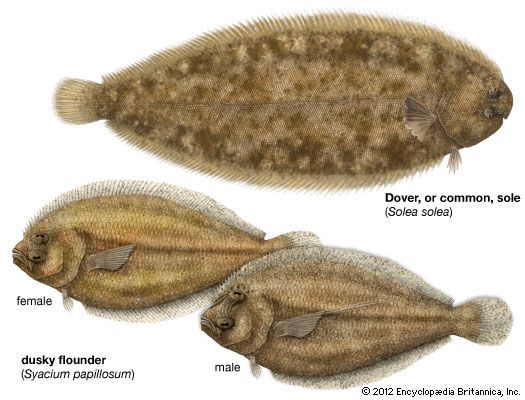
There are approximately 600 species of flatfish within the order Pleuronectiformes, which are categorized into 14 distinct families. These fish are generally divided into those that are “left-eyed” (sinistral) and “right-eyed” (dextral) based on the side of their head where their eyes are located.27
Common types of flatfish include:
- Halibuts: Large, economically valuable fish belonging to the family Pleuronectidae. They are typically right-eyed, such as the Atlantic halibut and Pacific halibut.78
- Flounders: This group includes several families, such as the Bothidae (left-eyed flounders) and Pleuronectidae (right-eyed flounders).7
- Turbots: Members of the family Scophthalmidae, these are left-eyed flatfish found in the North Atlantic and Mediterranean.7
- Soles: Including the Soleidae family and tongue soles (Cynoglossidae), these are generally right-eyed and left-eyed, respectively.7
How do fish camouflage themselves on the ocean floor?
Fish employ a variety of sophisticated strategies to camouflage themselves on the ocean floor, primarily relying on background matching and disruptive coloration to evade predators.
Mechanisms of Concealment
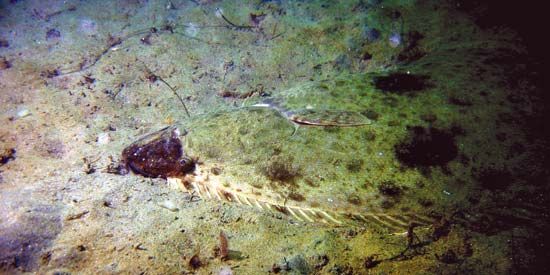
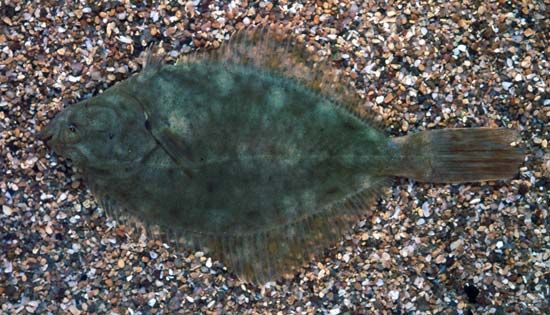
- Background Matching: Many bottom-dwelling species, such as flatfishes, possess a remarkable ability to alter their coloration to match the pattern and texture of the substrate upon which they rest. This is achieved through the movement of pigments within specialized cells called chromatophores11.10
- Disruptive Coloration: Some fish use patterns that break up their body outline, making them difficult to distinguish from their surroundings. For example, the blenny uses mottled patterns and dark “saddles” to blend in with elements like algae or barnacles.11
- Morphological Adaptations: Certain species, such as scorpion fishes and sculpins, utilize fleshy lappets on their heads and fins to mimic the irregular textures of rocky or coral-covered bottoms, rendering them virtually invisible.12
- Physiological Control: While some color changes are rapid, others occur over months as fish adjust their pigment levels—such as the storage of guanine—in response to the lightness or darkness of their environment.13
Sources
- sanddab — Encyclopædia Britannica
- Did you know? — Merriam-Webster
- pleuronectiform — Encyclopædia Britannica
- flounder — Encyclopædia Britannica
- pleuronectiform - Form and function — Encyclopædia Britannica
- pleuronectiform - Reproduction — Encyclopædia Britannica
- pleuronectiform - Critical appraisal — Encyclopædia Britannica
- pleuronectiform - Annotated classification — Encyclopædia Britannica
- halibut — Encyclopædia Britannica
- coloration - Background matching — Encyclopædia Britannica
- fish - The skin — Encyclopædia Britannica
- coloration - Disruptive coloration — Encyclopædia Britannica
- scorpaeniform - Camouflage and coloration — Encyclopædia Britannica
- coloration - Short-term changes — Encyclopædia Britannica
- fish - Locomotion — Encyclopædia Britannica
Published on · 3 min read