Stewartia
Stewartia is a genus comprising at least nine species of shrubs and small trees within the tea family (Theaceae), native to regions of East Asia and eastern…
What is stewartia?
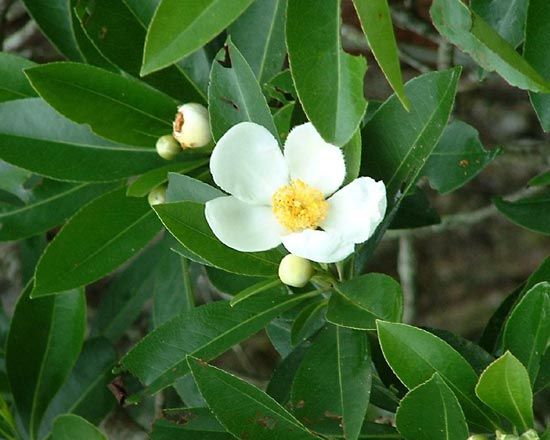
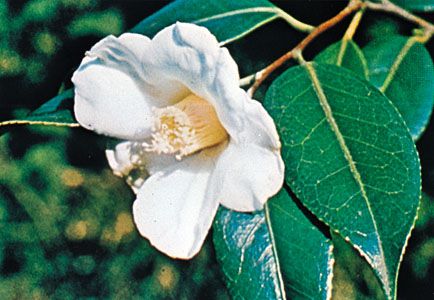
Stewartia is a genus comprising at least nine species of shrubs and small trees within the tea family (Theaceae), native to regions of East Asia and eastern North America. These plants are widely cultivated as ornamentals in warmer climates, prized for their showy, camellia-like flowers and their distinctive, peeling bark.12
Notable species include:
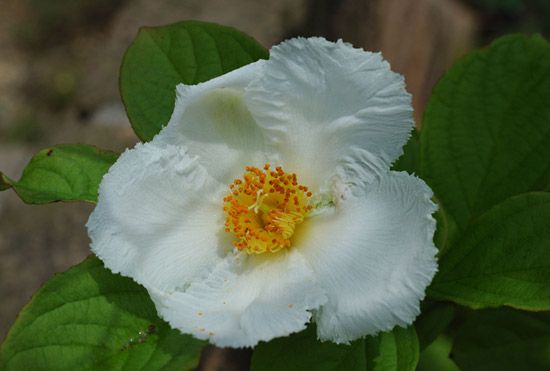
- Japanese stewartia (S. pseudocamellia): A tree reaching up to 15 metres (50 feet) in height, known for its reddish, exfoliating bark and white flowers featuring prominent orange stamens.1
- Silky camellia (S. malacodendron): A shrub growing to 3.5 metres (11.5 feet) with white flowers and purple stamens.1
- Mountain stewartia (S. ovata): A shrubby species primarily found in the southern Appalachian Mountains.1
The genus name is derived from John Stuart, the 3rd Earl of Bute. These plants are characterized by their large, solitary flowers that develop into woody, 5-celled capsules.2
What other plants belong to the tea family?
The Theaceae family, commonly known as the tea family, consists of approximately 9 to 40 genera of trees and shrubs, primarily native to tropical and temperate regions of East Asia and the Americas.34
Beyond the well-known Camellia genus—which includes Camellia sinensis, the source of tea—the family includes several other notable plants:35
- Franklinia: A genus represented by a single species that is now extinct in the wild, historically native to Georgia in the United States.34
- Gordonia: A genus of trees and shrubs known for their camellia-like white blooms.4
- Stewartia: A genus of nine species prized for their showy flowers and exfoliating bark.34
- Pyrenaria: A genus comprising about 42 species found in Southeast Asia and western Malesia.3
- Eurya: Slow-growing, low-foundation plants from East Asia with small yellow-green flowers.4
- Cleyera japonica: A species known for its fragrant, creamy-white blooms and dark red berries.4
- Ternstroemia japonica: A small Asian tree featuring bronze-colored leaves and slightly fragrant flowers.4
How does the Japanese stewartia differ from American species?
The Japanese stewartia (Stewartia pseudocamellia) differs significantly from the American species in both size and floral characteristics. While the Japanese stewartia is a tree that can reach heights of up to 15 metres (50 feet), the American species—such as the silky camellia (S. malacodendron) and the mountain stewartia (S. ovata)—are typically shrubby in habit.1
The floral features also provide a clear distinction:
- Japanese stewartia: Features large white flowers with conspicuous orange stamens in the center.1
- Silky camellia: Distinguished by its white flowers that possess purple stamens.1
Additionally, the Japanese stewartia is noted for its reddish, peeling bark, which contributes to its popularity as an ornamental tree. The American species have more restricted native ranges, with the mountain stewartia being primarily confined to the southern Appalachian Mountains.1
What are the best conditions for growing ornamental trees?
To ensure the health and longevity of ornamental trees, it is essential to provide conditions that promote vigorous growth, as healthier trees are naturally more resistant to pests and diseases. The following practices are key to successful cultivation:8
Site Selection and Preparation
- Species Adaptation: Select species that are well-adapted to your specific site, ideally matching the latitude and climate of their native habitat.9
- Soil Quality: Ensure the soil is fertile and well-drained. Modern arboriculture allows for site improvement through mechanical draining or plowing to facilitate the penetration of air, water, and roots.109
- Planting: When planting, ensure the root system is kept moist and cool. For container-grown or nursery stock, proper site preparation—such as creating a saucer to retain water—is a foundational practice.911
Ongoing Maintenance
- Nutrition and Hydration: While forest crops are rarely irrigated, ornamental trees benefit from proper watering and fertilization to encourage vigor, especially in species susceptible to diseases like Verticillium wilt.910
- Weed and Pest Control: Control weeds during the early years of growth to reduce competition for nutrients and water. Monitor for insects and diseases regularly; sanitation—such as the prompt removal of diseased branches or trees—is critical to preventing the spread of pathogens.9810
- Pruning: Prune to improve shape, remove dead or diseased wood, and increase air circulation and light penetration. Always make cuts just above the branch collar rather than flush with the trunk to allow for proper callus formation.12
- Wound Care: Protect trees from unnecessary wounding, as injuries provide entry points for decay-inducing fungi. If a tree is wounded, trimming the area to sound tissue and applying appropriate dressings can help protect the exposed wood.1211
Sources
- stewartia — Encyclopædia Britannica
- Stewartia — Merriam-Webster
- Ericales - Theaceae — Encyclopædia Britannica
- Theaceae — Encyclopædia Britannica
- Theaceae — Merriam-Webster
- Camellia — Encyclopædia Britannica
- tea — Encyclopædia Britannica
- forestry - Artificial regeneration — Encyclopædia Britannica
- bonsai — Encyclopædia Britannica
- forestry - Insect and disease control — Encyclopædia Britannica
- pruning — Encyclopædia Britannica
- arboriculture — Encyclopædia Britannica
- horticulture - Trees — Encyclopædia Britannica
- Wilt — Encyclopædia Britannica
Published on · 3 min read