Gordonia
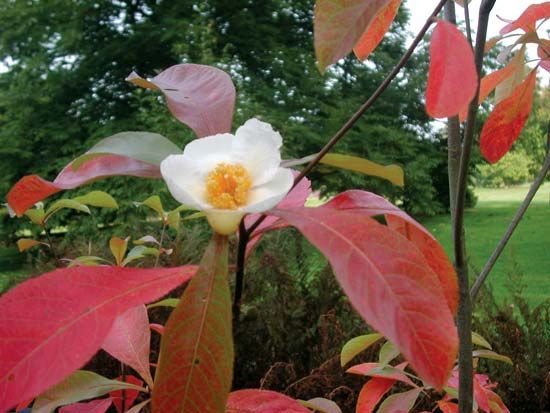
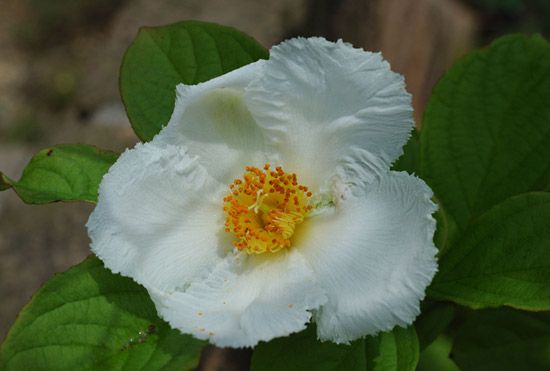
Gordonia is a genus comprising approximately 70 species of shrubs and trees belonging to the tea family (Theaceae). Native to North America and East Asia…
What is gordonia?
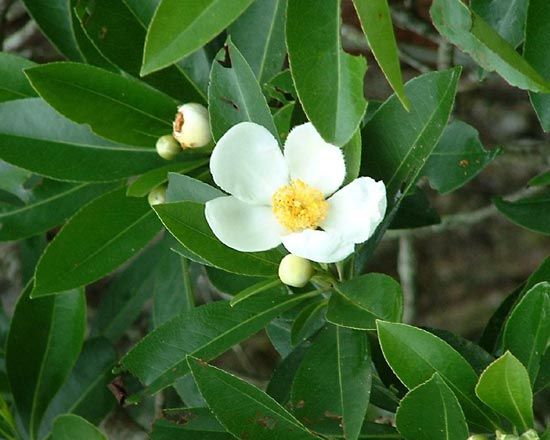
Gordonia is a genus comprising approximately 70 species of shrubs and trees belonging to the tea family (Theaceae)1. Native to North America and East Asia, these plants are characterized by their evergreen foliage and large, white, camellia-like flowers with yellow centers.12
Notable species include:
- Loblolly bay (G. lasianthus): A tree native to southeastern North America that can reach heights of about 19 meters (60 feet) and produces fragrant flowers in late summer.2
- G. axillaris: An evergreen species from South China that features stalkless blossoms and typically flowers during the winter.2
While the franklinia tree was historically classified within the genus Gordonia, it is now recognized as a distinct genus, Franklinia alatamaha. The genus name honors the 18th-century English gardener James Gordon.21
What other plants belong to the tea family?
The tea family (Theaceae) consists of approximately 40 genera of trees and shrubs. Beyond the genus Gordonia, several other notable plants belong to this family:
- Camellia: This genus includes about 250 species, most famously Camellia sinensis, which is the source of commercial tea. Other popular ornamental species include C. japonica, C. reticulata, and C. sasanqua.34
- Franklinia: Known for its camellia-like white blooms, this genus is closely related to Gordonia.3
- Stewartia: Another genus within the family that produces attractive, white, camellia-like flowers.3
- Eurya: These are slow-growing, low-foundation plants from East Asia characterized by glossy leaves and small yellow-green flowers.3
- Cleyera japonica: A species known for its fragrant, creamy-white blooms and dark red berries.3
- Ternstroemia japonica: A small Asian tree featuring slightly fragrant flowers and distinctive bronze-colored leaves with red stalks.3
How do evergreen trees differ from deciduous trees?
The primary difference between evergreen and deciduous trees lies in their foliage retention and survival strategies regarding seasonal changes.
Evergreen Trees
Evergreens retain their leaves throughout the year, often keeping them for two or more years. In cold climates, these plants have evolved thick, waxy, or resinous coatings on their leaves to protect cells from freezing and fracturing. Their foliage is typically thicker and more leathery than that of deciduous trees, and in many temperate regions, they are cone-bearing conifers, such as pines and firs.56
Deciduous Trees
Deciduous trees shed their leaves annually, typically in autumn or during a dry season. This is a protective mechanism: because their leaves are generally thin and tender, they are highly susceptible to cold damage. If they retained their leaves in winter, the water within the leaf cells would freeze and expand, rupturing the cells and rendering them useless for photosynthesis. Furthermore, dropping leaves prevents physical damage from wind and the weight of snow, while allowing the tree to enter a state of dormancy to conserve energy.56
What is the history of the Franklinia tree?
The Franklinia (Franklinia alatamaha), a member of the tea family, has a unique and somewhat mysterious history. It was first identified in 1765 by the botanist John Bartram along the Altamaha River near Fort Barrington, Georgia. Bartram named the tree in honour of Benjamin Franklin.910
The Franklinia is notable for its status as an extinct species in the wild. Although it was once native to the southeastern United States, it has not been found in its natural habitat for many years. Consequently, every Franklinia tree currently in existence is a descendant of the original seeds and plants collected by Bartram.9
Growing up to 9 metres (30 feet) tall, the tree is prized for its large, cupped white flowers that bloom from midsummer until the first frost. Because of its resemblance to the loblolly-bay (Gordonia lasianthus), it is sometimes referred to as mountainbay.9
Sources
- gordonia — Encyclopædia Britannica
- gordonia — Merriam-Webster
- Theaceae — Encyclopædia Britannica
- Camellia — Encyclopædia Britannica
- Evergreen — Encyclopædia Britannica
- Why Do Leaves Fall in Autumn? — Encyclopædia Britannica
- Temperate forest - Flora — Encyclopædia Britannica
- Tree - Popular classifications — Encyclopædia Britannica
- franklinia — Encyclopædia Britannica
- Franklinia — Merriam-Webster
Published on · 3 min read