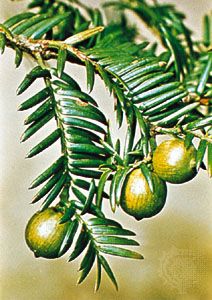
Stinking Yew
The stinking yew (Torreya taxifolia) is an evergreen conifer native to a restricted range in western Florida and southwestern Georgia. While the provided…
What role does the stinking yew tree play in its native ecosystem, and are there any conservation concerns?
The stinking yew (Torreya taxifolia) is an evergreen conifer native to a restricted range in western Florida and southwestern Georgia. While the provided search results do not detail its specific ecological interactions, they note that the genus Torreya produces seeds surrounded by fleshy, plumlike arils, which are structures typically evolved to aid in seed dispersal by animals.123
Regarding conservation, the stinking yew is considered a critically imperiled endangered species in the wild. Its populations have suffered due to habitat destruction, and researchers have observed that remaining wild specimens often fail to reach their full height or reproduce successfully, though the underlying causes for these reproductive failures are not yet fully understood. Current scientific efforts are focused on stabilizing these remnant populations and restoring the species to its former habitats.1
What are the unique characteristics of the stinking yew tree’s leaves, bark, and overall appearance?
The stinking yew (Torreya taxifolia) is an ornamental evergreen conifer in the yew family characterized by its distinct appearance and pungent odor.
Overall Appearance
The tree typically grows to 13 meters (about 43 feet) in cultivation, featuring an open, pyramidal head composed of spreading, slightly drooping branches. A defining trait of the species—along with its leaves and wood—is the disagreeable, fetid odor it emits when bruised or crushed.16
Leaves
The leaves are persistent, linear, and spiny-pointed, measuring 2 to 3 cm (about 0.7 to 1.2 inches) in length and 3 mm (0.1 inch) in breadth. They are arranged roughly in two rows and are dark green and slightly curved (convex) on the upper surface, while the underside features two pale green, sunken, waxy-appearing bands that parallel the midrib. Compared to the closely related Taxus genus, these leaves are relatively hard and rigid.164
Bark
The bark of the stinking yew is brownish with an orange tinge and is characterized by an irregularly furrowed and scaly texture.1
How tall can a stinking yew tree grow, and what is its average lifespan?
The stinking yew (Torreya taxifolia) is known to reach a height of approximately 13 meters (about 43 feet) when grown in cultivation.1
Regarding its lifespan, the provided search results do not contain specific data on the average longevity of the stinking yew. While the broader yew family (genus Taxus) is noted for being long-lived, this characteristic is not explicitly confirmed for Torreya taxifolia in the available information. Furthermore, wild populations of the stinking yew currently face significant challenges, as they often fail to reach their full potential height or reproduce successfully due to factors that remain under scientific investigation.41
What is the scientific name of the stinking yew tree, and where is it primarily found?
The scientific name of the stinking yew is Torreya taxifolia.1
This evergreen conifer is native to a very limited geographic range, found primarily in western Florida and southwestern Georgia in the United States. While it is often grown as an ornamental plant, it is considered a critically endangered species in its natural habitat due to factors such as population decline and reproductive failure.1
Sources
- stinking yew — Encyclopædia Britannica
- Florida yew — Merriam-Webster
- Torreya — Encyclopædia Britannica
- yew — Encyclopædia Britannica
- English yew — Encyclopædia Britannica
- Taxaceae — Encyclopædia Britannica
- stinking cedar — Merriam-Webster
Published on · 2 min read