Stropheodonta
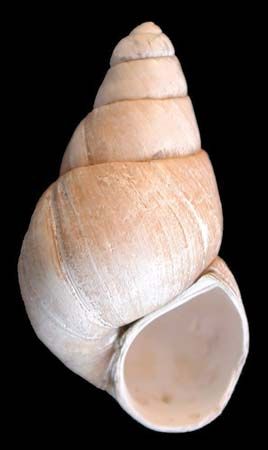
Stropheodonta is a genus of small, extinct brachiopods, commonly known as lamp shells, that lived during the Devonian Period, approximately 359 million to…
What is Stropheodonta?
Stropheodonta is a genus of small, extinct brachiopods, commonly known as lamp shells, that lived during the Devonian Period, approximately 359 million to 416 million years ago.1
These organisms are characterized by their concavo-convex shells, which feature distinct fine linear and arcuate, or bowlike, markings. Internally, they possess a unique structure that distinguishes them within the strophomenid group. Because of their specific temporal range, Stropheodonta serves as a valuable index fossil for geologists dating Devonian marine rock formations.1
While they share the strophomenid classification with the older Strophomena genus—which dates back to the Ordovician Period—Stropheodonta is distinct in its specific morphology and geological occurrence.12
What are brachiopods and how do they live?
Brachiopods, commonly known as lamp shells, are a phylum of sedentary, bottom-dwelling marine invertebrates. They are characterized by two unequal, bilaterally symmetrical valves (shells) that cover the dorsal and ventral sides of the body.34
How They Live
Brachiopods are filter feeders that inhabit all oceans. Their lifestyle and physical structure vary based on their classification:3
- Attachment and Movement: Many species use a fleshy, stalklike organ called a pedicle to attach themselves to the substrate. While some remain fixed, others, like the genus Lingula, use a flexible, contractile pedicle to burrow into mud or sand, allowing them to extend or retract their shells. Some specialized forms are cemented directly to surfaces, while others have an atrophied pedicle and simply lie loose on the sea floor.54
- Feeding: Brachiopods possess a lophophore—a complex, often horseshoe-shaped structure with ciliated filaments—that directs food-bearing water currents toward the mouth.5
- Reproduction: Most species have separate sexes, though some are hermaphroditic. Fertilization typically occurs externally in the water, though some species develop their young within specialized brood pouches. The resulting larvae are free-swimming before settling on the sea floor to mature.65
Why are index fossils important to geologists?
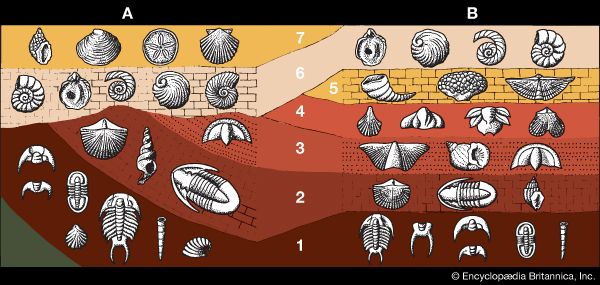
Index fossils are essential tools for geologists because they provide a reliable method for defining boundaries in the geologic time scale and correlating rock strata across different locations12.
To be effective, an ideal index fossil must possess several key characteristics:
- Short temporal range: The species existed for a brief period, allowing geologists to pinpoint a specific interval of time.1213
- Wide geographic distribution: Being “cosmopolitan” ensures the fossil can be used to link separated outcrops globally.1213
- Abundance and distinctiveness: They must be easily recognizable and common enough to be discovered with high probability.1213
By applying the principle of faunal succession, geologists use these fossils to establish that rock layers containing the same species were formed contemporaneously. While other methods like stratigraphic correlation or physical rock properties are used, index fossils remain a primary means of dating sedimentary deposits and confirming the relative order of Earth’s history.1312
What defines the Devonian period?
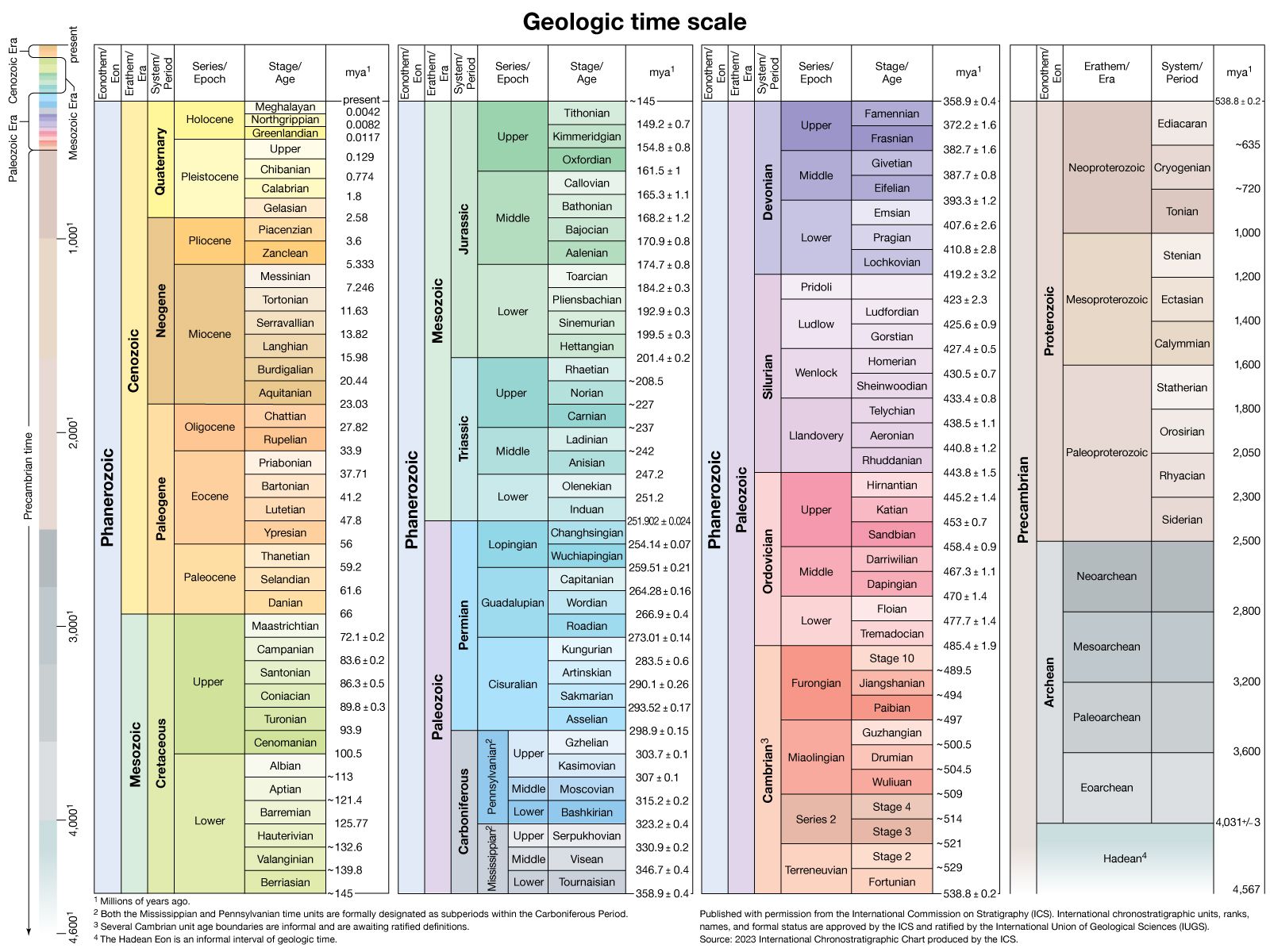
The Devonian Period is a major interval of the Paleozoic Era that occurred approximately 419.2 million to 358.9 million years ago, following the Silurian Period and preceding the Carboniferous Period.14
Often called the “Age of Fishes,” the period is defined by the remarkable diversification and abundance of primitive fishes in both marine and freshwater environments. Other defining biological milestones include the first appearance of ammonites, the rise of vascular plants and in-place forests, and the emergence of the first four-legged tetrapods (amphibians) toward the end of the period.151614
Geologically, the period was characterized by a warm, equitable climate and the formation of the supercontinent Laurussia (or Euramerica) in the Northern Hemisphere, while Gondwana occupied the Southern Hemisphere. Approximately 85 percent of the globe was covered by oceans, which experienced periodic episodes of low oxygen (anoxia) that triggered significant extinction events, such as the Kellwasser Event and the Hangenberg Event.151417
Sources
- Stropheodonta — Encyclopædia Britannica
- Strophomena — Encyclopædia Britannica
- lamp shells — Encyclopædia Britannica
- branchiopod - Distinguishing taxonomic features — Encyclopædia Britannica
- branchiopod - Reproduction and life cycles — Encyclopædia Britannica
- branchiopod - Distribution and abundance — Encyclopædia Britannica
- lamp shells - Size range and diversity of structure — Encyclopædia Britannica
- lamp shells - Reproduction — Encyclopædia Britannica
- lamp shells - Form and function — Encyclopædia Britannica
- Brachiopoda — Merriam-Webster
- branchiopod - External features — Encyclopædia Britannica
- index fossil — Encyclopædia Britannica
- dating - Principles and techniques — Encyclopædia Britannica
- A Journey Through Time Since the Precambrian - Devonian Period: 419.2 million to about 359 million years ago — Encyclopædia Britannica
- Devonian Period - Paleoclimate — Encyclopædia Britannica
- Devonian Period - Devonian life — Encyclopædia Britannica
- Devonian Period - Extinction events — Encyclopædia Britannica
- Devonian Period — Encyclopædia Britannica
Published on · 3 min read