Tectonic Landform
Folded mountains form primarily through the process of crustal shortening at convergent plate boundaries, where two tectonic plates collide. When continents…
How do folded mountains form as a result of tectonic activity?
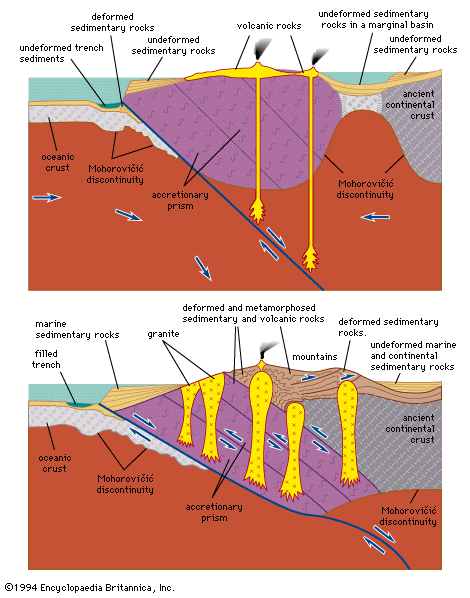
Folded mountains form primarily through the process of crustal shortening at convergent plate boundaries, where two tectonic plates collide. When continents converge, the buoyant continental crust cannot be easily subducted into the mantle. Instead, the leading edge of the descending continent is scraped off and stacked in slices, while the rest of the continent plunges beneath the overriding plate.1
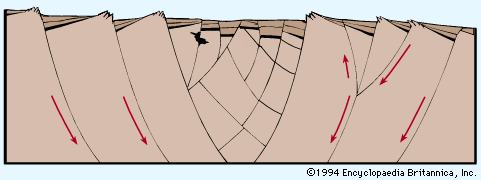
As this convergence occurs, sedimentary layers deposited on the continental margins are compressed. These layers often detach from the underlying basement along weak surfaces—such as shale or salt—in a process called décollement. The stronger sedimentary rock layers are then forced into a series of linear, regularly spaced folds known as anticlines and synclines.1
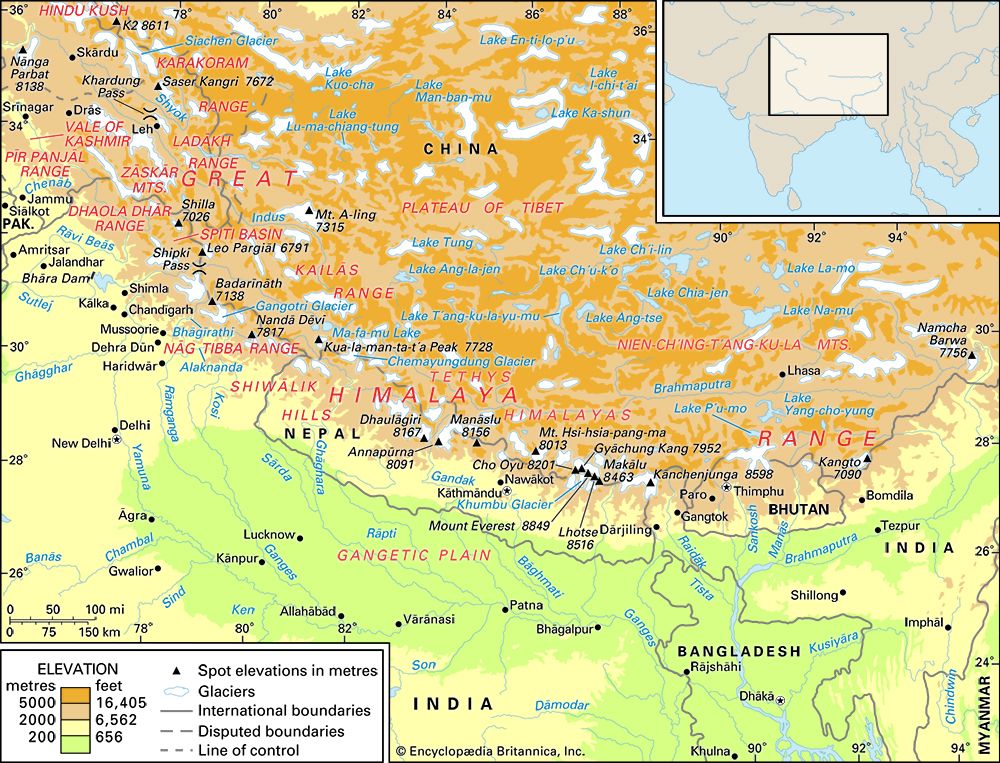
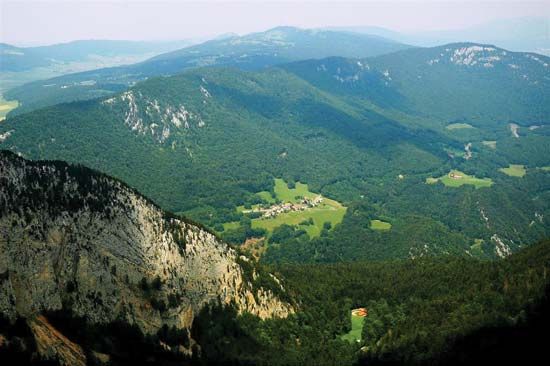
These structures often form fold and thrust belts, where rock layers are not only folded but also pushed over one another along faults. This intense deformation and stacking of crustal material result in the uplift of mountain ranges, such as the Himalayas or the Jura Mountains.12
How do tectonic processes create different types of landforms?
Tectonic processes act as the primary “builders” of Earth’s major relief features, creating landforms through the uplift, subsidence, and magmatic movement of the crust. These features are shaped by the interactions of lithospheric plates at their boundaries interactions of lithospheric plates at their boundaries.5116
Convergent Boundaries
When plates collide, they create high-elevation landforms through compression and crustal thickening.5
- Volcanic Arcs: As one plate subducts, it triggers melting in the mantle, producing magma that rises to form volcanic arcs. These appear as island arcs in oceanic settings or volcanic mountain chains on continents, such as the Andes.7
- Folded Mountains: Horizontal forces cause crustal shortening, folding rock layers into ridges and valleys, or pushing one terrain over another via overthrusting.5
Divergent Boundaries
Where plates move apart, the crust thins and subsides.5
- Rift Valleys: Crustal extension creates elongated troughs known as rift valleys, such as the East African Rift System.89
- Oceanic Ridges: As plates separate, magma rises to form new crust, creating vast, elevated oceanic ridges that span the globe.108
Transform Boundaries
At transform faults, plates slide laterally past one another. While these boundaries are “conservative”—neither creating nor destroying crust—they generate distinct linear ridges and troughs and are frequent sites of earthquakes due to stress buildup.1110
While tectonic forces build these structures, erosional processes subsequently sculpt them into their final profiles.56
What are rift valleys and how are they created by tectonic forces?
A rift valley is an elongated, steep-sided trough formed by the subsidence of a segment of the Earth’s crust between parallel faults. Unlike valleys carved by rivers or glaciers, these are tectonic landforms created by the movement of the Earth’s lithospheric plates.98
Formation by Tectonic Forces
Rift valleys are primarily produced by the extension of the Earth’s crust, which occurs at divergent plate boundaries where two plates move apart. As the brittle crust is pulled, it fractures, and a central block of crust—known as a graben—drops down into the resulting gap.91314
This process can be driven by several mechanisms:
- Crustal Stretching: As plates diverge, the crust thins and settles, creating a depression.1514
- Magmatic Upwelling: The rise of hot material from the asthenosphere can push the lithosphere upward, causing it to bulge, expand, and eventually stretch, leading to rifting.14
- Distant Tectonic Forces: Some rifts form due to regional stresses, such as the collision of distant plates, rather than local upwelling.14
As the rift widens, the continental crust may eventually separate entirely, leading to the formation of new oceanic crust and oceanic ridges crust and oceanic ridges.8
How do earthquakes and volcanoes relate to tectonic activity?
Earthquakes and volcanoes are both fundamental expressions of plate tectonics, the theory that Earth’s outer shell is composed of moving plates that interact at their boundaries.1617
Tectonic Origins
- Earthquakes: These occur when the movement of tectonic plates causes stress to accumulate along faults. When this stress exceeds the strength of the rock, the crust fractures and slips, releasing stored energy as seismic waves.17
- Volcanoes: Volcanic activity is driven by the generation of magma at plate boundaries. At subduction zones, the descent of an oceanic plate into the asthenosphere triggers melting, while at divergent boundaries, the upwelling of mantle material creates new crust.1816
Geographic Correspondence
There is a strong geographic correlation between these phenomena, most notably in the Ring of Fire, which hosts the majority of the world’s strongest earthquakes and about 75 percent of its volcanoes. While both often occur in the same regions, they are not always directly causal; rather, they are typically independent consequences of the same underlying tectonic processes.1819
Notably, transform faults—where plates slide past each other—frequently produce earthquakes but are generally devoid of volcanic activity.1820
Sources
- plate tectonics - Mountains by subduction — Encyclopædia Britannica
- mountain - Alpine- (or Himalayan-)type belts — Encyclopædia Britannica
- mountain - Geomorphic characteristics — Encyclopædia Britannica
- plate tectonics - Mountains by continental collision — Encyclopædia Britannica
- plate tectonics - Discovery of ocean basin features — Encyclopædia Britannica
- plate tectonics - Island arcs — Encyclopædia Britannica
- tectonic landform — Encyclopædia Britannica
- plate tectonics - Continental rifting — Encyclopædia Britannica
- rift valley — Encyclopædia Britannica
- plate tectonics - Transform faults — Encyclopædia Britannica
- plate tectonics - Plate boundaries — Encyclopædia Britannica
- continental landform — Encyclopædia Britannica
- tectonic basins and rift valleys — Encyclopædia Britannica
- tectonic basins and rift valleys - Rift valleys — Encyclopædia Britannica
- rift valley — Merriam-Webster
- earthquake - Volcanism — Encyclopædia Britannica
- volcano - Subduction volcanoes — Encyclopædia Britannica
- Ring of Fire — Encyclopædia Britannica
- earthquake - Tectonic associations — Encyclopædia Britannica
- volcano - Volcanoes related to plate boundaries — Encyclopædia Britannica
- How do earthquakes occur? — Encyclopædia Britannica
Published on · 4 min read