Thelypteridaceae
Thelypteridaceae is a family of ferns within the division Pteridophyta, comprising approximately 900 to 950 species across 5 to 30 genera. While these plants…
What is Thelypteridaceae?
Thelypteridaceae is a family of ferns within the division Pteridophyta, comprising approximately 900 to 950 species across 5 to 30 genera. While these plants are distributed nearly worldwide, they are most diverse in tropical regions.12
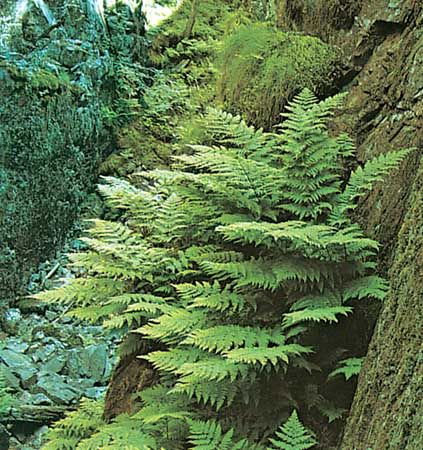
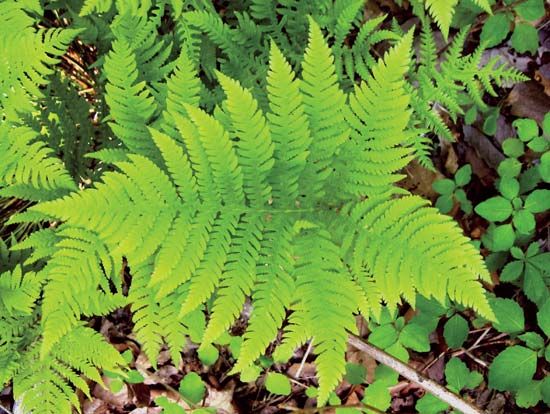
Most members of this family are terrestrial, typically inhabiting moist or wet environments, though some may grow on rocks. Their rhizomes can be short-creeping, long-creeping, or erect and are generally scaly. The leaves are highly variable in size and morphology, though they are most commonly one or two times pinnately divided. A defining characteristic of the family is the presence of slender, needlelike hairs on the leaves, which may also appear on the rhizomes, sporangia, or indusia.12
The sori are round or elongate and may lack an indusium or possess a kidney-shaped, membranous protective flap. The spores are monolete, meaning they are more or less bean-shaped.12
What is the function of the indusium on a fern leaf?
The primary function of the indusium is to protect the sori—the clusters of sporangia—from environmental hazards such as drying, exposure, and other potential damage during their development.3
There are two main ways this protection is achieved:
- True Indusium: This is a distinct, often papery, specialized structure that covers the sorus. Its shape and attachment vary significantly among species, ranging from cup-shaped structures that enclose the sorus until maturity to kidney-shaped or shieldlike flaps that cover round sori.34
- False Indusium: This is not a separate structure but rather a modified, rolled-over leaf margin that creates a protective pocket or groove under which the sporangia can form and mature.3
By shielding the sporangia, the indusium helps ensure the successful maturation of spores, which are essential for the plant’s reproduction.34
How do ferns reproduce without using seeds?
Ferns reproduce through a complex life cycle that alternates between two distinct stages: the sporophyte and the gametophyte. Because they do not produce seeds, they rely on spores and vegetative propagation to multiply.56
The Sexual Life Cycle
- Spore Production: The mature fern (the sporophyte) produces haploid spores within structures called sporangia, which are often clustered into sori on the undersides of the fronds.56
- Gametophyte Development: When released, spores land in suitable moist environments and germinate into tiny, heart-shaped plants known as prothallia (gametophytes).56
- Fertilization: The prothallium produces male (antheridia) and female (archegonia) sex organs6. Sperm swim through free water to reach the egg. Once fertilized, the resulting zygote grows into a new, independent sporophyte, eventually causing the prothallium to wither and die.675
Vegetative Reproduction
Much of the world’s fern population actually expands through vegetative reproduction rather than the sexual cycle. This occurs via:8
- Rhizomes: Underground stems that branch out to form large, genetically uniform colonies.58
- Proliferations: Some species propagate through specialized growths on their roots or leaves.58
Additionally, some ferns are apomictic, meaning they bypass fertilization entirely, allowing new sporophytes to arise directly from the gametophyte.58
What are the main differences between terrestrial and epiphytic ferns?
The primary distinction between terrestrial and epiphytic ferns lies in their chosen substrate and ecological adaptations.
Terrestrial Ferns
Terrestrial ferns grow directly in the soil or within the crevices of rocks. While many prefer shaded, damp forest floors, some species have adapted to open, exposed sites or salt marshes. These ground-dwelling ferns often utilize rhizomes to form large, clonal colonies, which accounts for the bulk of their population growth.89
Epiphytic Ferns
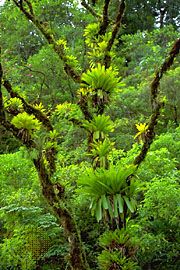
Epiphytic ferns grow upon other plants, typically on the trunks and branches of trees or within their crowns. In tropical regions, they can account for up to two-thirds of the local fern population. Some epiphytes are actually climbers that begin their life on the ground before ascending tree trunks, often developing different leaf forms—bathyphylls for vegetation and acrophylls for reproduction—as they climb.810
Shared Adaptations
Despite these differences, both groups may exhibit structural adaptations to manage water stress, especially in drier environments. These include:
Sources
- Thelypteridaceae — Encyclopædia Britannica
- Fern - Annotated classification — Encyclopædia Britannica
- Fern - The indusium — Encyclopædia Britannica
- Fern - The sorus — Encyclopædia Britannica
- Fern - Life cycle — Encyclopædia Britannica
- Fern - Sexual reproduction — Encyclopædia Britannica
- Plant reproductive system - Ferns — Encyclopædia Britannica
- Fern - Ecology — Encyclopædia Britannica
- Fern - Size range and habitat — Encyclopædia Britannica
- houseplant - Ferns — Encyclopædia Britannica
Published on · 3 min read