Traveler’s Tree
The traveler’s tree (Ravenala madagascariensis) is a unique plant belonging to the Strelitziaceae family, native to Madagascar. It is named for two practical…
What is traveler’s tree?
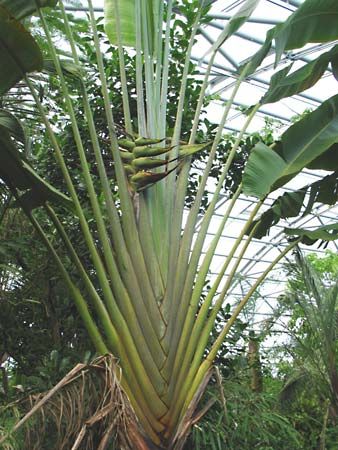
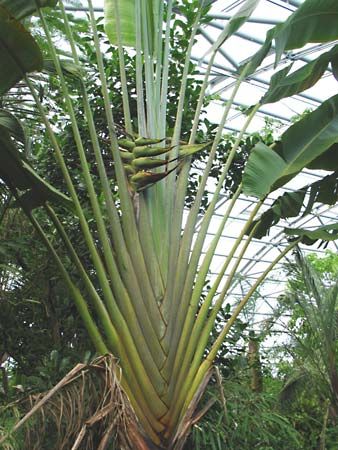
The traveler’s tree (Ravenala madagascariensis) is a unique plant belonging to the Strelitziaceae family, native to Madagascar. It is named for two practical reasons: its leaf bases accumulate rainwater that can be used for drinking in emergencies, and its fan-shaped leaves typically grow along an east-west line, which can serve as a crude compass for travelers.1
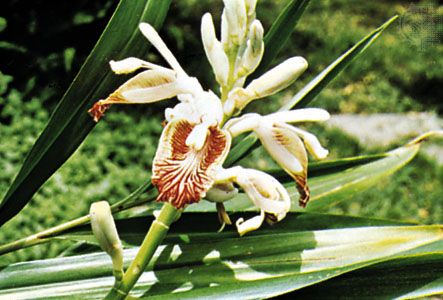
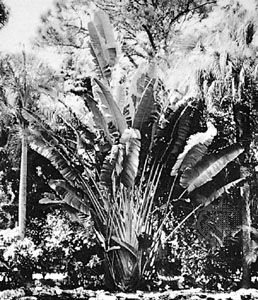
Although it resembles a palm tree, it is characterized by large, banana-like leaves arranged in a single plane, creating a distinct fanlike appearance. These leaves can reach lengths of 4 to 5 meters, and their cup-shaped bases can hold approximately one liter of water. The plant also produces white flower clusters similar to the bird-of-paradise flower and features light blue seeds.12
How does the traveler’s tree store water?
The traveler’s tree (Ravenala madagascariensis) stores water primarily within its leaf bases, which are shaped like large, cup-like structures capable of holding approximately one liter of rainwater each. Additionally, the plant’s petioles (leaf stalks) contain significant quantities of clear, watery sap that has historically served as a source of hydration for travelers in emergency situations.12
The plant features long, pale petioles that support large, banana-like leaves arranged in a single plane, creating its signature fanlike appearance. While often associated with its ability to provide water, the tree is also noted for its flower clusters, which resemble those of the bird-of-paradise flower, and its unique light blue seeds.1
What makes the traveler’s tree look like a fan?
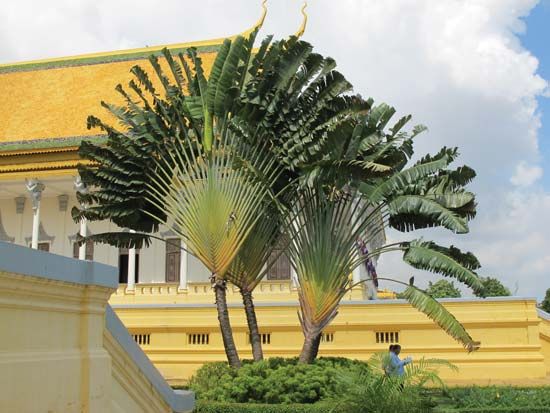
The traveler’s tree (Ravenala madagascariensis) achieves its signature fanlike appearance because its large, banana-like leaves are arranged in a single, vertical plane.1
This distinctive structure is supported by long, pale petioles (leaf stalks) that extend from the top of the plant’s palm-like trunk. While many plants in the Strelitziaceae family feature leaves and bracts that occur in two vertical rows, the specific alignment of these massive leaves—which can reach lengths of 4 to 5 meters—creates the expansive, flat, fan-shaped silhouette for which the tree is named.13
How is the traveler’s tree related to the bird-of-paradise flower?
The traveler’s tree (Ravenala madagascariensis) and the bird-of-paradise flower (Strelitzia reginae) are related through their shared membership in the Strelitziaceae family, a group of flowering plants within the ginger order (Zingiberales).13
This botanical relationship is evident in several shared physical characteristics:
- Floral Structure: Both plants produce large, complex flower clusters that are enclosed in prominent, leaflike bracts.13
- Foliage: Members of this family typically feature large, paddle-shaped or banana-like leaves borne on long petioles (leaf stalks).13
- Growth Pattern: Both the leaves and the bracts of these plants characteristically occur in two vertical rows.3
While the traveler’s tree is the sole member of its genus and develops a distinct, palm-like trunk, it shares a striking structural resemblance to certain species within the Strelitzia genus, such as the mountain strelitzia (S. caudata), which also grows to significant heights and possesses banana-like fruit.13
Sources
- traveler’s tree — Encyclopædia Britannica
- traveler's-tree — Merriam-Webster
- Strelitziaceae — Encyclopædia Britannica
Published on · 2 min read