Trochodendrales
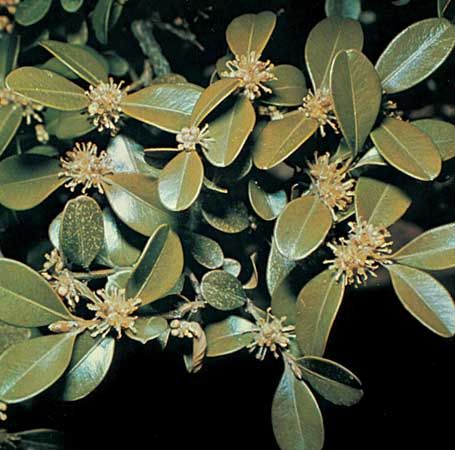
The order Trochodendrales consists of only two species of evergreen trees: Trochodendron aralioides and Tetracentron sinense.
Are there any notable uses or economic importance of Trochodendrales plants?
The order Trochodendrales consists of only two species of evergreen trees: Trochodendron aralioides and Tetracentron sinense.
Regarding their economic importance or notable uses, these plants are primarily recognized for their botanical significance rather than commercial utility. Both species are occasionally cultivated as ornamental trees in gardens and landscapes due to their unique appearance.
From a scientific perspective, they are highly notable for their primitive wood anatomy. Unlike most angiosperms, these trees lack specialized water-conducting vessel cells. Instead, they rely on tracheids, a type of conducting cell more commonly associated with gymnosperms like conifers. This evolutionary trait makes them a subject of interest for researchers studying the development and diversification of flowering plants.
What is the evolutionary significance of the Trochodendrales order?
The order Trochodendrales holds significant evolutionary interest primarily due to its unique wood anatomy. While most angiosperms possess specialized vessel cells for efficient water conduction, the two species in this order—Trochodendron aralioides and Tetracentron sinense—lack these structures entirely.12
Instead, they rely on tracheids, a primitive conducting cell type characteristic of gymnosperms like conifers. This feature is rare among flowering plants; while most vessel-less angiosperms are found within the magnoliid clade, Trochodendron and Tetracentron are notable exceptions classified within the eudicot clade.12
Because they exhibit these primitive wood characteristics while possessing the triaperturate pollen typical of eudicots, they serve as a critical link in understanding the evolutionary diversification of flowering plants. Despite their primitive internal structure, these plants have developed specialized floral arrangements, such as the insect-pollinated flowers of Trochodendron and the wind-pollinated catkins of Tetracentron, illustrating a complex evolutionary history.12
Where are Trochodendrales plants primarily found in nature?
The order Trochodendrales is native to eastern Asia, where its two species are found in distinct geographic regions:
- Trochodendron aralioides: This species is primarily found in South Korea, Japan, and Taiwan.1
- Tetracentron sinense: This species is native to central and south-central China, Nepal, and northern Myanmar (Burma).1
Both species are members of the family Trochodendraceae, which is characterized as a group of eastern Asiatic trees.13
How have Trochodendrales plants adapted to their specific environments?
The order Trochodendrales exhibits distinct evolutionary adaptations to its environment, primarily through specialized reproductive strategies despite possessing primitive wood anatomy.
Reproductive Adaptations
The two genera within this order have evolved divergent methods for pollination to suit their ecological niches:
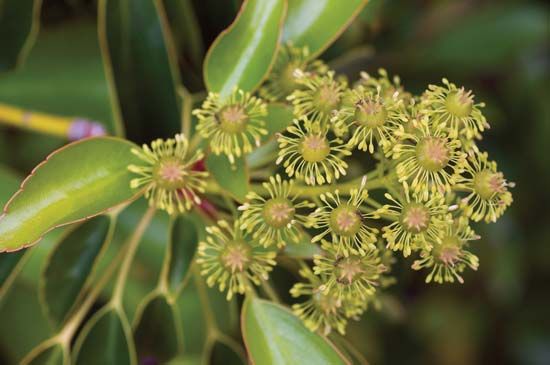
- Insect Pollination: Trochodendron aralioides features a unique floral structure characterized by a ring of approximately 70 stamens, which gives the plant its common name, “wheel tree.” These flowers lack traditional sepals and petals, instead relying on their specialized arrangement to attract insects for pollination.1
- Wind Pollination: In contrast, Tetracentron sinense has adapted to wind pollination. Its small, bisexual flowers are organized into slender, dangling catkins, an efficient structure for dispersing pollen via air currents.1
Structural Characteristics
While these plants lack specialized vessel cells for water conduction—relying instead on tracheids similar to gymnosperms—they maintain their status as eudicots through features like triaperturate pollen. Their leaf morphology also reflects environmental adaptation: Trochodendron possesses pinnately veined leaves, while Tetracentron features palmately veined leaves, both supporting their growth as evergreen or medium-sized trees in their respective Asian habitats.1
Sources
- Trochodendrales — Encyclopædia Britannica
- magnoliid clade - Vegetative structures — Encyclopædia Britannica
- Trochodendraceae — Merriam-Webster
Published on · 2 min read