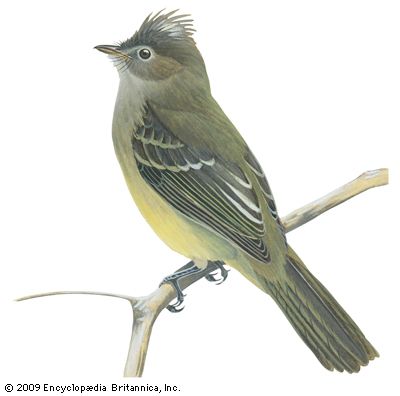
Tyrannulet
A tyrannulet is any of approximately 50 species of birds belonging to the tyrant flycatcher family, Tyrannidae. These birds are distinguished from other…
What is Tyrannulet?
A tyrannulet is any of approximately 50 species of birds belonging to the tyrant flycatcher family, Tyrannidae1. These birds are distinguished from other members of their family by their small size and diminutive bills. The name is applied to species across about 20 different genera.1
A well-known example is the beardless tyrannulet (Camptostoma), which measures about 9 centimeters (3.5 inches) in length. These birds are called “beardless” because they lack the bristles at the corners of the mouth typically found in other flycatchers. While some species are widely distributed—ranging from the southern United States to Argentina—others, such as the bent-billed tyrannulets (Oncostoma), exhibit unique nesting behaviors, often building their nests near aggressive wasps for protection against intruders.1
What makes the tyrant flycatcher family unique among birds?
The tyrant flycatcher family (Tyrannidae) is a large, exclusively American group of birds that exhibits several unique characteristics:
- Aggressive Territoriality: Most species are highly territorial during the breeding season. They are known to harass or attack much larger birds, such as hawks or crows, that enter their nesting areas.2
- Feeding Habits: While primarily insectivorous and known for darting from perches to seize insects on the wing, the family is diverse in diet; some species feed extensively on fruit, and larger forms like the shrike-tyrants take prey as substantial as mice and small frogs.21
- Anatomical Features: Many possess a flattened, slightly hooked bill with bristles at the base to aid in insect capture. A common, though often concealed, feature is an erectile patch of red or yellow feathers on the crown.21
- Vocal Structure: As members of the suborder Tyranni, most tyrant flycatchers are classified as “mesomyodian,” meaning their syringeal muscles are inserted on the middle of the bronchial semi-rings. Their vocal apparatus is generally less complex than that of true songbirds, resulting in songs that are often simple, grating, or monotonous.23
Why do some birds build their nests near aggressive wasps?
Some bird species choose to build their nests near active wasp nests primarily for the protection the wasps provide against potential predators. By situating their nests in close proximity to these aggressive insects, the birds benefit from a natural deterrent that discourages intruders from approaching their eggs or young.7
This behavior is one of many diverse nesting strategies observed among passerines, which also include nesting in rock crevices, on ledges, or within the abandoned nests of other species. While the wasps are not intentionally guarding the birds, their defensive nature creates a safer environment for the nesting pair.7
How do tyrant flycatchers catch their prey?
Tyrant flycatchers (family Tyrannidae) primarily catch their prey by utilizing a “sit-and-wait” strategy. These birds typically perch in an upright position and dart out from their vantage point to seize insects while in flight.2
To facilitate this method of hunting, many species have evolved specific physical adaptations:
- Bill Structure: Their bills are generally broad, flattened, and slightly hooked, which helps them grasp prey effectively.2
- Sensory Bristles: They possess bristles at the base of their bills, which are believed to assist in the capture of insects.2
While the majority of the family is insectivorous, their dietary habits are diverse. Some species, such as the shrike-tyrants (Agriornis), are capable of taking larger prey, including mice and small frogs. Additionally, several members of the family, particularly the elaenias, supplement their diet by feeding extensively on berries and other fruits.2
Sources
- Tyrannulet — Encyclopædia Britannica
- Tyrant flycatcher — Encyclopædia Britannica
- Syrinx — Encyclopædia Britannica
- Tyrannidae — Merriam-Webster
- tyrannosaur - Classification — Encyclopædia Britannica
- Passeriform - Syrinx — Encyclopædia Britannica
- Passeriform - Nesting — Encyclopædia Britannica
- Hymenoptera - Solitary forms — Encyclopædia Britannica
- Nest — Encyclopædia Britannica
- falconry - Hunting and training techniques — Encyclopædia Britannica
- Flycatcher — Encyclopædia Britannica
Published on · 3 min read