Viséan Stage
The Viséan Stage, which occurred approximately 346.7 million to 330.9 million years ago during the Carboniferous Period, is named after the town of Visé in…
What are some notable Viséan fossil sites around the world?
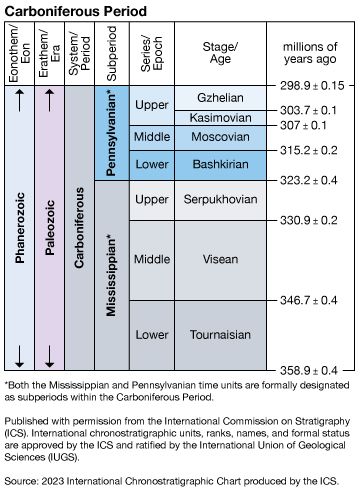
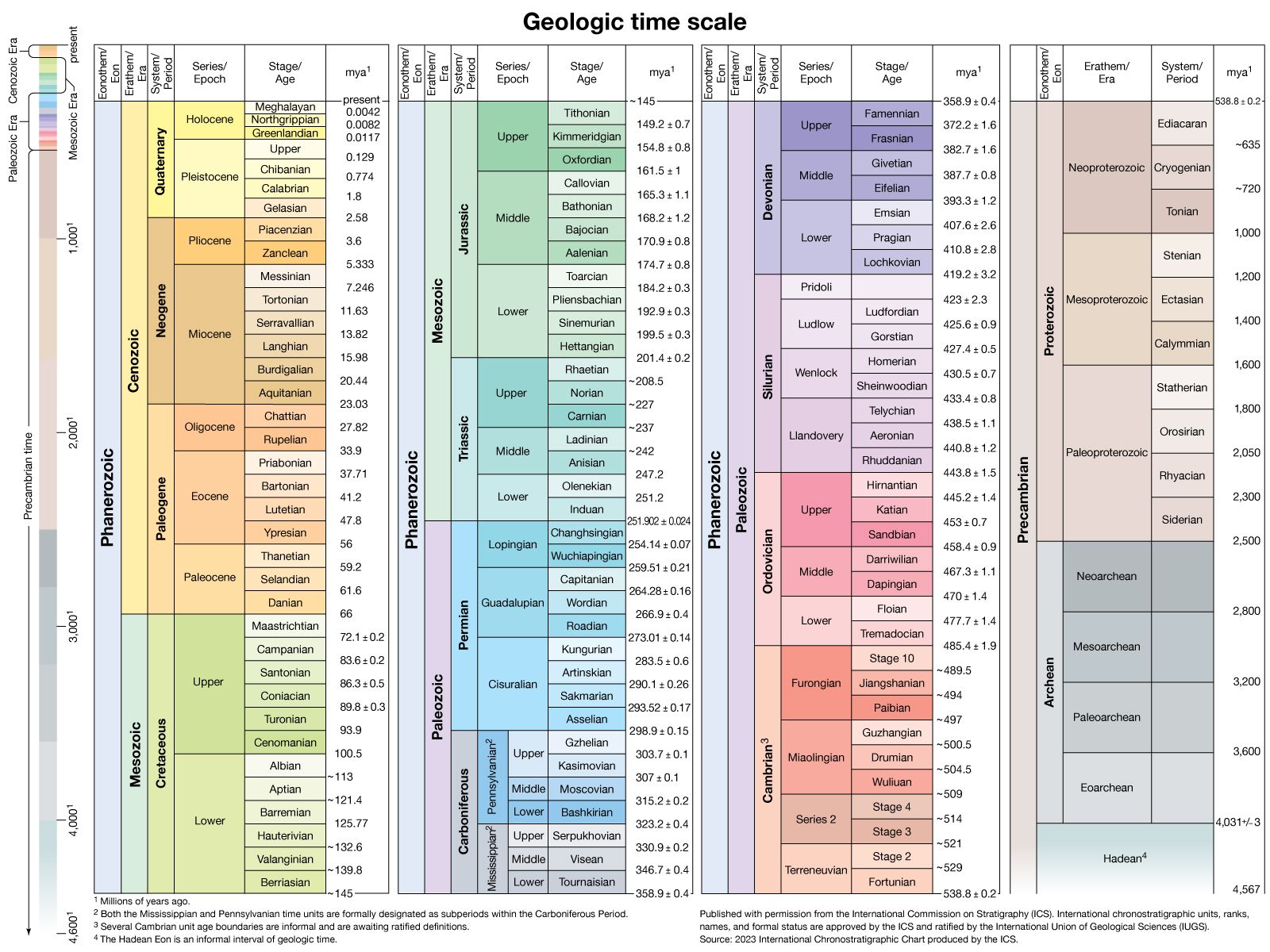
The Viséan Stage, which occurred approximately 346.7 million to 330.9 million years ago during the Carboniferous Period, is named after the town of Visé in Belgium.1
While the stage is named for this Belgian town, the most significant geological understanding of the Viséan comes from exposures surrounding the town of Dinant, Belgium. In these areas, the base of the stage is identified by a black limestone facies known as marbre noir.1
Additionally, the International Commission on Stratigraphy (ICS) has proposed the Penchong section in the Guangxi province of southern China as the Global Standard Section and Point for the base of the Viséan Stage. These sites are critical for studying the fossil record of organisms such as conodonts and foraminifers, which help define the boundaries of this geological interval.1
How does the Viséan Stage compare to the stages immediately before and after it?
The Viséan Stage is the second of three stages within the Mississippian Subsystem of the Carboniferous Period. Its position relative to the stages before and after it is defined by specific biostratigraphic markers:
- Relationship to the Tournaisian Stage: The Viséan overlies the Tournaisian Stage. The boundary between them is marked by the first appearance of the foraminifer Eoparastaffella simplex, which occurs near the first appearance of the conodont Gnathodus homopunctatus.12
- Relationship to the Serpukhovian Stage: The Viséan is followed by the Serpukhovian Stage. While the boundary between these two stages is currently undefined, it is roughly approximated by the first appearance of the conodont Lochriea ziegleri.1
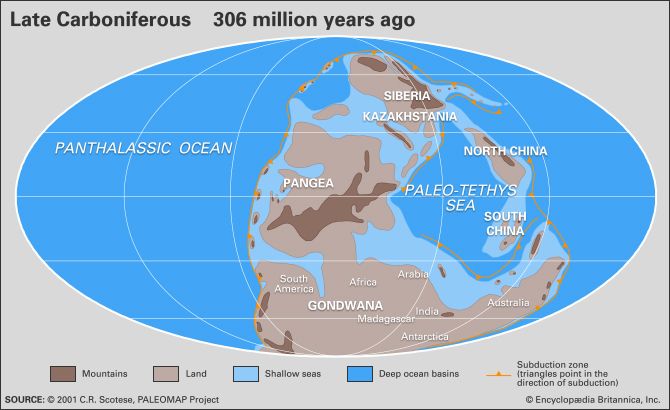
There is growing evidence that the transition from the Viséan to the Serpukhovian corresponds to a significant episode of glaciation on the ancient supercontinent of Gondwana. Unlike the Tournaisian, which has a globally ratified base, the boundaries of the Viséan remain subject to ongoing study, and there is currently no international agreement on the biostratigraphic horizons that define its limits.12
How do geologists use biostratigraphy to correlate Viséan rocks across different regions?
Geologists use biostratigraphy to correlate Viséan rocks by identifying specific index fossils that represent distinct intervals of geologic time. Because these organisms were abundant, evolved rapidly, and were widely distributed, their presence in rock layers allows scientists to determine the age equivalence of strata across different regions.16
For the Viséan Stage, the primary biostratigraphic tool is the first appearance of the foraminifer Eoparastaffella simplex, which is used to define the boundary between the Viséan and the underlying Tournaisian Stage. Historically, the first appearance of the conodont Gnathodus homopunctatus was also used to characterize this boundary.17
Correlation of the upper boundary of the Viséan—where it meets the Serpukhovian Stage—is less precise and currently relies on approximating the first appearance of the conodont Lochriea ziegleri. Because recognition of the Viséan by various fossil groups remains problematic, there is currently no international agreement on the specific biostratigraphic horizons that define its boundaries, making correlation a subject of ongoing study.1
How has our understanding of the Viséan Stage changed with modern dating techniques?
Our understanding of the Viséan Stage has evolved significantly through the integration of modern geochronological techniques, which have moved the field beyond reliance on purely relative biostratigraphy.
Historically, the Viséan was defined primarily by the presence of specific fossils, such as the foraminifer Eoparastaffella simplex and the conodont Gnathodus homopunctatus. However, modern dating techniques—specifically isotopic dating—have allowed geologists to assign absolute ages to these rock successions. By utilizing uranium–lead dating on minerals like zircon, researchers can now constrain the Viséan Age to approximately 346.7 million to 330.9 million years ago.1
These advanced methods provide a more precise framework for correlating strata globally, even when index fossils are absent or problematic. Furthermore, the ability to analyze minute samples with high precision has enabled geologists to distinguish between primary rock-forming events and subsequent disturbances, such as reheating or lead loss, which previously complicated the interpretation of geologic history. This shift toward absolute dating has been essential in refining the geologic time scale and understanding the timing of major events, such as the glaciation on the supercontinent of Gondwana1.11112
Sources
- Viséan Stage — Encyclopædia Britannica
- Tournaisian Stage — Encyclopædia Britannica
- Carboniferous Period - Paleoclimate — Encyclopædia Britannica
- Carboniferous Period - Distinctive features — Encyclopædia Britannica
- Cambrian explosion — Encyclopædia Britannica
- Ordovician Period - Correlation of Ordovician strata — Encyclopædia Britannica
- Precambrian - Correlation of Precambrian strata — Encyclopædia Britannica
- index fossil — Encyclopædia Britannica
- Silurian Period - Conodonts — Encyclopædia Britannica
- Cambrian Period - Correlation of Cambrian strata — Encyclopædia Britannica
- geochronology - Completion of the Phanerozoic time scale — Encyclopædia Britannica
- dating - Double uranium-lead chronometers — Encyclopædia Britannica
- dating - Importance of zircon in uranium-lead dating — Encyclopædia Britannica
- Archaeology - Dating — Encyclopædia Britannica
Published on · 3 min read