West Indies
The West Indies experience a tropical maritime climate characterized by high humidity and warm temperatures, which significantly shape the region's ecosystem…
How does the climate of the West Indies affect its ecosystem and agriculture?
The West Indies experience a tropical maritime climate characterized by high humidity and warm temperatures, which significantly shape the region’s ecosystem and agricultural practices.12
Impact on Ecosystems
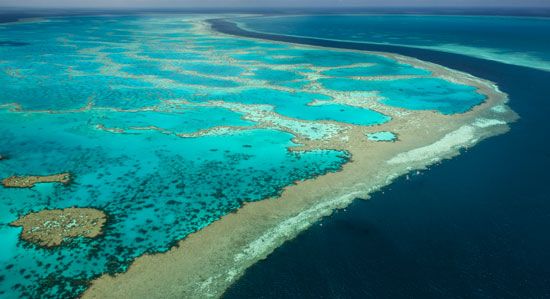
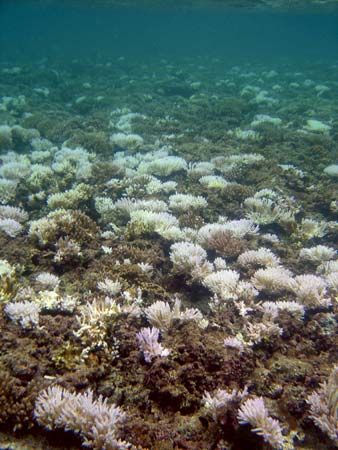
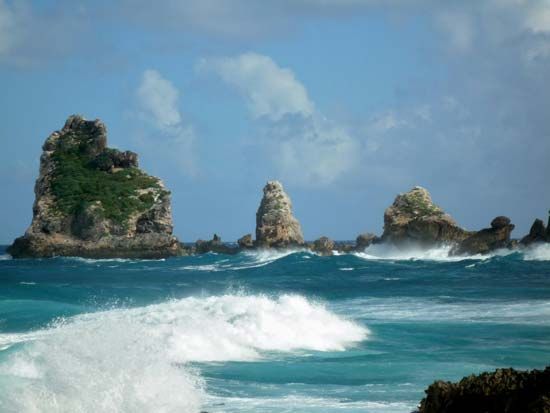
The region’s uniformly warm temperatures and clear waters support diverse marine life, particularly coral reefs, which serve as vital habitats. However, these ecosystems are sensitive to climate fluctuations; rising water temperatures have been linked to coral bleaching, a process where reefs lose the algae necessary for their survival. On land, vegetation is diverse, ranging from mangroves in coastal lagoons to varied tropical flora, though many islands feature nutrient-poor limestone soils.34
Impact on Agriculture
Agriculture is heavily influenced by rainfall patterns and the threat of hurricanes. While the tropical climate allows for the cultivation of crops like cocoa, bananas, and various fruits, seasonal storms are a major cause of crop failure. Farmers often manage water through irrigation or drainage systems to mitigate the risks of both drought and excessive rainfall.12567
What are some unique plant and animal species found only in the West Indies?
The West Indies archipelago is home to a diverse array of endemic species, many of which are restricted to specific islands due to the region’s unique geography and isolation.
Unique Plant Species
- Cork Palms (Microcycas calocoma): Found in the western regions of Cuba, these rare plants are considered “living fossils,” representing a genus of cycads that has existed for over 100 million years.10
- Mariposa (Hedychium coronarium Koenig): Known as the “butterfly” flower, this is the national flower of Cuba. It features long, green stems and fragrant, white, butterfly-like petals.10
Unique Animal Species
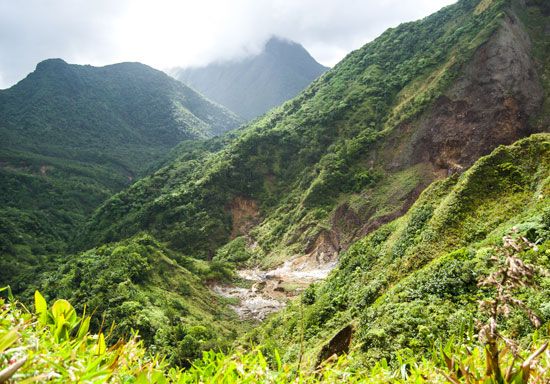
- Imperial Parrot (Amazona imperialis): Also known as the sisserou, this bird is found only on the island of Dominica.11
- Red-necked Parrot (Amazona arausiaca): Like the imperial parrot, this species is endemic to Dominica.11
- Cuban Solenodon (Atopogale cubana): These nearly extinct, ratlike insectivores are found only in the most remote eastern regions of Cuba.10
- Tocororo (Trogon temnurus): The national bird of Cuba, this forest-dwelling species is endemic to the island and is known for its vibrant red, white, and blue plumage.10
- Blue-headed Hummingbird (Cyanophaia bicolor): This species is native only to the islands of Dominica and Martinique.11
How do the West Indies participate in international sports competitions, particularly in cricket?
While the islands of the West Indies generally participate in most international sports as independent nations, cricket is a notable exception where they compete as a unified regional team. This tradition stems from British colonial influence, which led to the formation of a combined West Indies side that became the fourth Test-playing nation in 1928.14
The West Indies cricket team historically achieved significant success, particularly during the 1970s and 1980s, when they were considered virtually unbeatable due to a legendary lineup of fast bowlers and destructive batsmen. The team reached the finals of the first three Cricket World Cups (1975, 1979, and 1983), winning the first two. In contrast, for sports such as athletics, football, and basketball, individual islands typically field their own national teams in global competitions like the Olympics or the Commonwealth Games.1415
What are the main languages spoken in the West Indies, and how did they develop?
The linguistic landscape of the West Indies is a diverse reflection of the region’s colonial history and the forced migration of enslaved peoples from Africa. The main languages spoken today include European colonial languages and various creole languages, which emerged as common vernaculars in plantation societies.1911
Development of Languages
Creole languages in the West Indies developed during the 17th and 18th centuries as a result of contact between speakers of mutually unintelligible languages—primarily European colonists and enslaved Africans. Scholars have proposed several theories regarding their structural formation:11
- Substrate Hypothesis: Suggests that the grammatical structures of the African languages spoken by enslaved people were imposed upon the European colonial languages.20
- Superstrate Hypothesis: Argues that the colonial varieties of European languages were the primary source of the creole’s structural features, with substrate influence limited to specific vocabulary or cultural domains.20
- Universalist Hypothesis: Proposes that creoles developed according to universal principles of language acquisition, often suggesting that children exposed to a pidgin created new, complex grammars based on a biological “bioprogram”.20
Major Language Groups
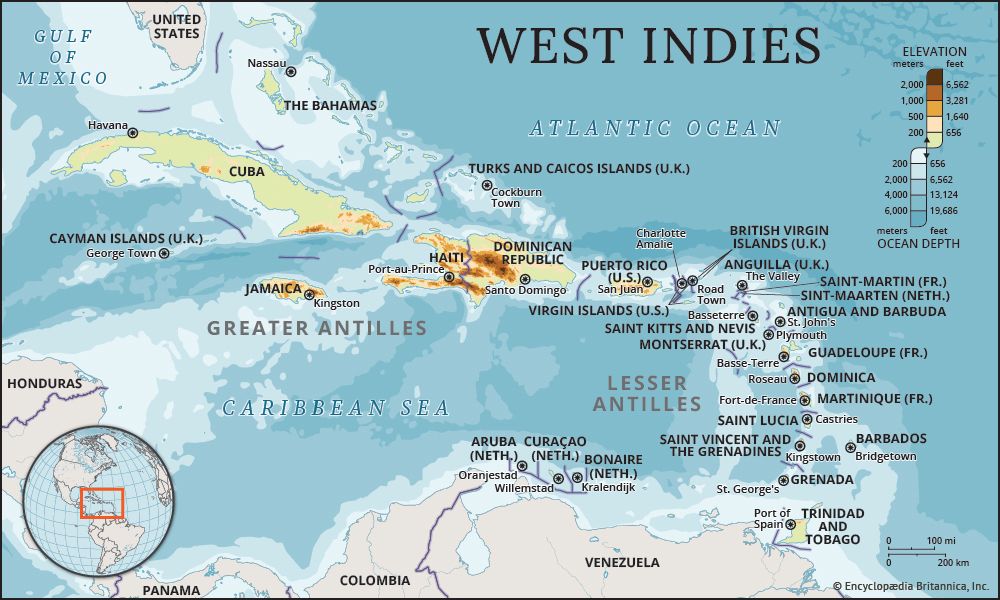
- Creole Languages: These are widely spoken across the region. Examples include Haitian Creole, which is based on French, and Jamaican Creole, which is based on English but incorporates phrasing from West African languages and Spanish. Papiamentu, spoken in Aruba, Bonaire, and Curaçao, is a unique creole blending Spanish, Dutch, Portuguese, and English.112119
- European Languages: Spanish remains the primary language in Cuba, Puerto Rico, and the Dominican Republic, where it is spoken in its standard form. English, French, and Dutch also serve as official or widely used languages in their respective former colonial territories.1921
Sources
- Caribbean Sea - Climate — Encyclopædia Britannica
- West Indies: Top Questions — Encyclopædia Britannica
- Caribbean Sea - Resources — Encyclopædia Britannica
- Nicaragua - Climate — Encyclopædia Britannica
- Grenada - Agriculture, forestry, and fisheries — Encyclopædia Britannica
- Caribbean Sea - Study and exploration — Encyclopædia Britannica
- tropical cyclone - Rainfall — Encyclopædia Britannica
- Agricultural technology - Water management — Encyclopædia Britannica
- Vegetable farming - Moisture — Encyclopædia Britannica
- Cuba - Plant and animal life — Encyclopædia Britannica
- West Indies — Encyclopædia Britannica
- Dominica - Plant and animal life — Encyclopædia Britannica
- Trinidad and Tobago - Plant and animal life — Encyclopædia Britannica
- cricket - West Indies — Encyclopædia Britannica
- West Indies — Merriam-Webster
- Saint Vincent and the Grenadines - Sports and recreation — Encyclopædia Britannica
- list of islands - Trinidad and Tobago — Encyclopædia Britannica
- West Indies Associated States — Encyclopædia Britannica
- creole languages — Encyclopædia Britannica
- creole languages - Theories of creolization — Encyclopædia Britannica
- West Indies - Colonialism of the West Indies — Encyclopædia Britannica
- West Indies - Emancipation — Encyclopædia Britannica
- Jamaica - Ethnic groups and languages — Encyclopædia Britannica
- West Indies - Plantation slavery — Encyclopædia Britannica
Published on · 4 min read