Why Do Bats Sleep Upside Down?
Bats sleep upside down primarily because their anatomy and physiology are uniquely adapted for this position. Their legs are too slender for standing or…
Why do bats sleep upside down?
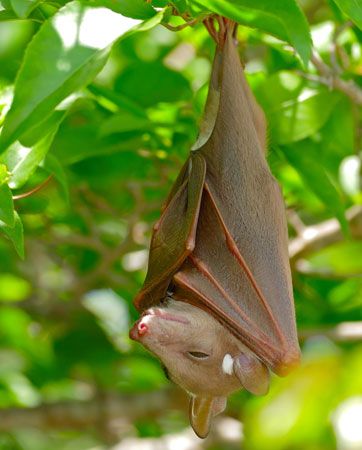
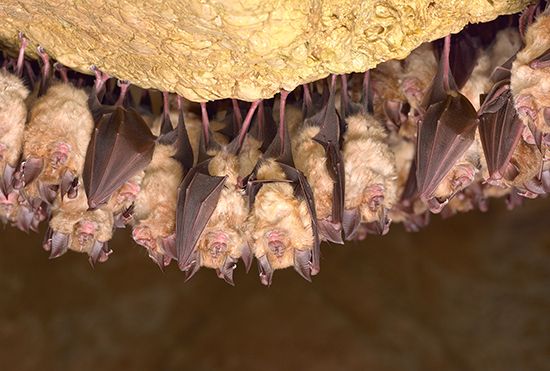
Bats sleep upside down primarily because their anatomy and physiology are uniquely adapted for this position. Their legs are too slender for standing or walking, but they possess a specialized tendon-locking mechanism that allows their feet to clench automatically under their body weight. This enables them to remain suspended without expending muscular energy.1
Furthermore, this posture is essential for flight. Unlike birds, bats cannot generate enough lift to take off from the ground. By hanging upside down, they can simply release their grip and drop into the air, using gravity to gain the necessary momentum for flight. Additionally, roosting in high, secluded areas provides protection from predators and a clear vantage point for escape. While most species exhibit this behavior, it is worth noting that some bats use suction pads to cling to surfaces instead.12
How does echolocation help bats navigate in the dark?
Bats navigate and hunt in the dark using echolocation, a biological sonar system. By emitting high-frequency sound pulses through their mouths or noses, bats create acoustic signals that reflect off objects in their environment. When these echoes return, the bat’s highly specialized ears and nervous system process the information to determine the direction, distance, velocity, and nature of nearby objects.34
The process involves three distinct phases of pulse output:
- Search: The bat emits pulses at a steady rate to scan its surroundings.3
- Approach: Upon detecting an object, the bat increases its pulse rate and adjusts the frequency pattern to focus on the target.3
- Terminal: During final interception or avoidance, the bat emits extremely rapid, short pulses—sometimes exceeding 200 per second—to gain precise spatial awareness.3
To interpret these echoes, bats utilize complex mechanisms, such as the Doppler shift to measure target velocity and specialized proteins like prestin to enhance sensitivity to high-frequency sounds. This allows them to perform remarkable feats, such as capturing small insects or avoiding obstacles as thin as a human hair in total darkness.34
What are the differences between Megachiroptera and Microchiroptera?
The order Chiroptera is divided into two distinct suborders: Megachiroptera and Microchiroptera. While they share the ability to fly, they differ significantly in their sensory adaptations, physical characteristics, and evolutionary traits.
Key Differences
Feature
Megachiroptera
Microchiroptera
Common Name
Large Old World fruit bats
Small bats (found worldwide)
Orientation
Primarily visual; most lack echolocation
Primarily acoustic (echolocation)
Diet
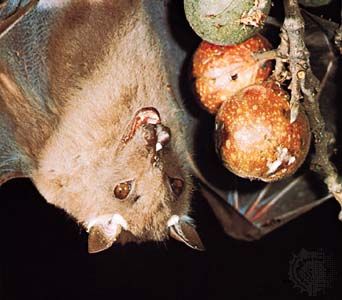
Primarily fruit and flowers
Mostly insects, though some eat fish, fruit, or blood
Physical Traits
Smooth-crowned molars; claw on index finger
Highly varied; often possess complex nose leaves or facial adornments
Sensory and Evolutionary Distinctions
The most notable difference lies in how these bats navigate. Microchiroptera rely on echolocation to hunt and orient themselves in the dark, a system facilitated by a mutated form of the protein prestin that enhances high-frequency sound sensitivity. In contrast, Megachiroptera generally orient visually and possess larger eyes, with the exception of the genus Rousettus, which uses a form of echolocation.754
Evolutionarily, it is uncertain if these suborders share a common ancestor; they may have diverged very early in history or evolved independently from flightless insectivores.5
Why are bats the only mammals capable of true flight?
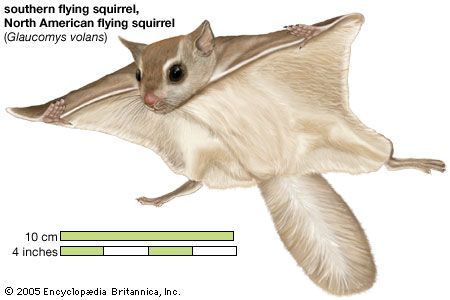
Bats are the only mammals capable of true, powered flight. While other mammals, such as “flying” squirrels, possess adaptations that allow them to glide, they lack the anatomical specializations required for sustained, self-powered flight.106
The ability to fly is made possible by significant evolutionary modifications to the bat’s body plan:
- Wing Structure: Their forelimbs are highly modified into wings, featuring greatly elongated fingers (excluding the thumb) that support a thin, flexible membrane of skin. This allows for precise control over wing shape, angle, and extension, enabling complex maneuvers like hovering, diving, and turning.111
- Musculature: Bats possess large, well-muscled chests and shoulders to provide the necessary power for their wings.11
- Weight Management: To maintain flight, bats have evolved to be lightweight. They digest food extremely rapidly, often excreting within 30 to 60 minutes of eating, which helps them keep their body mass low.10
- Takeoff Adaptations: Unlike birds, bats are generally not adapted for ground takeoff because their hind limbs are underdeveloped and cannot generate sufficient lift from a stationary position. Instead, most species roost upside down, allowing them to drop into the air and use gravity to gain the momentum needed for flight.210
Sources
- Why do bats sleep upside down? — Encyclopædia Britannica
- 5 Surprising Facts About Bats — Encyclopædia Britannica
- bat - Orientation — Encyclopædia Britannica
- Echolocation — Encyclopædia Britannica
- Megachiroptera — Merriam-Webster
- bat - Evolution and paleontology — Encyclopædia Britannica
- bat - General features — Encyclopædia Britannica
- mammal - Food habits — Encyclopædia Britannica
- bat - Annotated classification — Encyclopædia Britannica
- bat - Locomotion — Encyclopædia Britannica
- Flight — Encyclopædia Britannica
- Bird - The origin of flight — Encyclopædia Britannica
- bat - Anatomical specializations — Encyclopædia Britannica
- Bird - Flightlessness — Encyclopædia Britannica
Published on · 3 min read