5 Surprising Facts About Bats
Bats are fascinating creatures with unique biological adaptations. Here are five surprising facts about them:
What are 5 Surprising Facts About Bats?
Bats are fascinating creatures with unique biological adaptations. Here are five surprising facts about them:
- They are the only mammals capable of true flight: While other mammals like flying squirrels can only glide, bats are the only ones that can achieve powered flight. To maintain the low weight necessary for flying, they have extremely fast digestion, sometimes excreting food within 30 to 60 minutes of eating.1
- They are not blind: The common saying “blind as a bat” is a misconception. In reality, many bats have eyesight that is keener than that of humans, and their eyes are specifically adapted to function well in low-light conditions.12
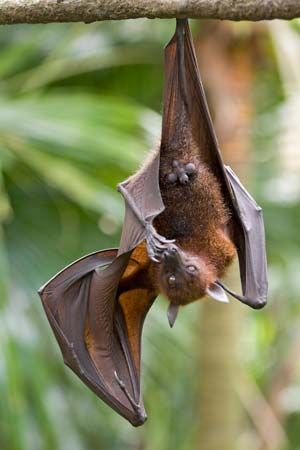
- Not all bats hang upside down: While most species do, there are six species that do not. These bats often possess suction pads on their limbs, allowing them to stick to surfaces like leaves.1
- Their droppings have historical utility: Bat guano is rich in potassium nitrate (saltpeter), which was an important resource for manufacturing gunpowder and explosives during the American Civil War. Today, it is more commonly used as agricultural fertilizer.13
- There is immense diversity in species: There are more than 1,200 species of bats, ranging from the tiny bumblebee bat with a 6-inch wingspan to giant flying foxes that can reach wingspans of up to 5 feet.1
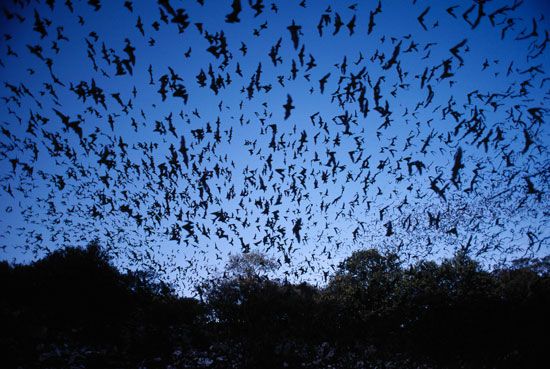
How does echolocation help bats navigate in the dark?
Bats navigate and hunt in the dark using echolocation, a biological sonar system. By emitting high-frequency sound pulses—often above the range of human hearing—through their mouths or noses, bats create sound waves that bounce off surrounding objects.67
When these sound waves strike an object, such as an insect or an obstacle, they reflect back to the bat as echoes. By interpreting these returning signals, bats can determine an object’s direction, distance, velocity, and size. This process relies on several sophisticated adaptations:6
- Acoustic Processing: Bats possess large, sensitive ears and specialized inner ear structures that are often acoustically isolated from the skull to improve signal detection.6
- Brain Integration: The bat’s nervous system must rapidly analyze the altered echoes to distinguish them from background noise and other pulses, even while the bat is in motion.6
- Dynamic Pulse Control: Bats adjust their pulse rates and durations based on their activity. During insect pursuit, they transition through search, approach, and terminal phases, increasing the pulse rate to as many as 200 per second to track targets with high precision.6
- Molecular Specialization: Many bats possess a mutated version of the Prestin gene, which enhances their sensitivity to high-frequency sounds.7
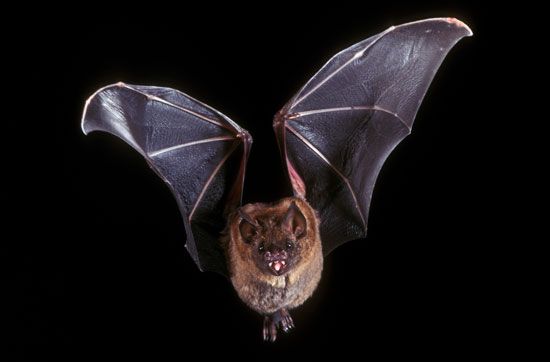
Why are bats important for pollination and seed dispersal?
Bats play a vital role in maintaining the health and diversity of tropical and subtropical ecosystems through their contributions to pollination and seed dispersal.8
Pollination
More than 500 species of tropical plants are pollinated by nectar- and pollen-eating bats, a relationship known as chiropterophily. These “bat-loving” plants have evolved specific traits to attract nocturnal visitors:9
- Floral Adaptations: They produce large, white flowers that are easily visible at night and often emit fermented or musky odors.910
- Nutritional Exchange: These plants provide nectar and protein-rich pollen, which contains amino acids like tyrosine and proline that are essential for bat health, including wing membrane development and milk production.9
- Nectar Corridors: Migratory bats pollinate plants in sequence along their travel routes, effectively creating a “nectar corridor” that supports both the bats and the plant populations.9
Seed Dispersal
Fruit-eating bats are essential for forest regeneration by transporting seeds away from parent trees.38
- Transport Mechanisms: Bats often carry fruit to feeding roosts located away from the source tree. They may consume small seeds and excrete them during flight, or discard larger seeds at the roost site.3
- Ecological Synergy: In some cases, the dispersal process requires multiple animals. For example, fruit bats may drop seeds that are subsequently buried by rodents like the agouti, which protects the seeds from predators and increases their chances of germination.3
What are the differences between Megachiroptera and Microchiroptera?
The order Chiroptera is divided into two primary suborders: Megachiroptera and Microchiroptera. While both share the general flight characteristics of bats, they exhibit significant differences in size, sensory capabilities, and feeding habits.
Key Differences
Feature
Megachiroptera
Microchiroptera
Common Name
Old World fruit bats or flying foxes
Small bats (found worldwide)
Echolocation
Generally absent (except for the genus
Rousettus
)
Employed by all members
Diet
Primarily fruit and nectar
Mostly insects, though some eat fish, fruit, or small vertebrates
Sensory Focus
Well-developed vision
Highly developed echolocation
Physical Traits
Simple muzzle; small ears
Often possess complex nose leaves or specialized ear structures
Evolutionary and Biological Distinctions
- Echolocation: Most microchiropterans use echolocation to navigate and hunt, a process facilitated by a mutated Prestin gene that increases sensitivity to high-frequency sounds. In contrast, most megachiropterans rely on their well-developed vision to locate food.147
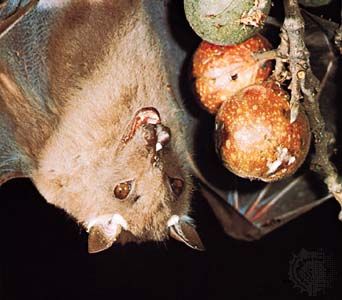
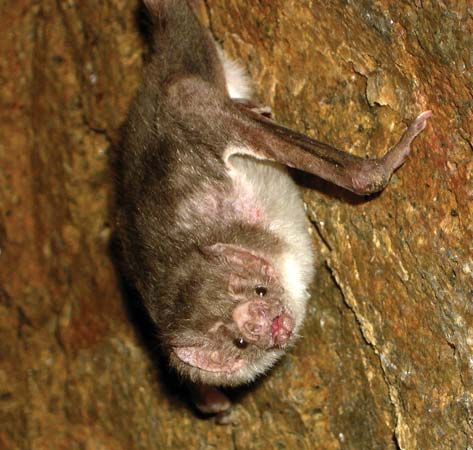
- Feeding Niches: Megachiropterans are largely conservative in their diet, focusing on fruit and flowers. Microchiropterans have undergone significant adaptive radiation, occupying diverse feeding niches that include insectivory, carnivory, and even blood-lapping in the case of vampire bats.157
- Diversity: The suborder Microchiroptera is significantly more diverse, comprising 17 families and approximately 930 species, whereas the Megachiroptera consists of a single family, Pteropodidae, with about 186 species.7
Sources
- 5 Surprising Facts About Bats — Encyclopædia Britannica
- Donald Redfield Griffin: Top Questions — Encyclopædia Britannica
- bat - Importance to humans — Encyclopædia Britannica
- bat - Anatomical specializations — Encyclopædia Britannica
- Are Bats Really Blind? — Encyclopædia Britannica
- bat - Orientation — Encyclopædia Britannica
- Echolocation — Encyclopædia Britannica
- Bat-loving flowers — Encyclopædia Britannica
- Hitching a ride — Encyclopædia Britannica
- bat - Food habits — Encyclopædia Britannica
- bat - Roosting — Encyclopædia Britannica
- guano — Encyclopædia Britannica
- bat - General features — Encyclopædia Britannica
- mammal - Food habits — Encyclopædia Britannica
- bat - Annotated classification — Encyclopædia Britannica
Published on · 4 min read