Whydah
Whydahs (subfamily Viduinae) are brood parasites that lay their eggs in the nests of specific estrildid finch species. Unlike some other brood parasites…
How does the whydah bird’s parasitic nesting behavior impact other bird species?
Whydahs (subfamily Viduinae) are brood parasites that lay their eggs in the nests of specific estrildid finch species. Unlike some other brood parasites, such as cuckoos, whydah nestlings do not typically harm the host’s own brood.123
Instead, whydahs have evolved highly specialized mimicry to ensure their survival within the host’s nest. The nestlings perfectly replicate the unique mouth patterns, begging calls, and head movements of the host species. Because host parents only feed nestlings that display the correct, species-specific mouth markings, this mimicry is essential for the young whydah to receive food. Furthermore, the juvenile plumage of the whydah matches that of the host, and its digestive system is adapted to the host’s specific diet.1
By learning the host’s vocalizations during development, adult male whydahs ensure they attract females reared by the same host species, maintaining the specialized parasite-host relationship.1
What is the significance of the whydah bird’s name and its historical connections?
The name “whydah” carries two distinct origins: a geographical association and a linguistic evolution.
Geographical Connection
The name is primarily associated with Whydah (also known as Ouidah), a town in Benin. These birds are common in the region, and the name reflects this historical and regional link to the area.3
Linguistic Evolution
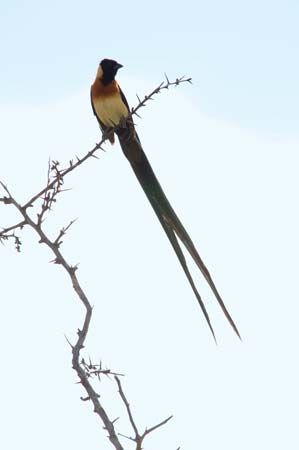
Linguistically, “whydah” is an alteration of the term “widow bird.” This naming convention likely stems from the appearance of the male birds during the breeding season. Many species, particularly those in the subfamily Viduinae, possess long, dark, flowing tail feathers that resemble a funeral veil, evoking the imagery of a widow in mourning.43
While the name links these birds to a specific African locale, it also highlights their striking physical characteristics, specifically the dramatic elongation of tail feathers in males, which serves as a key identifier for the group.34
How do whydah birds communicate and what types of vocalizations do they use?
Whydah birds exhibit a unique and highly specialized form of communication driven by their status as brood parasites. Because each whydah species relies on a single host species—typically an estrildid finch—they have evolved to communicate using the vocalizations of their hosts rather than their own species-specific songs.1
Vocalization and Learning
Whydah nestlings learn the songs of their foster parents during a critical developmental period. As adults, male whydahs utilize these learned host vocalizations to attract mates. This serves as a vital species-isolating mechanism: because the males sing the songs of their specific host, they only attract females that were reared by that same host species. This ensures that whydahs do not hybridize, as hybrid offspring would likely fail to match the specific requirements of either host.1
Nestling Communication
Beyond adult songs, whydah nestlings communicate with their foster parents through:
- Begging Calls: Young whydahs perfectly duplicate the specific begging calls of their host species to solicit food.1
- Visual Signaling: While not vocal, nestlings also mimic the unique mouth patterns (gape) and head movements of the host, which act as essential “releasers” for feeding behavior.1
What is the whydah bird and where is it primarily found?
The whydah refers to several species of African passerine birds belonging to the family Ploceidae. These birds are primarily found across the African continent, and their name is historically associated with the town of Whydah (Ouidah) in Benin, where they are commonly observed.3
Whydahs are categorized into two subfamilies:
- Viduinae: These are social parasites that lay their eggs in the nests of specific weaver finches. Males are typically black with four greatly elongated central tail feathers.3
- Ploceinae: Unlike the Viduinae, these species are not parasitic. They often exhibit behaviors similar to bishop birds, with some males, such as the Jackson’s whydah, creating dancing grounds to attract females.3
The name “whydah” is an alteration of “widow bird,” a reference to the long, dark, flowing tail feathers males develop during the breeding season, which resemble a funeral veil.34
Sources
- mimicry - Parasitic weaverbirds — Encyclopædia Britannica
- parasitism — Encyclopædia Britannica
- Whydah — Encyclopædia Britannica
- whydah — Merriam-Webster
- Animal learning - Song learning — Encyclopædia Britannica
Published on · 3 min read