Wood Wasp
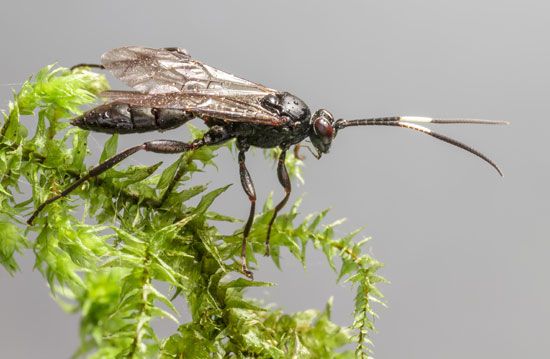
Wood wasps are distinct from the common wasps found in the suborder Apocrita because they belong to the suborder Symphyta. While most familiar wasps (such as…
How do wood wasps differ from other types of wasps?
Wood wasps are distinct from the common wasps found in the suborder Apocrita because they belong to the suborder Symphyta. While most familiar wasps (such as hornets, yellow jackets, and paper wasps) are characterized by a narrow “waist” or petiole that attaches the abdomen to the thorax, wood wasps lack this feature.12
Key differences include:
- Classification: Wood wasps comprise three specific families—Xiphydriidae, Orussidae, and Anaxyelidae—which are considered more primitive than the Apocrita suborder.1
- Behavior: Unlike many social wasps that build complex paper nests or solitary wasps that provision cells with paralyzed prey, wood wasp larvae typically bore directly into the wood of trees. For example, the larvae of cedar wood wasps bore into incense cedar, while those of the Xiphydriidae family target dead or dying deciduous trees.1
- Parasitism: While some wood wasps, such as the Orussidae, are parasitic, they specifically target wood-boring beetle larvae rather than the diverse range of prey or hosts utilized by other parasitic wasps.13
What is the life cycle of a wood wasp?
The life cycle of a wood wasp, which belongs to the suborder Symphyta, is primarily defined by its development within woody environments. While specific details vary by family, the general progression involves the following stages:
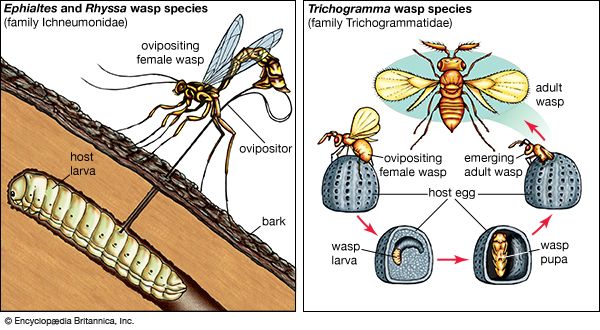
- Egg-laying: Adult females deposit their eggs directly into the wood of host trees, such as dead or dying deciduous trees or incense cedars, using their specialized ovipositors.1
- Larval Stage: Upon hatching, the larvae begin to bore into the wood, creating galleries as they feed. In the case of parasitic wood wasps (family Orussidae), the larvae act as parasites on the larvae of wood-boring beetles.1
- Pupation: Before pupating, the larva typically chews a gallery or cell close to the surface of the tree, often just beneath the bark. They may construct a protective pupal cell using frass—chewed wood fibers—to shield themselves from predators.5
- Emergence: Once the adult form has developed and hardened within the pupal cell, it must chew its way through the remaining solid wood to emerge from the tree.5
What methods are used to control wood wasp populations in forestry?
In forestry, the management of wood wasp populations—particularly invasive species like Sirex noctilio—relies on a combination of preventive, silvicultural, and biological control strategies.78
Management Strategies
- Biological Control: This is a primary method for managing wood wasp outbreaks. Researchers introduce and encourage the presence of parasitoid wasps, such as the ichneumon wasp Megarhyssa nortoni. These wasps act as natural enemies by parasitizing the larvae of wood-boring pests, effectively regulating their population numbers in both natural and managed forests.78
- Silvicultural Practices: Foresters utilize long-range management techniques to maintain forest vigor, as healthier trees are more resistant to infestation. This includes:
- Sanitation and Monitoring: Routine monitoring allows for the timely harvest of infested trees. Sanitation harvests, which involve removing and properly disposing of infested timber, help limit the spread of pests to uninfested areas.7
- Quarantine and Regulation: Because invasive species are often spread through global trade, the enforcement of plant quarantine laws is essential to prevent the accidental introduction of wood-boring insects via shipping materials or the transport of infested logs and firewood.79
What is the difference between the suborders Symphyta and Apocrita?
The order Hymenoptera is divided into two primary suborders: Symphyta and Apocrita. They are distinguished by their physical structure and larval development.1011
Key Differences
Feature
Symphyta
Apocrita
Body Structure
Possess a broad “waist” where the abdomen meets the thorax.
Characterized by a narrow, constricted waist.
Larval Form
Usually caterpillar-like with thoracic and abdominal legs.
Typically maggot-like and legless.
Larval Head
Tough, well-developed head covering and mouthparts.
Softer, thinner head covering; often reduced in parasitic forms.
Examples
Sawflies
,
horntails
, and
wood wasps
.
Ants
,
bees
, and various
wasps
.
Developmental and Behavioral Distinctions
Symphyta are considered the more primitive members of the order. Most are phytophagous (plant-eating), though the family Orussidae is parasitic. Their larvae often have three pairs of thoracic legs and six to eight pairs of abdominal legs, though wood-boring species may lack abdominal legs entirely.1012
In contrast, the suborder Apocrita includes the more specialized stinging and parasitic forms. Their larvae are generally legless and lack the robust head structure found in Symphyta, reflecting their different developmental environments, which often involve living within a host or a protected cell.12
Sources
- wood wasp — Encyclopædia Britannica
- Hymenoptera - Solitary forms — Encyclopædia Britannica
- wasp — Encyclopædia Britannica
- yellow jacket — Encyclopædia Britannica
- wood wasp — Merriam-Webster
- Coleoptera - Pupae — Encyclopædia Britannica
- forestry - Insect and disease control — Encyclopædia Britannica
- emerald ash borer — Encyclopædia Britannica
- ichneumon wasp — Encyclopædia Britannica
- Symphyta — Encyclopædia Britannica
- list of ants, bees, and wasps — Encyclopædia Britannica
- Hymenoptera - Egg and larva — Encyclopædia Britannica
- Apocrita — Merriam-Webster
Published on · 3 min read