Wryneck
A wryneck refers to two species of birds belonging to the subfamily Jynginae within the woodpecker family (Picidae), though they are sometimes classified as…
What is Wryneck?
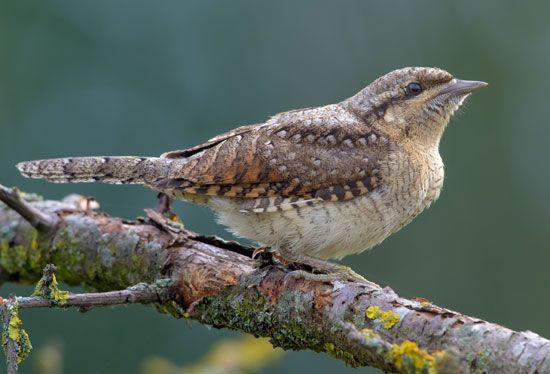
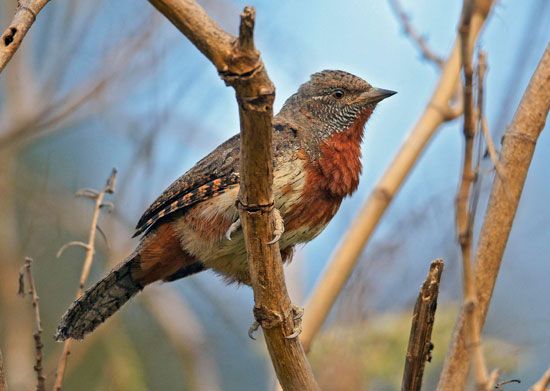
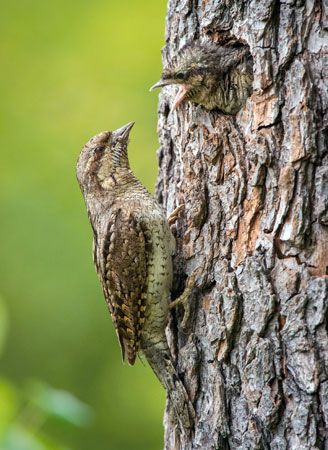
A wryneck refers to two species of birds belonging to the subfamily Jynginae within the woodpecker family (Picidae), though they are sometimes classified as their own family, Jyngidae. These gray-brown birds are named for their unique behavior of twisting their necks in a snakelike fashion when they feel threatened.12
Unlike typical woodpeckers, wrynecks possess soft tail feathers. They primarily feed on ants and insects, which they capture using their long tongues, and they typically nest in abandoned woodpecker holes. The two recognized species are:21
- The Eurasian wryneck (Jynx torquilla), which breeds across a range from England to Japan and migrates to the tropics for the winter.1
- The red-breasted wryneck (J. ruficollis), which is native to Africa.1
Additionally, the term “wryneck” is used in medical contexts as a synonym for torticollis, a condition involving the twisting of the neck.2
How do wrynecks differ from typical woodpeckers?
Wrynecks differ from typical woodpeckers in several distinct ways:
- Physical Characteristics: Unlike typical woodpeckers, which have stiff tail feathers that help them prop themselves against tree trunks, wrynecks possess soft tail feathers.13
- Behavior: Wrynecks are named for their unique habit of twisting their necks in a snakelike fashion when they feel threatened. Additionally, unlike most woodpeckers, wrynecks often perch crosswise on branches.132
- Nesting Habits: While typical woodpeckers are well-known for their ability to excavate their own nesting cavities in trees, wrynecks do not share this specialization. Instead, they typically nest in natural crevices, old swallow holes in banks, or abandoned holes previously excavated by woodpeckers.12
What is the significance of the wryneck’s long tongue?
The significance of the wryneck’s long tongue lies in its role as a specialized tool for foraging. Wrynecks utilize this elongated, distensible organ to flick up ants from the ground or extract insects from trees, allowing them to access food sources that are otherwise beyond the reach of their bills.1
While the provided search results do not explicitly detail the internal anatomy of the wryneck’s tongue, they note that in the broader woodpecker family (Picidae), such tongues are often equipped with tiny barbs and coated in a sticky substance produced by enlarged salivary glands. This adaptation enables the bird to effectively probe for and capture prey, functioning as both a probe and a spear to secure insects.4
What is torticollis and how does it relate to the name?
Torticollis is a medical condition characterized by the involuntary contraction of neck muscles, which causes the head to tilt, turn, or jerk into an abnormal, twisted position. It can arise from various factors, including congenital issues in infants, trauma, poor posture, or neurological disorders such as spasmodic torticollis.51
The term is etymologically derived from the New Latin words tortus (twisted) and collum (neck). The condition is also commonly referred to as wryneck. This shared name links the medical condition to the wryneck bird, a member of the woodpecker family named for its distinct, snakelike habit of twisting its neck when alarmed. While the bird’s behavior is a natural defensive display, the term “wryneck” has been used to describe the human medical condition since at least the 16th century, long before the term “torticollis” appeared in medical literature around 1811.562
Sources
- Wryneck — Encyclopædia Britannica
- wryneck — Merriam-Webster
- Piciform - Reproduction — Encyclopædia Britannica
- Piciform - Form and function — Encyclopædia Britannica
- torticollis — Merriam-Webster
- torticollis — Encyclopædia Britannica
Published on · 3 min read