Abuná River
The Abuná River is a headwater of the Amazon River that originates east of the Andes' Cordillera Oriental. This navigable river flows approximately 200 miles…
What is Abuná River?
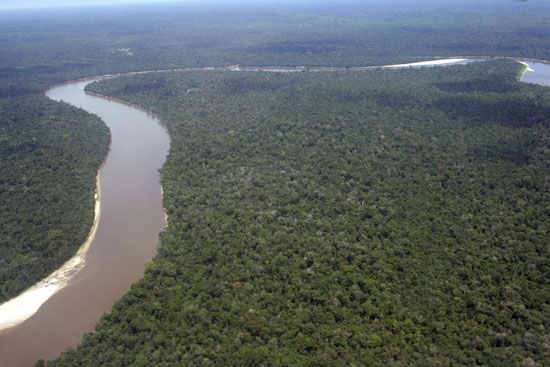
The Abuná River is a headwater of the Amazon River that originates east of the Andes’ Cordillera Oriental. This navigable river flows approximately 200 miles (320 km) in a northeasterly direction through dense rain forests, serving as the northern border between Bolivia and Brazil1.
The river eventually empties into the Río Madeira—a major tributary of the Amazon—at the town of Manoa, Bolivia. The surrounding Abuná region is sparsely populated, and its primary economic activities involve the trade of forest products such as Brazil nuts, rubber, and quinine.1
What is the importance of the Madeira River in the Amazon basin?
The Madeira River is a vital component of the Amazon basin, serving as its second-largest affluent. Its importance is defined by several key factors:
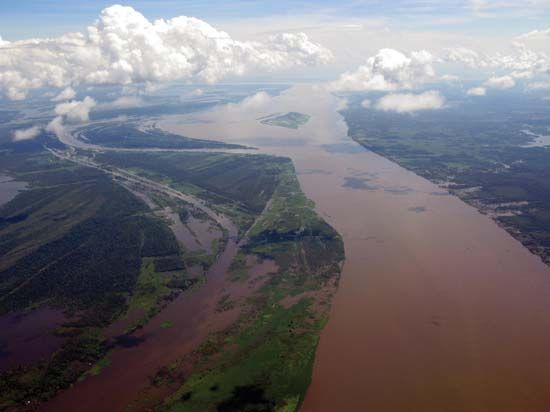
- Sediment Transport: Originating in the geologically youthful and tectonically active Andes, the Madeira carries heavy loads of silt. This “whitewater” sediment has significantly shaped the landscape, including the formation of the 200-mile-long island of Tupinambarana near its confluence with the Amazon River.2
- Navigation and Access: The river is navigable by seagoing vessels for over 800 miles from its mouth. Historically, its upper reaches and major affluents—the Madre de Dios, Beni, and Mamoré—provided critical access to the rubber-rich forests of the Bolivian Oriente.32
- Economic History: The region has long been significant for the trade of forest products, including Brazil nuts and rubber. The Madeira-Mamoré Railway was constructed to circumvent the river’s extensive rapids and waterfalls, facilitating trade in these remote areas.3
How do Brazil nuts grow in the rainforest?
Brazil nut trees (Bertholletia excelsa) grow wild in the Amazon River basin, where they tower over the forest canopy, reaching heights of 49 meters (160 feet). These trees have complex ecological requirements and can only produce fruit in undisturbed habitats, as they cannot be cultivated in pure stands.4
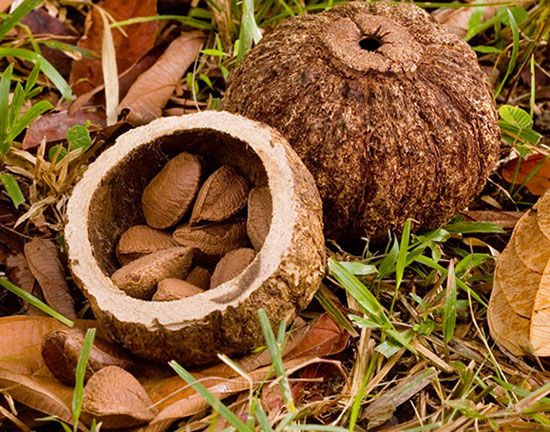
The trees produce large, spherical, woody pods that resemble coconuts and contain 12–24 seeds arranged like orange sections. Their reproduction relies on two specific ecological relationships:4
- Pollination: The trees require large native bees to pollinate their semi-enclosed flowers.4
- Seed Dispersal: Once the pods ripen and fall to the forest floor, the trees rely exclusively on agoutis—medium-sized rodents—to disperse their seeds. Agoutis bury the nuts to store them for later, which facilitates the growth of new trees.45
Because of these specialized dependencies, the trees are extremely sensitive to deforestation these specialized dependencies, the trees are extremely sensitive to deforestation.4
What are the main characteristics of the Amazon River system?
The Amazon River system is the largest drainage network in the world, covering approximately two-fifths of South America and accounting for one-fifth of the planet’s total flowing freshwater. Its primary characteristics include:63
Scale and Hydrology
- Volume and Flow: The river carries more water than any other, discharging about 6,350,000 cubic feet per second into the Atlantic Ocean.6
- Length: Stretching roughly 4,000 miles (6,400 km), it rises in the Peruvian Andes and is fed by more than 1,000 tributaries.6
- Flood Cycles: The river experiences regular, anticipated seasonal floods caused by rainfall in the Andes. These floods create a “gigantic wave” of rising water that moves downstream from November to June.7
River Classifications
The system is defined by the distinct characteristics of its tributaries, which are categorized by their water composition:
- Whitewater: Originating in the Andes, these rivers carry heavy sediment loads, which contribute to the fertility of the várzea (floodplains).83
- Blackwater: These rivers, such as the Negro River, are rich in humic acids and tannins, giving them a dark appearance and higher acidity.83
- Clearwater: These tributaries have higher mineral content and lower levels of humic acids.8
Geography and Environment
The basin contains a complex mosaic of ecosystems, including the Amazon Rainforest, which harbors 10 percent of the world’s known life forms. The river itself does not form a traditional delta; instead, its massive sediment load is transported northward by coastal currents.37
Sources
- Abuná River — Encyclopædia Britannica
- Madeira River — Encyclopædia Britannica
- Amazon River - Physiography of the river course — Encyclopædia Britannica
- Brazil nut — Encyclopædia Britannica
- agouti — Encyclopædia Britannica
- South America - Rivers of South America — Encyclopædia Britannica
- Amazon River - Hydrology of the Amazon River — Encyclopædia Britannica
- Amazon basin — Encyclopædia Britannica
- Amazon River - Climate — Encyclopædia Britannica
Published on · 3 min read