Capelin
The capelin (Mallotus villosus) is a small, slender marine fish belonging to the smelt family, Osmeridae. Typically reaching lengths of no more than 20 cm (8…
What is capelin?
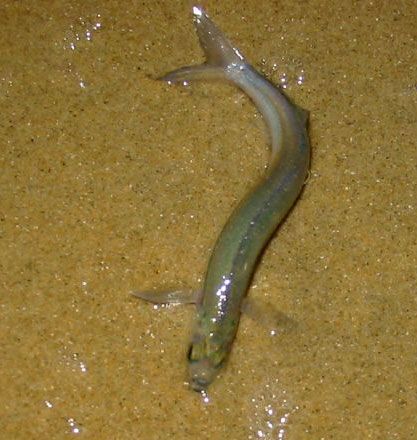
The capelin (Mallotus villosus) is a small, slender marine fish belonging to the smelt family, Osmeridae. Typically reaching lengths of no more than 20 cm (8 inches), these fish are characterized by their olive-green backs, silvery-white bellies, small scales, and large eyes.12
Found in cold Arctic seas worldwide, the capelin extends into northern temperate coastal waters. Unlike many other smelt species, it does not spawn in freshwater; instead, it lays its eggs inshore, often on the gravel of wave-washed beaches. Because they are exceedingly abundant, capelins serve as a vital food source for a wide variety of marine mammals, seabirds, and other fish.1
What animals rely on capelin as a food source?
Capelin are a crucial component of the marine food web, serving as a primary food source for a wide variety of predators in cold Arctic and northern temperate waters. Because they are exceedingly abundant, they support the diets of:
- Marine mammals: Various species that rely on these small fish for sustenance.
- Seabirds: Many avian species that hunt in coastal and offshore waters.
- Other fishes: A great variety of predatory fish that inhabit the same northern ecosystems.1
How do capelin spawn on gravel beaches?
Unlike many other species of smelt, the capelin does not migrate into freshwater to reproduce. Instead, these fish spawn close to the shore, depositing their eggs directly onto the gravel of wave-washed beaches.1
This unique behavior allows the species to utilize the intertidal zone for spawning, where the movement of the waves helps oxygenate the eggs as they develop within the gravel substrate.1
What are some other species in the smelt family?
The family Osmeridae, commonly known as the smelt family, consists of slender, silvery, carnivorous fishes found in cold northern waters. In addition to the capelin, several other notable species belong to this family:
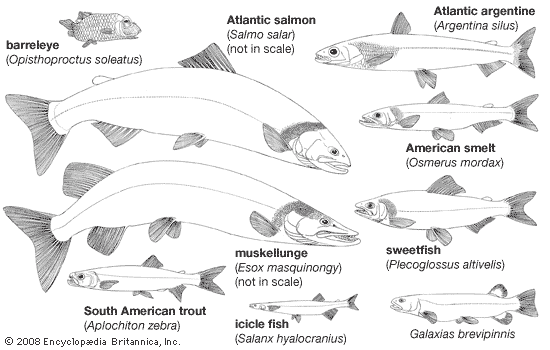
- American smelt (Osmerus mordax): A species native to the Atlantic Ocean that has been introduced to the Great Lakes, where it supports a significant commercial fishery.
- European smelt (O. eperlanus): A species similar in characteristics to the American smelt.
- Rainbow herring (O. dentex): A Pacific species related to other smelts.
- Surf smelt (Hypomesus pretiosus): Another Pacific-dwelling member of the family.
- Eulachon or candlefish (Thaleichthys pacificus): A Pacific species notable for being so oily during spawning that it can be dried and burned like a candle.
While some unrelated fishes, such as silversides, are sometimes colloquially referred to as smelts, the true smelts are classified within the family Osmeridae.
Sources
- capelin — Encyclopædia Britannica
- capelin — Merriam-Webster
- smelt — Encyclopædia Britannica
- Osmeridae — Merriam-Webster
- protacanthopterygian - Distribution and abundance — Encyclopædia Britannica
Published on · 2 min read