Silversides
Silversides are small, slender, schooling fish belonging to the family Atherinidae. They are found globally in both freshwater environments and along the…
What is silversides?
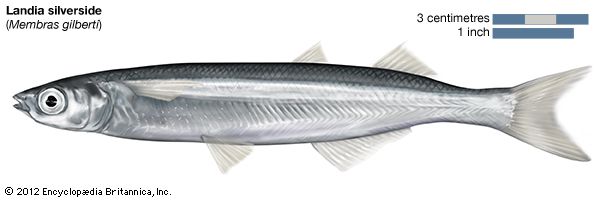
Silversides are small, slender, schooling fish belonging to the family Atherinidae. They are found globally in both freshwater environments and along the coasts of warm and temperate regions.12
These fish are named for the characteristic wide, silvery stripe that typically runs along each side of their bodies. They possess two dorsal fins and can reach lengths of up to 70 cm (28 inches). While they are sometimes harvested for food, some species are notable for their unique reproductive behaviors, such as the grunion, which comes ashore at night during high tides to bury its eggs in the sand.13
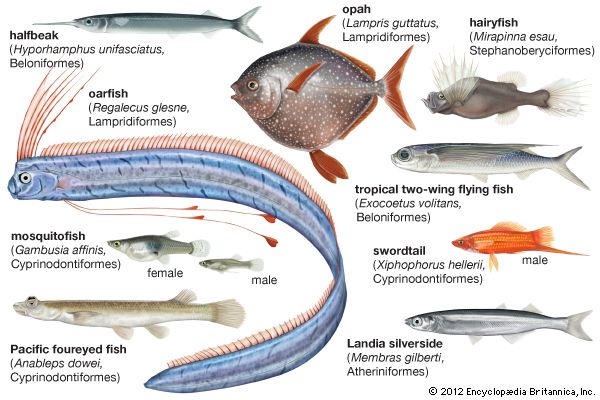
Taxonomically, silversides are classified within the order Atheriniformes. They are distinguished by features such as the absence of a lateral line and the placement of their pelvic fins midway along the belly.12
How do grunion fish spawn on beaches?
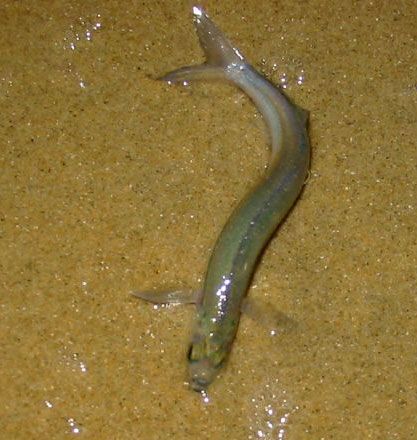
The grunion (Leuresthes tenuis) exhibits a unique spawning behavior that occurs on beaches along the western coast of the United States during the warm months.4
The process unfolds as follows:
- Timing: Spawning takes place at night, specifically following the peak of the highest tides, known as spring tides, which coincide with a full or new moon.4
- Egg Deposition: During these high tides, the fish come ashore to lay their eggs directly into the sand.4
- Incubation and Hatching: The eggs remain buried in the sand for approximately two weeks. They hatch when they are inundated by the water during the subsequent spring tide, at which point the young fish are carried out into the Pacific Ocean.4
What are the main differences between freshwater and saltwater fish habitats?
The primary differences between freshwater and saltwater fish habitats center on osmoregulation, oxygen availability, and environmental diversity.
Osmoregulation and Survival
The most significant physiological difference involves how fish maintain their internal salt and water balance:
- Saltwater Fish: Because seawater has a higher salt concentration than their bodies, these fish lose water through osmosis. To survive, many drink large quantities of seawater and use their kidneys to excrete excess salts while retaining water.5
- Freshwater Fish: These fish live in environments with lower salt concentrations than their bodies, causing them to naturally absorb water. Consequently, they drink very little and use their kidneys to excrete large amounts of excess water to maintain balance.5
Oxygen and Environmental Factors
The physical characteristics of the water also differ significantly:
- Oxygen Availability: Oxygen is less soluble in water than in air, and its availability decreases as water temperature or salt content increases. Therefore, saltwater environments often have lower oxygen capacity than freshwater ones.6
- Habitat Diversity: Freshwater habitats range from mountain torrents to tropical rivers, each requiring specialized physiological adaptations. Marine habitats are equally diverse, categorized by depth and coastal features, such as benthic zones, estuaries, and pelagic regions.7
While most species are restricted to one environment, some, like salmon, are adapted to migrate between both.57
Why do some fish species form schools?
Fish species, particularly clupeiform fish like herrings and anchovies, form schools primarily to enhance individual safety. By swimming together, these fish appear to act as a single organism, which helps thwart predators. When threatened, a school may contract into a tight, writhing sphere, making it difficult for a predator to isolate and capture a single individual.89
Beyond protection, schooling offers several other potential advantages:
- Feeding Efficiency: Hydrodynamic interactions between members may facilitate movement, and the school’s structure ensures that individuals rotate positions, allowing everyone a turn to feed rather than just those at the front.9
- Reproduction: The aggregation of large numbers of fish simplifies the process of finding mates.9
- Survival: Schooling provides a better chance for small fish to survive environmental hazards compared to living solitarily.9
Schools are typically composed of individuals of similar size, which helps maintain the school’s cohesion through visual contact or the lateral line system.89
Sources
- silversides — Encyclopædia Britannica
- atheriniform - Annotated classification — Encyclopædia Britannica
- silverside — Merriam-Webster
- grunion — Encyclopædia Britannica
- Do fish drink water? — Encyclopædia Britannica
- Respiratory system - The gases in the environment — Encyclopædia Britannica
- fish - Distribution and abundance — Encyclopædia Britannica
- Schooling behaviour — Encyclopædia Britannica
- clupeiform - Schooling behaviour — Encyclopædia Britannica
Published on · 3 min read