Smelt
Smelts are small, slender, silvery bony fishes belonging to the family Osmeridae. They are closely related to salmon and trout, sharing several key…
What are the main characteristics that distinguish smelt fish from other fish species?
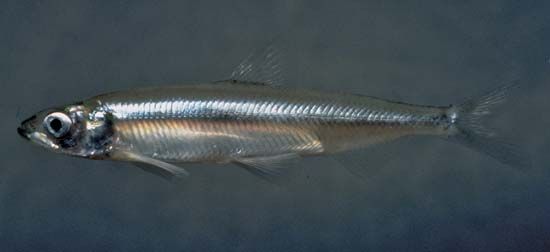
Smelts are small, slender, silvery bony fishes belonging to the family Osmeridae. They are closely related to salmon and trout, sharing several key structural characteristics:
- Adipose Fin: Like trout, smelts possess a small, fleshy adipose fin located on their backs.12
- Physical Appearance: They are typically sleek and slender carnivores, often featuring olive-green backs and silvery-white bellies.13
- Habitat and Behavior: Found primarily in cold northern waters, many species are anadromous, meaning they ascend rivers to spawn, though some are landlocked or spawn in the surf.14
- Biological Traits: They are known for their delicate, oily flesh, which is often noted for a distinctive odor and taste. Some species, such as the eulachon, are so oily during spawning that they can be dried and burned like a candle.41
- Reproduction: Many smelts lay sticky eggs that adhere to objects they touch, though spawning habits vary; for instance, the capelin typically spawns on wave-washed gravel beaches rather than in freshwater.13
Where are smelt fish typically found, and what are their preferred habitats?
Smelt fish, belonging to the family Osmeridae, are primarily found in the cold northern waters of Europe, Asia, and North America. While they are widely distributed, their habitat preferences vary based on their life cycle:15
- Marine and Anadromous Environments: Most smelt species are either marine or anadromous, meaning they spend much of their lives in the sea and migrate to fresh water—specifically short distances upstream, into ponds, or into the surf—to spawn.15
- Freshwater Habitats: Some smelts are permanent freshwater inhabitants, though they have not established as broad a distribution in inland fresh waters as salmonid fishes have.5
- Geographic Range: In the Northern Hemisphere, they are indigenous to cooler freshwater environments. In the Southern Hemisphere, ecologically similar fish—such as those in the family Retropinnidae—are found in the freshwater environments of Australia, New Zealand, and Tasmania.5
Additionally, some species, such as the American smelt, have been successfully introduced to new environments like the Great Lakes, where they support commercial fisheries.1
How do smelt fish reproduce, and what is unique about their spawning behavior?
Smelt fish in the family Osmeridae exhibit diverse reproductive strategies, primarily characterized by their migration patterns and egg-laying behaviors.
Spawning Patterns
Most smelt species are anadromous, meaning they migrate from marine environments to fresh water—such as short distances upstream, into ponds, or into the surf—to spawn during late winter or spring. A notable exception is the capelin, which does not enter freshwater; instead, it spawns inshore, depositing its eggs directly onto wave-washed gravel beaches.13
Unique Reproductive Traits
A defining characteristic of many smelt species is the nature of their eggs. Once released, these eggs are sticky and adhere to any objects they touch, such as rocks or vegetation, which helps keep them in place during development.1
Additionally, some species undergo significant physiological changes during the spawning season. For example, the eulachon becomes so saturated with oil during this period that it has historically been dried and used as a candle, a unique trait that highlights the intense metabolic investment these fish make during their reproductive cycle.1
What are the different species of smelt fish within the Osmeridae family?
The family Osmeridae, commonly known as smelts, consists of 7 genera and approximately 15 species of slender, silvery, carnivorous fish found in cold northern waters.13
Several notable species within this family include:
- American smelt (Osmerus mordax): A species introduced from the Atlantic Ocean to the Great Lakes, where it supports a significant commercial fishery.1
- European smelt (O. eperlanus): A species similar in characteristics to the American smelt.1
- Capelin (Mallotus villosus): An abundant marine fish inhabiting cold Arctic and northern temperate seas. Unlike many other smelts, it does not enter freshwater to spawn, instead depositing its eggs on inshore gravel beaches.12
- Rainbow herring (O. dentex): A Pacific species related to the American and European smelts.1
- Surf smelt (Hypomesus pretiosus): Another Pacific species within the family.1
- Eulachon or candlefish (Thaleichthys pacificus): A North Pacific species known for being so oily during spawning that it can be dried and burned like a candle.189
Sources
- smelt — Encyclopædia Britannica
- protacanthopterygian - Annotated classification — Encyclopædia Britannica
- capelin — Encyclopædia Britannica
- smelt — Merriam-Webster
- protacanthopterygian - Behaviour and locomotion — Encyclopædia Britannica
- Marine ecosystem - Migrations of marine organisms — Encyclopædia Britannica
- protacanthopterygian - Distribution and abundance — Encyclopædia Britannica
- candlefish — Merriam-Webster
- eulachon — Merriam-Webster
Published on · 3 min read