East Korea Warm Current
The East Korea Warm Current is a surface oceanic current that serves as a northward-flowing branch of the Tsushima Current within the Sea of Japan within the…
What is East Korea Warm Current?
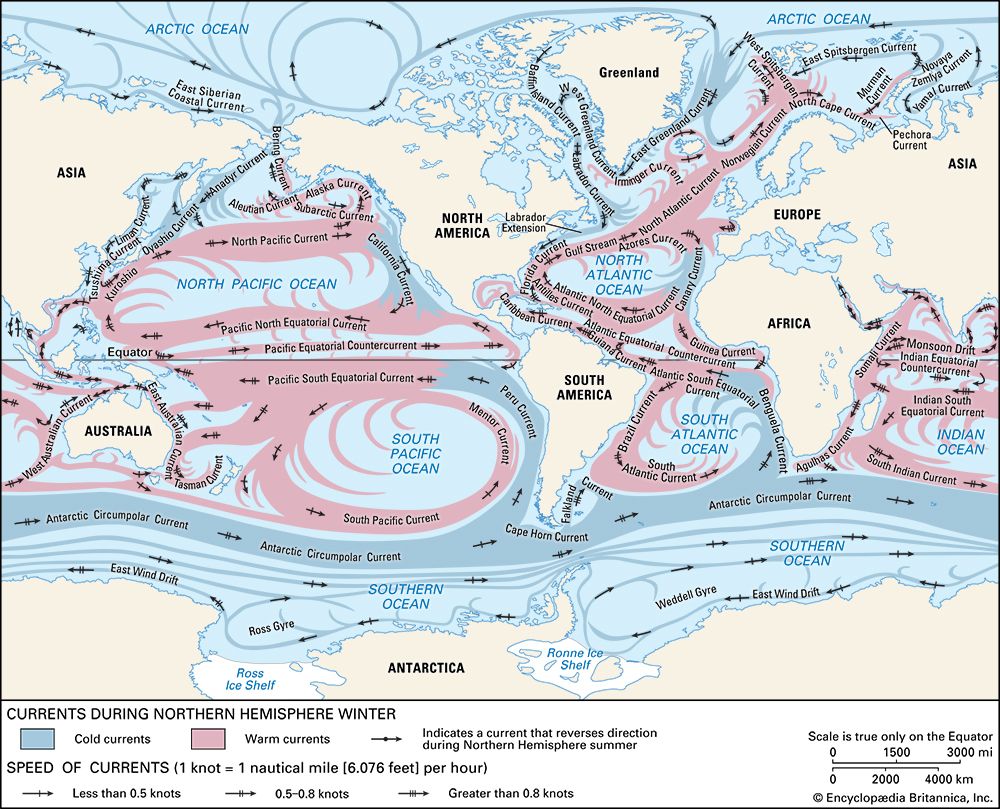
The East Korea Warm Current is a surface oceanic current that serves as a northward-flowing branch of the Tsushima Current within the Sea of Japan within the Sea of Japan.1
After traveling along the coast of Korea, this current turns eastward, where it eventually divides into two distinct paths:
- The Tsugaru Warm Current, which flows into the Pacific Ocean via the Tsugaru Strait.2
- The Sōya Warm Current, which enters the Sea of Okhotsk through the La Perouse Strait and continues southeast along the coasts of Honshu and Hokkaido.2
The influence of such currents is significant for regional geography; for instance, they contribute to the fact that winter temperatures on the east coast of the Korean peninsula are notably higher than those on the west coast.3
What is the Kuroshio Current and how does it influence the region?
The Kuroshio (or “Black Current”) is a powerful, warm surface oceanic current in the Pacific Ocean. It acts as the northeasterly continuation of the Pacific North Equatorial Current, flowing between Luzon in the Philippines and the east coast of Japan.4
Regional Influence
The Kuroshio plays a critical role in shaping the climate of the region:
- Warming Effect: Similar to the Gulf Stream in the Atlantic, the Kuroshio has a significant warming effect on the south and southeast coastal regions of Japan, extending as far north as Tokyo.45
- Current Branching: Off the coast of southern Kyushu, the current branches westward to form the Tsushima Current, which flows into the Sea of Japan and influences the moisture levels of the winter monsoon.45
- Atmospheric Interaction: Where the warm waters of the Kuroshio meet the cold Oya Current off northeastern Japan, the temperature contrast frequently causes dense sea fogs during the summer.5
How do ocean currents affect marine biodiversity in the Sea of Japan?
Ocean currents in the Sea of Japan are fundamental to its high biological productivity and the health of its fisheries. The sea’s circulation is characterized by a counterclockwise pattern involving both warm and cold water masses, which creates a dynamic environment for marine life.1
The Tsushima Current—a branch of the Kuroshio—and its northern extension, the East Korea Warm Current, bring warmer, more saline water into the region. Simultaneously, cold currents such as the Liman and North Korea currents transport cooler, fresher water southward along the Asian mainland.41
This interaction of distinct water masses facilitates the formation of a thermocline in summer and supports the creation of deep water in winter, which helps maintain high concentrations of dissolved oxygen. These physical processes are vital for marine biodiversity, as currents generally act to transport nutrients and organisms, including larvae, across vast distances. By regulating temperature and nutrient distribution, these currents sustain the complex ecosystems that support the sea’s abundant marine life.127
What are the primary differences between warm and cold ocean currents?
Ocean currents are primarily categorized by their temperature relative to the surrounding waters, which significantly influences global climate and marine ecosystems.
Warm Ocean Currents
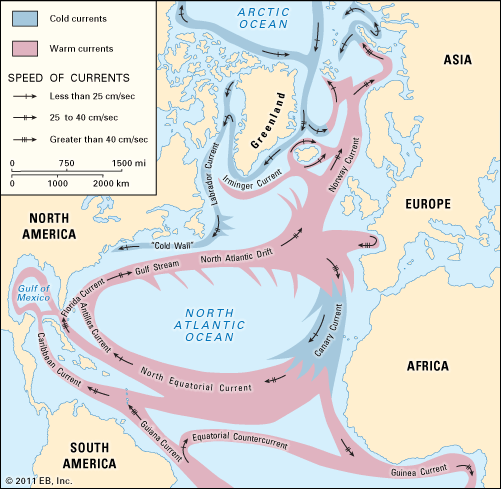
Warm currents typically originate in tropical regions and flow toward higher latitudes, acting as a mechanism for the poleward transfer of heat.116
- Characteristics: These currents are often “western boundary currents,” meaning they flow along the eastern coasts of continents. They are typically narrow, deep, and fast-moving, often reaching speeds of 2 to 4 meters per second.126
- Impact: By transporting excess heat from the tropics, they moderate the climates of coastal regions in higher latitudes. A prominent example is the Gulf Stream, which significantly warms northwestern Europe.1113
Cold Ocean Currents
Cold currents generally originate in polar or subpolar regions and flow toward the equator.12
- Characteristics: These are often “eastern boundary currents” that flow along the western coasts of continents. They are typically broad, shallow, and move much more slowly than their warm counterparts, often at speeds rarely exceeding 10 centimeters per second.126
- Impact: These currents often draw water from cold, deep sources, such as the Antarctic Circumpolar Current. They are frequently associated with coastal upwelling, which brings nutrient-rich water to the surface, supporting high biological productivity.126
Sources
- East Korea Warm Current — Encyclopædia Britannica
- Tsushima Current — Encyclopædia Britannica
- North Korea - Climate — Encyclopædia Britannica
- Kuroshio — Encyclopædia Britannica
- Japan - Climate — Encyclopædia Britannica
- Climate - The Kuroshio — Encyclopædia Britannica
- Sea of Japan / East Sea - Hydrology — Encyclopædia Britannica
- Marine ecosystem - Ocean currents — Encyclopædia Britannica
- Korea Strait — Encyclopædia Britannica
- How Do Ocean Currents Affect the Biosphere? — Encyclopædia Britannica
- ocean current - Distribution of ocean currents — Encyclopædia Britannica
- Climate - Circulation, currents, and ocean-atmosphere interaction — Encyclopædia Britannica
- ocean current - The subtropical gyres — Encyclopædia Britannica
Published on · 3 min read