Flowering Rush
The flowering rush (Butomus umbellatus) is a perennial freshwater plant native to Eurasia. It is the sole member of the family Butomaceae within the order…
What is flowering rush?
The flowering rush (Butomus umbellatus) is a perennial freshwater plant native to Eurasia. It is the sole member of the family Butomaceae within the order Alismatales.1
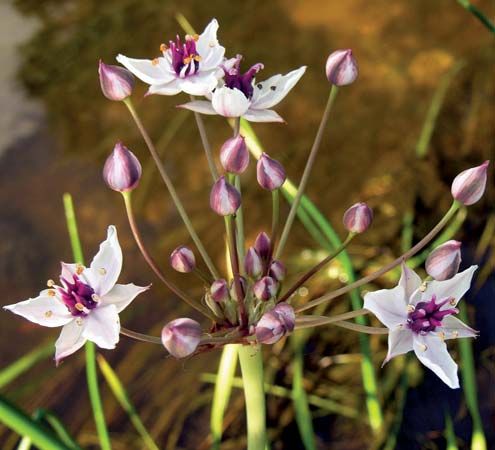
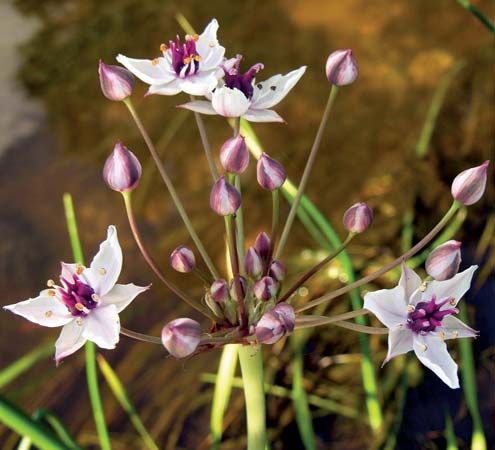
While it can grow fully submerged, it is most frequently found emerging from water. These emergent plants feature long, tapering leaves that reach approximately 1 meter (39 inches) in height and are distinctively triangular in cross section. The plant produces rose-colored flowers arranged in umbels, which consist of three sepals and three petals.1
Although the plant can produce dry fruits, it often reproduces through the release of bulblets from its root system. While native to Europe, the species has become naturalized in various regions of the north temperate zone, where it is often considered a weed.12
Why is flowering rush considered an invasive species in North America?
The flowering rush (Butomus umbellatus) is considered an invasive species in North America because it is a non-native plant from Eurasia that has successfully naturalized in local waterways, such as those adjacent to the St. Lawrence River.12
Its status as a weed is driven by its aggressive reproductive strategy. While the plant can produce seeds, it primarily spreads through the prolific production of bulblets that break off from its root system. This ability to propagate vegetatively allows it to colonize new areas rapidly, often outcompeting native vegetation in freshwater habitats. Once established, its dense growth can alter the structure of aquatic environments, leading to its classification as an invasive nuisance in many regions of the north temperate zone.1
What are the differences between native and invasive aquatic plants?
The primary distinction between native and invasive aquatic plants lies in their evolutionary history and their impact on the ecosystem. Native plants have evolved within a specific region, maintaining a balanced role within their local food web and habitat.3
In contrast, invasive species are non-native organisms that disrupt the ecosystems they colonize. While most introduced species fail to survive in new environments, invasive plants possess competitive advantages—such as a lack of natural predators—that allow them to thrive and spread aggressively.3
Key differences include:
- Resource Competition: Invasive plants often outcompete native species for essential resources like food, light, and living space, frequently leading to the localized extinction of native flora.3
- Ecosystem Disruption: Invasive species can significantly modify habitats, reduce biodiversity, and act as vectors for diseases or parasites.3
- Introduction: Native plants are indigenous to an area, whereas invasive species are typically introduced through human activities, such as global commerce or the pet trade.34
How do bulblets help plants spread in water?
Bulblets facilitate the spread of certain aquatic plants, such as the flowering rush, by serving as a primary mechanism for vegetative reproduction.
Unlike sexual reproduction, which relies on seeds, these bulblets are structures that readily break off from the plant’s root system. Once detached, they can be transported through the water to new locations, where they are capable of establishing new populations. This method of propagation allows the plant to colonize freshwater habitats rapidly and efficiently, often bypassing the need for successful seed production.1
Sources
- flowering rush — Encyclopædia Britannica
- flowering rush — Merriam-Webster
- invasive species — Encyclopædia Britannica
- Wetland - Disturbances caused by humans — Encyclopædia Britannica
- aquatic plant — Merriam-Webster
- Algae - Reproduction and life histories — Encyclopædia Britannica
Published on · 2 min read