Graptolite
The name "graptolite" is derived from the Greek word graptos, meaning "painted" or "written," which originates from the verb graphein (to write or paint).…
What does the name ‘graptolite’ mean and how does it relate to their appearance?
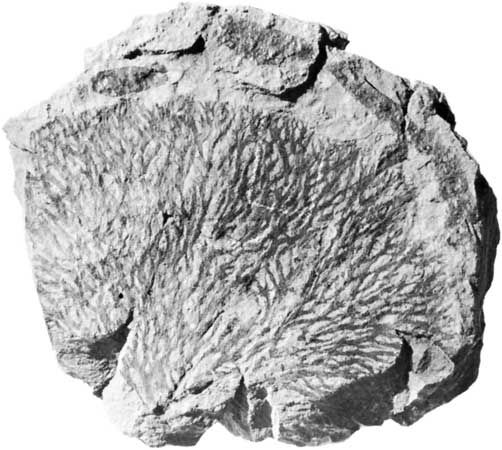
The name “graptolite” is derived from the Greek word graptos, meaning “painted” or “written,” which originates from the verb graphein (to write or paint). This etymology directly reflects their appearance in the fossil record: graptolites are most frequently preserved as carbonaceous impressions on black shales. Because these fossils often appear as flattened, dark, pencil-like markings on the surface of the rock, they resemble writing or drawings, hence the name.12
These extinct hemichordate colonial animals possessed a chitinous outer covering rather than mineralized hard parts. While their appearance can vary—ranging from simple, branch-like structures to distinct, leaflike forms such as those seen in the genus Phyllograptus—their characteristic “written” look is a result of how they are compressed within sedimentary layers.123
What can graptolite fossils tell us about ancient ocean environments and climate?
Graptolite fossils are highly valuable for reconstructing ancient marine environments and geological history. Because these colonial, planktonic animals were free-floating, they were widely distributed across the oceans, making them excellent index fossils for correlating rock units across vast distances.24
Their presence is particularly indicative of specific depositional settings. Graptolites are most abundantly preserved in dark, shaley facies, which typically represent deeper-water marine environments. These carbonaceous impressions are found in formations such as the Road River Group in the Yukon and the Longmaqi Formation in southern China, where the lack of oxygen in deep-water settings often favored the preservation of their protein-based exoskeletons.2
While graptolites are essential for defining biozones and providing precise stratigraphic correlation—sometimes within intervals of one million years or less—their utility is most pronounced in these deep-water settings. Consequently, they serve as a primary tool for geologists to map the spatial and temporal extent of ancient deep-sea basins during the Paleozoic Era.25
How did graptolites become extinct and what factors contributed to their decline?
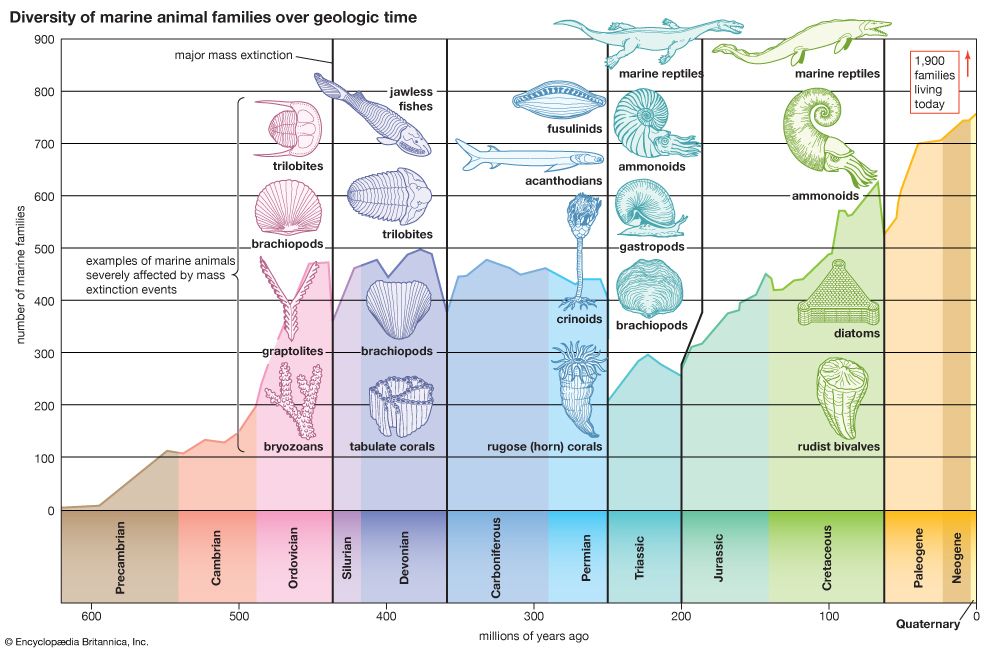
Graptolites were a long-lived group of colonial animals that persisted from the Cambrian Period until the Early Carboniferous Period. Their decline and eventual extinction were not the result of a single event but were driven by a combination of environmental stresses and climatic shifts throughout the Paleozoic Era.267
Key Factors in Their Decline
- Sea Level Fluctuations: During the Silurian Period, graptolites experienced multiple extinction events—with 52 to 79 percent of these planktonic animals disappearing—that were closely linked to drops in sea level. These regressions reduced available habitats and disrupted the environments these organisms relied upon.8
- Environmental Stress and Anoxia: Graptolites were highly sensitive to the conditions of the marine water column. Periods of widespread hypoxic or anoxic sedimentation—often caused by high global temperatures that slowed the mixing of ocean layers—created significant environmental stress. This lack of oxygen in deep-water settings, while sometimes aiding in the preservation of their fossils in black shale, was detrimental to the survival of many marine species.67
- Climatic Extremes: Rapid shifts between global warming and cooling, including periods of glaciation, significantly impacted graptolite populations. For instance, the Ordovician-Silurian extinction involved multiple phases of climate-driven stress, including global cooling and sea-level changes that drained epicontinental seas.9
- Faunal Turnover: Specific extinction episodes, such as the Lower Zlichov Event in the Devonian Period, are directly associated with the extinction of the graptoloids and the subsequent rise of other marine groups, such as coiled cephalopods.67
How have modern technologies improved our understanding of graptolite fossils?
Modern technologies have significantly enhanced our ability to study graptolite fossils, particularly by overcoming the limitations of traditional preservation. While many specimens are found as flattened, carbonaceous impressions on black shale where fine anatomical details are often lost, researchers now utilize advanced imaging and extraction techniques to analyze fossils found in limestone.
In these limestone environments, graptolites are often preserved in a three-dimensional, uncompressed state. By using acid-digestion methods to dissolve the surrounding rock matrix, scientists can recover delicate, chitinous structures that were previously inaccessible. These uncompressed fossils allow for a much more detailed examination of the animal’s morphology, including the structure of their tentacles and the complex organization of their colonies. These insights have been instrumental in refining our understanding of their evolutionary relationships and their classification as primitive hemichordates.
Sources
- graptolite — Merriam-Webster
- graptolite — Encyclopædia Britannica
- Phyllograptus — Encyclopædia Britannica
- Silurian Period - Graptolites — Encyclopædia Britannica
- Diplograptus — Encyclopædia Britannica
- Devonian extinctions — Encyclopædia Britannica
- Silurian Period - Silurian extinctions — Encyclopædia Britannica
- Ordovician-Silurian extinction — Encyclopædia Britannica
- Devonian Period - Extinction events — Encyclopædia Britannica
- Jurassic Period - Protists and invertebrates — Encyclopædia Britannica
- Cretaceous Period - Marine life — Encyclopædia Britannica
Published on · 3 min read