Hairstreak
The hairstreak butterfly, a member of the gossamer-winged butterfly family (Lycaenidae), undergoes complete metamorphosis, which consists of four distinct…
What is the life cycle of a hairstreak butterfly, from egg to adult?
The hairstreak butterfly, a member of the gossamer-winged butterfly family (Lycaenidae), undergoes complete metamorphosis, which consists of four distinct stages: egg, larva, pupa, and adult (imago).12
- Egg: The life cycle begins when an adult female lays eggs on a host plant.1
- Larva: Upon hatching, the larva (caterpillar) emerges. Hairstreak larvae are typically short, broad, and sluglike. While many feed on plant material, some species are carnivorous, consuming aphids or ant larvae. Notably, some larvae possess special glands that secrete honeydew, which attracts ants that “milk” the larvae for this substance.34
- Pupa: The larva eventually enters the pupal stage, forming a chrysalis. Unlike moths, most butterflies do not form cocoons; instead, the hairstreak pupa is often supported in a head-up position by a threadlike silk girdle wrapped around its body.5
- Adult: Inside the chrysalis, the insect undergoes a total transformation, eventually emerging as a delicate adult with characteristic hairlike markings on its wings.352
How do hairstreak butterflies get their name, and what unique physical features do they possess?
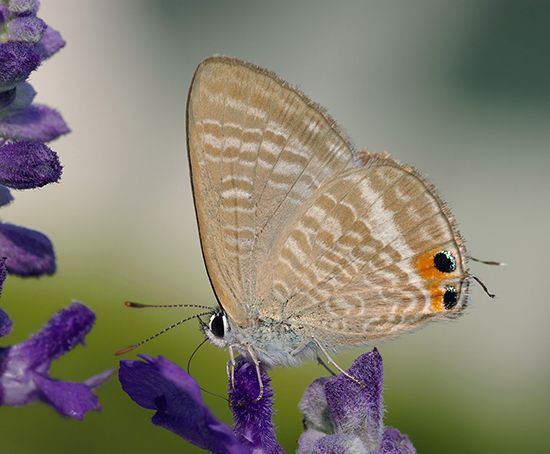
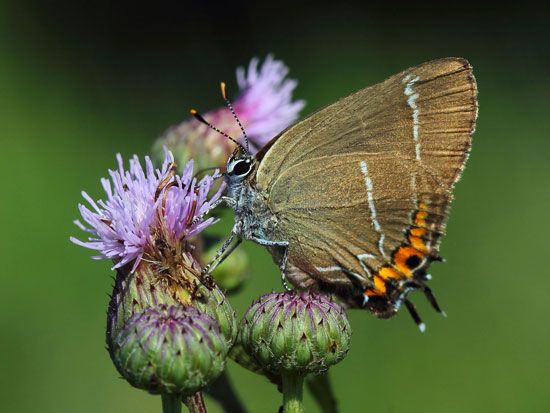
Hairstreak butterflies, which belong to the subfamily Theclinae within the gossamer-winged butterfly family (Lycaenidae), derive their common name from the distinct, hairlike or striped markings found on the underside of their wings.15
These butterflies possess several unique physical features that aid in their survival:
- Wing Markings and Extensions: In addition to the characteristic hairlike streaks on the underwings, many species feature thin, taillike extensions on their hind wings. These filaments, often accompanied by false eye-markings, serve as decoys for predators, drawing attacks toward less vulnerable parts of the body.1567
- Iridescence: The upper surfaces of the wings, particularly in males, are typically brightly colored and iridescent, often appearing in shades of gray or brown.16
- Size and Build: They are small, delicate insects with a wingspan typically ranging from 18 to 38 mm (0.75 to 1.5 inches).1
- Sexual Dimorphism: The physical structure of their legs differs between sexes; the male’s forelegs are reduced, while the female’s are fully developed.1
When disturbed, these butterflies often take flight, exposing their brightly colored upper wing surfaces to startle potential predators before disappearing back into their surroundings.7
What are some common species of hairstreak butterflies, and how do they differ from each other?
While the term “hairstreak” refers to a broad group of insects within the subfamily Theclinae, specific species are often categorized by their unique behaviors, host plants, or geographic distribution. The provided search results focus primarily on the general characteristics of the group rather than a comprehensive list of distinct species and their comparative differences.
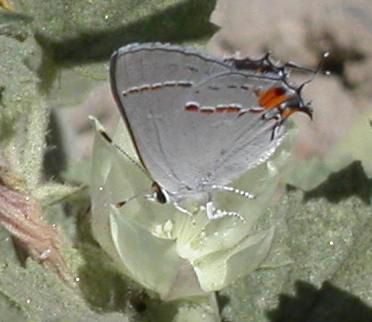
However, one notable species is the gray hairstreak (Strymon melinus), which is distinguished from other hairstreaks by its economic impact. Unlike many of its relatives, the larva of the gray hairstreak is known to bore into the fruit and seeds of various plants, making it the only species in this group of recognized economic significance.1
Beyond this, hairstreaks generally share common traits such as:
- Physicality: Small, delicate builds with wingspans between 18 and 38 mm.1
- Markings: Characteristic hairlike streaks on the underside of the wings and often thin, taillike extensions on the hind wings.15
- Larval Behavior: While many larvae feed on plant material, others are carnivorous, and some maintain symbiotic relationships with ants by secreting honeydew.15
Because the available data does not provide a detailed comparative analysis of other specific species, I cannot elaborate further on their individual differences.
What are the key characteristics that distinguish hairstreak butterflies from other butterfly species?
Hairstreak butterflies, members of the subfamily Theclinae within the gossamer-winged butterfly family (Lycaenidae), are distinguished from other butterflies by several specific physical and behavioral traits:
- Wing Markings: They are named for the characteristic hairlike or striped markings found on the underside of their wings.1
- Hind Wing Extensions: Many species possess one or more thin, taillike extensions on their hind wings. These are often accompanied by false eye-markings, which serve as decoys to divert predators toward less vulnerable parts of the body.15
- Size and Build: They are small and delicate, typically featuring a wingspan between 18 and 38 mm (0.75 to 1.5 inches).1
- Coloration: While many butterflies are known for vibrant colors, hairstreaks are often more humble in appearance, typically displaying iridescent shades of gray or brown on their upper wing surfaces.18
- Sexual Dimorphism: A structural difference exists in their legs; the male’s forelegs are reduced, whereas the female’s are fully developed.1
Additionally, their larvae are distinctively short, broad, and sluglike, with some species maintaining symbiotic relationships with ants by secreting honeydew.1
Sources
- hairstreak — Encyclopædia Britannica
- butterfly — Encyclopædia Britannica
- Lepidoptera - Pupa , or chrysalis — Encyclopædia Britannica
- pupa — Encyclopædia Britannica
- gossamer-winged butterfly — Encyclopædia Britannica
- Lepidoptera - Protection against danger — Encyclopædia Britannica
- hairstreak — Merriam-Webster
- What’s the difference between moths and butterflies? — Encyclopædia Britannica
Published on · 4 min read