Metalmark
A metalmark is a small to medium-sized butterfly belonging to the family Riodinidae (or the subfamily Riodininae within the gossamer-winged butterfly family…
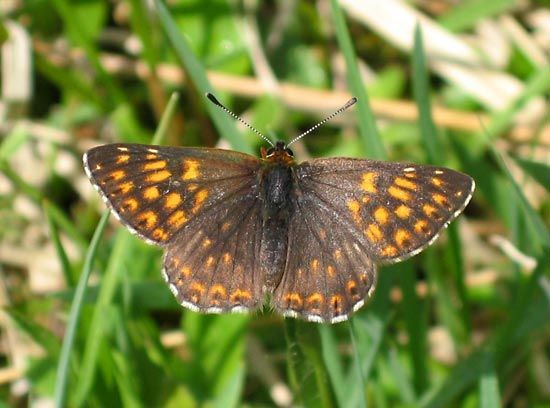
What is metalmark?
A metalmark is a small to medium-sized butterfly belonging to the family Riodinidae (or the subfamily Riodininae within the gossamer-winged butterfly family, Lycaenidae). These insects are primarily found in the New World tropics, particularly in South America.123
They are named for the characteristic metallic spots or markings often found on their wings. Because many species have evolved to mimic other butterflies, they display a wide variety of wing shapes and colors, making them sometimes difficult to identify. In this family, males typically possess reduced front legs, while females have functional ones. Their larvae are generally broad, flat, and hairy, and they are known to feed on plants such as ragwort and thistles.123
How do butterflies use mimicry to protect themselves?
Butterflies and other Lepidoptera utilize several forms of mimicry to protect themselves from predators by exploiting the predator’s learning processes and visual recognition.456
Primary Types of Mimicry
- Batesian Mimicry: In this form, a harmless or edible species evolves to resemble a dangerous or inedible “model” species. For example, many butterflies mimic stinging wasps or toxic butterflies. Predators that have learned to avoid the model will also avoid the harmless mimic, providing the mimic with a significant survival advantage.56
- Müllerian Mimicry: This occurs when two or more inedible or noxious species evolve to share similar warning patterns. Because predators must learn to avoid these species through trial and error—often at the cost of the individual sampled—sharing a common appearance spreads the “cost” of educating the predator population across multiple species, reducing the total number of individuals lost to predation.47
- Automimicry: Some species gain protection through the resemblance of certain individuals to others within the same species. For instance, some butterflies may be protected if they resemble other members of their own species that have sequestered toxins from their host plants, even if the individual mimic itself is not toxic.8
What are the main differences between butterfly families?
Butterflies are classified within the superfamily Papilionoidea, which includes several distinct families. While they share common traits like clubbed antennae and diurnal habits, they differ in physical characteristics, larval behavior, and evolutionary development.
The main butterfly families include:
- Papilionidae: Known as swallowtails and parnassians, these are often medium to large and brightly colored. Many species feature tail-like extensions on their hindwings. Their larvae often possess eversible, protective scent organs called osmeteria.91011
- Pieridae: Commonly called whites, sulfurs, and orange-tips, these are small to medium-sized butterflies. They are typically white, yellow, or orange and are well-known for their mass migration behaviors.1011
- Lycaenidae: This diverse family includes blues, coppers, hairstreaks, and metalmarks. Many species are small and iridescent. Their larvae are often sluglike and frequently maintain mutualistic relationships with ants, sometimes even preying on ant broods.1011
- Nymphalidae: The largest and most diverse family, including monarchs, admirals, and fritillaries. They are characterized by reduced, brush-like forelegs that are useless for walking.1011
- Hesperiidae: Known as skippers, these are distinguished by their fast, darting flight, broad heads, and antennae that are often hooked beyond the club.1011
An evolutionary trend across these families is the reduction of the forelegs, moving from fully developed legs in Pieridae and Papilionidae to greatly reduced, non-functional legs in Nymphalidae.11
What is the life cycle of a butterfly?
Butterflies undergo a process known as complete metamorphosis, which consists of four distinct stages: egg, larva, pupa, and adult.13
- Egg: Females typically lay eggs on or near a specific food plant. The number of eggs can range from fewer than a hundred to over a thousand, depending on the species. Development is often timed through diapause to ensure the larva emerges when conditions are favorable.14
- Larva: Commonly known as a caterpillar, this stage is primarily focused on growth and development. The larva differs significantly from the adult in form and habits, often possessing specialized adaptations for feeding.1315
- Pupa: In this resting stage, the caterpillar undergoes a dramatic transformation. Most butterflies form a chrysalis, a protective covering where larval tissues break down and adult structures, such as wings, develop.1617
- Adult: The mature butterfly emerges from the pupal skin. After emerging, it must spend time drying its wings before it is capable of flight. The primary goal of the adult stage is reproduction.18
Sources
- metalmark — Encyclopædia Britannica
- metalmark — Merriam-Webster
- Riodinidae — Merriam-Webster
- mimicry - Müllerian mimicry — Encyclopædia Britannica
- mimicry - Automimicry — Encyclopædia Britannica
- mimicry - Batesian mimicry — Encyclopædia Britannica
- Lepidoptera - Protection against danger — Encyclopædia Britannica
- Müllerian mimicry — Merriam-Webster
- swallowtail butterfly — Encyclopædia Britannica
- butterfly — Encyclopædia Britannica
- Lepidoptera - Annotated classification — Encyclopædia Britannica
- What’s the difference between moths and butterflies? — Encyclopædia Britannica
- pupa — Encyclopædia Britannica
- Lepidoptera - Pupa , or chrysalis — Encyclopædia Britannica
- Metamorphosis — Encyclopædia Britannica
- Monarch butterfly - Life cycle — Encyclopædia Britannica
- Lepidoptera - Egg — Encyclopædia Britannica
- Animal development - The larval phase and metamorphosis — Encyclopædia Britannica
Published on · 3 min read