Heartwood
Heartwood is the dead, central portion of a tree's wood. As a tree grows in diameter, the older, inner layers of xylem cease to participate in the transport…
What is heartwood?
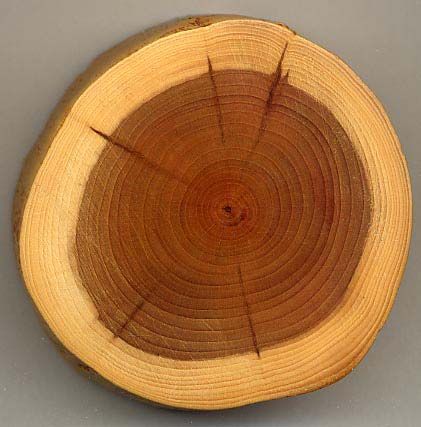
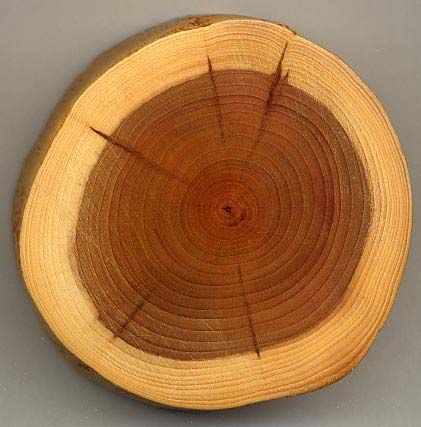
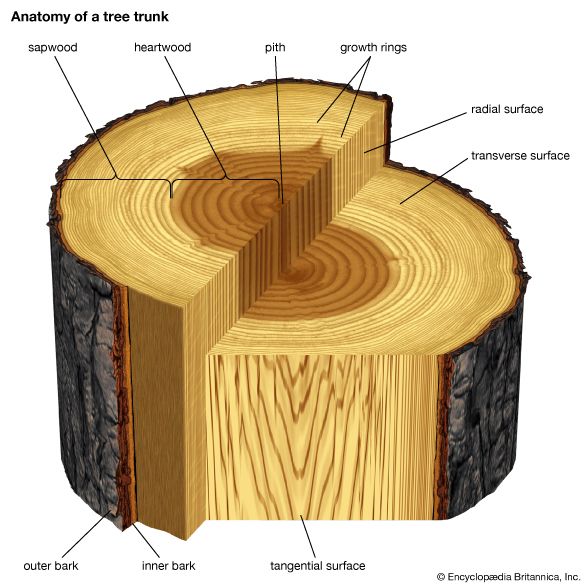
Heartwood is the dead, central portion of a tree’s wood. As a tree grows in diameter, the older, inner layers of xylem cease to participate in the transport and storage of water and nutrients, eventually transitioning into heartwood.123
While the surrounding sapwood remains active in the tree’s life processes, heartwood serves primarily as a structural support. Its cells often accumulate tannins or other substances, which can make the wood aromatic and darker in color, though this color change does not occur in all species. Because of its composition, heartwood is mechanically strong and highly resistant to decay, making it less permeable to wood-preservative chemicals than sapwood. In all tree species, heartwood eventually forms as the tree matures.12
What is the role of sapwood in a tree?
Sapwood consists of the younger, outer layers of a tree’s secondary wood that remain physiologically active. Its primary role is the transport of water and dissolved minerals from the roots to the crown of the tree. Additionally, sapwood participates in the storage of nutrients necessary for the tree’s life processes.4523
Because these cells are actively involved in conduction, they contain more water and lack the dark chemical deposits characteristic of heartwood. Structurally, sapwood is typically softer, paler, and more permeable than the inner heartwood. As a tree grows in diameter, the older, inner layers of sapwood eventually cease their transport and storage functions, transitioning into heartwood to provide structural support.4532
How do tannins help protect heartwood from decay?
Tannins contribute to the durability of heartwood by acting as toxic extractives that inhibit the growth and activity of wood-decaying organisms.71
While decay is not an innate property of wood, it occurs when environmental conditions—specifically moisture, air, and temperature—are suitable for fungi and other decomposers to thrive. Tannins, which are phenolic compounds sequestered within the plant’s cells, serve as natural chemical defenses. These compounds are known to be astringent and can form insoluble precipitates, which help deter herbivores and impede the biological processes of organisms that would otherwise break down the wood structure.18
Although these toxic extractives provide a significant delaying factor against decay, they do not render wood entirely immune to degradation. The presence of these substances is a primary reason why different tree species exhibit varying levels of natural resistance to rot and insect attack.1
What is the function of xylem in plants?
Xylem is a specialized vascular tissue found in all vascular plants that serves two primary functions: the transport of water and dissolved minerals from the roots to the rest of the plant, and the provision of physical support.3
Mechanisms of Transport
Water movement through xylem occurs passively along a gradient of decreasing pressure. While root pressure can push water upward under specific conditions—such as in early spring or in certain herbaceous plants—the primary force driving water ascent is transpiration. As water evaporates from the leaves, it creates a tension that pulls the water column upward through the xylem vessels and tracheids. This process, known as the cohesion theory, relies on the ability of water molecules to adhere to the vessel walls and cohere to one another, allowing the column to withstand significant tension without breaking.5
Structural Composition
Xylem tissue is composed of several cell types:
- Tracheary elements: Narrow, hollow, and elongated cells (tracheids and vessel members) that conduct water.3
- Fibre cells: Provide structural support to the plant.3
- Parenchyma: Thin-walled cells responsible for the storage of various substances.3
In woody plants, secondary xylem forms the bulk of the stem. As the plant grows, the outer layers, or sapwood, remain active in conduction, while the inner heartwood becomes a dead, structurally rigid skeleton.3
Sources
- heartwood — Encyclopædia Britannica
- wood - Heartwood and sapwood — Encyclopædia Britannica
- Xylem — Encyclopædia Britannica
- Sapwood — Encyclopædia Britannica
- Angiosperm - Process of xylem transport — Encyclopædia Britannica
- sapwood — Merriam-Webster
- tannin — Encyclopædia Britannica
- wood - Degradation — Encyclopædia Britannica
Published on · 3 min read