Sapwood
Sapwood refers to the outer, living layers of the secondary wood in a tree. It consists of the newer growth rings and is actively involved in the life…
What is Sapwood?
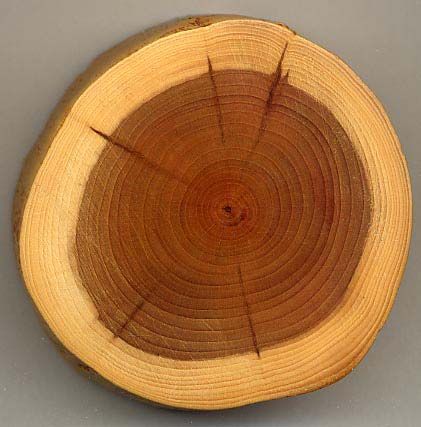
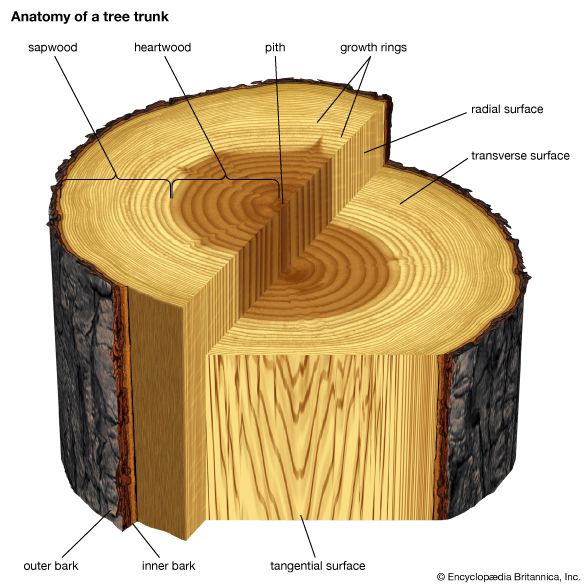
Sapwood refers to the outer, living layers of the secondary wood in a tree. It consists of the newer growth rings and is actively involved in the life processes of the tree, specifically the transport and storage of water and minerals from the roots to the crown.12
Because it is physiologically active, sapwood is typically paler and softer than the inner, non-conducting wood known as heartwood. While heartwood is often darker due to the accumulation of chemical deposits, sapwood lacks these substances and contains a higher water content. As a tree grows in diameter, the older, inner layers of sapwood eventually cease their transport functions and transition into heartwood. In cross sections of a tree trunk, this distinction between the peripheral sapwood and the central heartwood is often visible, though the clarity of this boundary varies significantly between different species.12
What is the role of xylem in a tree?
Xylem is a vital vascular tissue in trees responsible for two primary functions: the transport of water and dissolved minerals from the roots to the rest of the plant, and the provision of physical structural support.3
The tissue is composed of specialized cells called tracheary elements—specifically tracheids and vessel members—which are hollow and elongated to facilitate fluid movement. In mature trees, xylem is categorized by its development:
- Primary Xylem: Formed at growing tips, these cells eventually die to create a hard, supportive skeleton.3
- Secondary Xylem: As a tree grows in girth, it produces this layer. The outer portion, known as sapwood, remains active in water conduction, while the inner portion, or heartwood, provides structural strength.3
Additionally, xylem contains fiber cells for added support and parenchyma for storage. In temperate climates, the annual production of these rings allows for the determination of a tree’s age.3
How do annual growth rings form in trees?
Growth rings, also known as growth increments, form in trees primarily due to the seasonal “awakening” of the vascular cambium, a layer of meristematic cells responsible for secondary growth.45
In temperate regions, this process typically results in one ring per year. At the start of the growing season, the cambium produces cells that form the earlywood. These cells are characterized by larger diameters and thinner walls, which facilitate rapid water conduction. As the season progresses, the cambium produces latewood, which consists of cells with smaller diameters and thicker walls, providing greater structural support. The contrast between the dense, thick-walled latewood of one season and the large-diameter, thin-walled earlywood of the next creates the visible boundary of a growth ring.46
While often called “annual rings,” ring formation is actually a response to cyclic environmental conditions, such as fluctuations in water availability. Variations like “false rings” can occur if the growing season is interrupted by events like drought, which may cause the tree to temporarily produce latewood-like cells before resuming normal growth.47
What makes heartwood stronger than sapwood?
Heartwood is stronger and more durable than sapwood primarily due to the chemical changes that occur as the tree matures. As the inner layers of sapwood cease their role in transporting water and nutrients, they are converted into heartwood, a process that involves the infiltration of the cell walls with various chemical substances, such as tannins and other extractives.821
These deposits serve several critical functions:
- Enhanced Durability: The presence of these extractives makes heartwood significantly more resistant to decay and biological attacks from fungi and insects compared to the more vulnerable, nutrient-rich sapwood.8910
- Structural Integrity: The accumulation of these substances, combined with the fact that heartwood cells are dead and no longer participate in active transport, results in a denser, mechanically stronger material.81
- Chemical Resistance: Because of these internal deposits, heartwood is less easily penetrated by moisture and wood-preservative chemicals, further contributing to its longevity and stability.8
While sapwood remains lighter and softer because it is actively involved in the tree’s life processes, heartwood provides the essential structural foundation for the tree.21
Sources
- Sapwood — Encyclopædia Britannica
- wood - Heartwood and sapwood — Encyclopædia Britannica
- Xylem — Encyclopædia Britannica
- Tree - Growth ring formation — Encyclopædia Britannica
- dendrochronology — Encyclopædia Britannica
- wood - Earlywood , latewood , and pores — Encyclopædia Britannica
- Tree - General features of the tree body — Encyclopædia Britannica
- heartwood — Encyclopædia Britannica
- wood - Extractives — Encyclopædia Britannica
- wood - Degradation — Encyclopædia Britannica
Published on · 3 min read