How Do Snakes Swallow Large Prey?
Snakes are able to consume prey significantly larger than their own heads due to their highly specialized, flexible skulls. Unlike most vertebrates, a…
How do snakes swallow large prey?
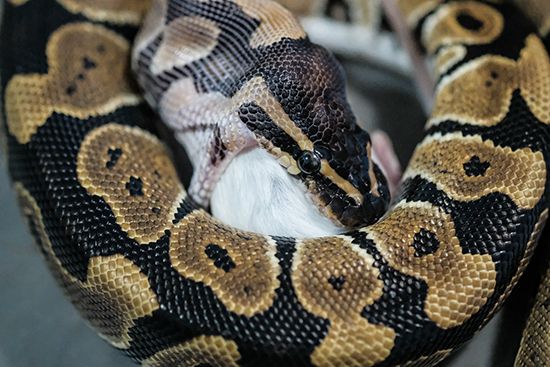
Snakes are able to consume prey significantly larger than their own heads due to their highly specialized, flexible skulls. Unlike most vertebrates, a snake’s skull consists of multiple bones connected by elastic ligaments and muscles, allowing for independent movement of the jaw segments.12
The two halves of the lower jaw are not fused at the chin, which enables them to move separately. Most snakes utilize a method called “walk feeding,” where they “walk” their jaws over the prey. In this process, one side of the jaw is disengaged and moved forward to gain a new grip, while the other sides hold the prey in place. This cycle repeats, gradually pulling the food into the throat.12
Additionally, snake teeth are typically long and recurved, which helps secure the prey and prevents it from escaping while the snake maneuvers its jaws. This remarkable anatomical flexibility allows the snake to expand its mouth and throat to engulf items several times its own diameter.21
How do snakes digest such large meals after swallowing them?
The provided search results do not contain information regarding the physiological or chemical processes snakes use to digest large meals after they have been swallowed. The available documentation focuses exclusively on the morphological and behavioral specializations snakes use to capture and ingest prey, such as their flexible skull structures, jaw mechanics, and sensory organs.
What is the difference between constriction and venomous hunting?
Snakes have evolved distinct strategies to secure food, primarily categorized into constriction and venomous hunting. These methods reflect different evolutionary adaptations for capturing and immobilizing prey.4
Constriction
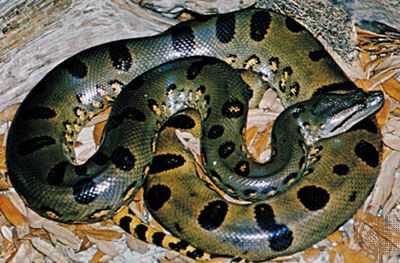
Constriction is a method used by many colubrids and nearly all boids, such as anacondas and boa constrictors. In this process:34
- The snake strikes and secures the prey with its teeth.4
- It rapidly throws a series of body coils around the prey.4
- The coils tighten until the prey can no longer breathe, leading to suffocation.4
- Contrary to popular belief, this method rarely results in crushed or broken bones; rather, it causes organ failure by cutting off blood flow.34
Venomous Hunting
Venomous snakes utilize specialized salivary glands to produce potent toxins, which are delivered through grooved or tubular fangs. This method allows for rapid immobilization:4
- Injection: Depending on the species, snakes may possess long tubular fangs (like viperids), short fixed fangs (like elapids), or rear-facing grooved teeth.4
- Effect: Venom components can cause coagulation defects, blood-vessel injury, and deleterious changes to the heart, respiratory system, and motor functions.4
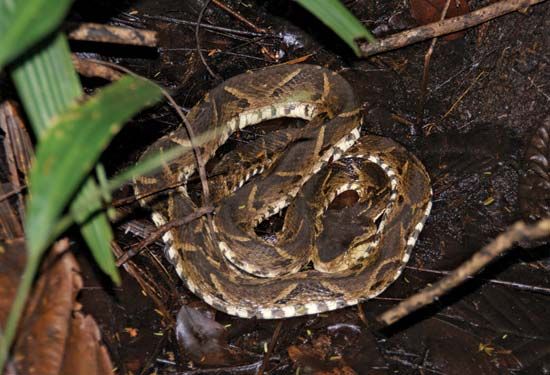
- Strategy: Some snakes, such as the fer-de-lance, use fast-acting venom to prevent prey from escaping. Others may bite and release, later tracking the prey using their tongue and Jacobson’s organ until the animal succumbs.4
How do snakes breathe while their mouths are full of prey?
Snakes are able to breathe while consuming large prey because of a specialized anatomical adaptation involving the glottis, which serves as the opening to their respiratory tract.
In most animals, the airway can be obstructed during the swallowing process. However, in snakes, the glottis is located at the floor of the mouth, just behind the tongue. When a snake begins to swallow a large meal, it can extend this tube-like structure forward, protruding it out of the mouth and past the prey item. This allows the snake to continue drawing air into its trachea and lungs even while its mouth and throat are completely occupied by food.3
This mechanism ensures that the snake does not suffocate during the often lengthy process of “walk feeding,” where the snake’s independent jaw arches gradually pull the prey down its esophagus.21
Sources
- How do snakes swallow large prey? — Encyclopædia Britannica
- snake - Skull and sense organs — Encyclopædia Britannica
- snake - Specializations for securing food — Encyclopædia Britannica
- What are the differences between anacondas and boa constrictors? — Encyclopædia Britannica
- What are the differences between pythons and boa constrictors? — Encyclopædia Britannica
- scorpion - Venoms — Encyclopædia Britannica
- larynx — Encyclopædia Britannica
Published on · 3 min read