What Are the Differences Between Anacondas and Boa Constrictors?
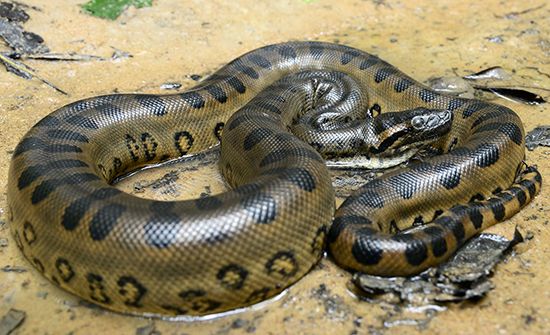
Anacondas and boa constrictors are both nonvenomous constricting snakes, but they differ significantly in size, habitat, and hunting behavior.
What are the differences between anacondas and boa constrictors?
Anacondas and boa constrictors are both nonvenomous constricting snakes, but they differ significantly in size, habitat, and hunting behavior.12
Physical Size
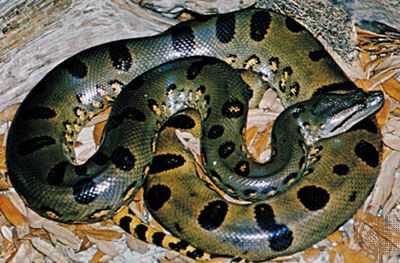
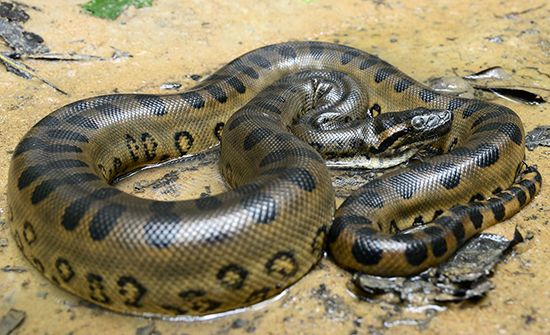
Anacondas, particularly the green anaconda, are among the world’s largest snakes, reaching lengths of up to 9 meters (about 30 feet) and weighing as much as 250 kg (550 pounds). In contrast, boa constrictors are generally smaller, typically measuring about 3 meters (10 feet), though some individuals can reach up to 5.5 meters (18 feet).132
Habitat and Hunting
- Anacondas: These snakes are primarily aquatic, thriving in the swamps, marshes, and rivers of tropical South America. They are adapted for life in the water, with eyes and nostrils positioned on top of their heads to remain submerged while stalking prey like caimans and capybaras.13
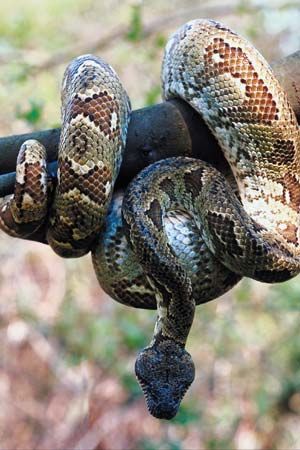
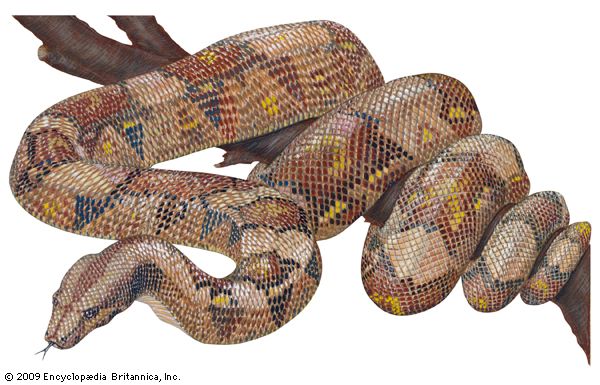
- Boa Constrictors: These are largely terrestrial and arboreal, inhabiting diverse environments from Mexico to Argentina, including rainforests and scrublands. They hunt a wide variety of birds and mammals on land or in trees.12
Both species are ovoviviparous, meaning they give birth to live young rather than laying eggs.43
What is the difference between oviparous and ovoviviparous reproduction in snakes?
The primary difference between oviparous and ovoviviparous reproduction in snakes lies in where the embryo completes its development and how it receives nourishment.56
Oviparous Reproduction
In oviparous species, the female deposits a clutch of fertilized eggs into a protected environment, such as a nest in soil or leaf litter.57
- Development: The embryo develops outside the mother’s body, relying on the conditions of the external environment for incubation.57
- Shell: These eggs typically possess a firm, leathery, or calcareous shell that protects the embryo while allowing for gas and liquid exchange.5
- Parental Care: While most snakes abandon their eggs, some species remain with the clutch to provide protection or, in rare cases, assist in incubation.57
Ovoviviparous Reproduction
In ovoviviparous species, the female retains the eggs within her oviducts until the young are ready to hatch.56
- Development: The embryo is retained inside the mother, which provides physical protection and a more stable temperature compared to the external environment.56
- Nourishment: Unlike true viviparity (where a placenta facilitates nutrient exchange), ovoviviparous embryos derive their nourishment primarily from the yolk contained within the egg.6
- Birth: The young are born live, as the eggs hatch either just before or immediately upon being laid.76
How did the prehistoric Titanoboa compare in size to modern anacondas?
The prehistoric Titanoboa (Titanoboa cerrejonensis) was significantly larger than any modern anaconda. Paleontologists estimate that the average adult Titanoboa reached lengths of approximately 13 meters (42.7 feet) and weighed about 1,135 kg (1.25 tons).9
In comparison, modern anacondas are much smaller:
- Average length: Adult anacondas typically average about 6.5 meters (21.3 feet).9
- Record size: The largest verified anacondas reach about 9 meters (approximately 29.5 feet) in length.9
No living snake has been documented with a length exceeding 9.6 meters (about 31.5 feet). The massive size of Titanoboa is attributed to the exceptionally warm climate of the Paleocene Epoch, which allowed this cold-blooded predator to grow to such proportions in its waterlogged, tropical environment.9
What are some other examples of snakes in the Boidae family?
The family Boidae, commonly known as the true boas, includes a diverse group of nonvenomous constricting snakes. These snakes are primarily divided into two subfamilies: Boinae and Erycinae.2
Subfamily Boinae
Members of this subfamily are found in the American tropics, Madagascar, and the southwestern Pacific. Notable examples include:2
- Boa constrictor: A widespread species found from Mexico to Argentina, known for its ability to grow to significant lengths.2
- Anacondas: Including the green anaconda, which is among the largest members of the family.2
- Tree boas: Such as the emerald tree boa, which possesses large teeth for catching birds.2
- Rainbow boa: Known for its iridescent scales.2
Subfamily Erycinae
These snakes are typically smaller, often measuring less than 70 cm, and are frequently found in arid or semiarid habitats. Examples include:2
- Sand boas: Various species within the genus Eryx found in Asia, India, and Africa.2
- Rubber boa: A burrowing species native to western North America.2
- Rosy boa: A species ranging from the southwestern United States into Mexico.2
- Earth python: A West African species.2
Some classifications also include groups like the African burrowing pythons, bevel-nosed boas, and rubber boas as subfamilies within Boidae.10
Sources
- What are the differences between anacondas and boa constrictors? — Encyclopædia Britannica
- boa — Encyclopædia Britannica
- What are the differences between pythons and boa constrictors? — Encyclopædia Britannica
- anaconda — Encyclopædia Britannica
- snake - Egg formation and laying — Encyclopædia Britannica
- reptile - Embryonic development and parental care — Encyclopædia Britannica
- water snake — Encyclopædia Britannica
- Viviparity — Encyclopædia Britannica
- Titanoboa — Encyclopædia Britannica
- List of snakes — Encyclopædia Britannica
- Boidae — Merriam-Webster
Published on · 4 min read