What Are the Differences Between Pythons and Boa Constrictors?
While both pythons and boa constrictors are large, muscular snakes that kill by constriction, they differ significantly in their biology and distribution.
What are the differences between pythons and boa constrictors?
While both pythons and boa constrictors are large, muscular snakes that kill by constriction, they differ significantly in their biology and distribution.12
Key Differences
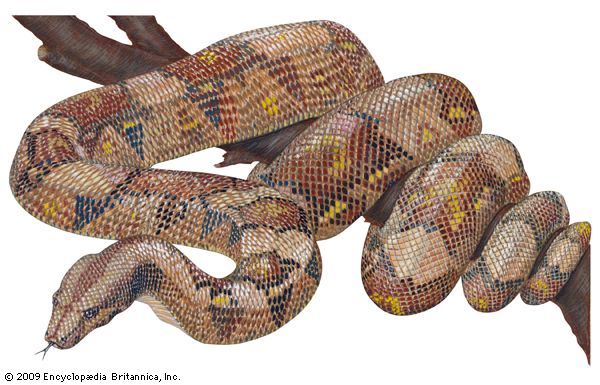
- Reproduction: Pythons are oviparous, meaning they lay eggs. Females often coil around their eggs to protect and regulate their temperature through muscle contractions. In contrast, boa constrictors are ovoviviparous; they incubate eggs internally and give birth to live young.13
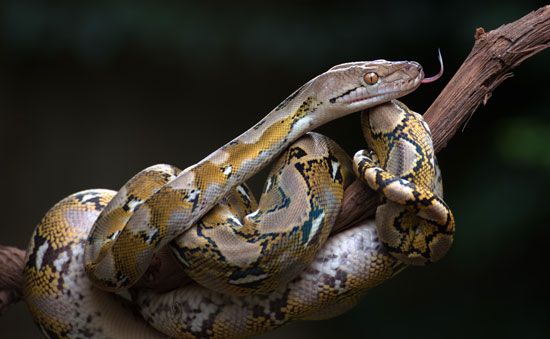
- Physical Traits: Pythons generally grow larger than boa constrictors, with some reticulated pythons reaching up to 10 meters (33 feet), whereas boa constrictors typically measure around 3 meters (10 feet). Additionally, pythons possess heat-sensing pits between their lip scales to detect warm-blooded prey, a feature not found in boa constrictors.13
- Geography: Pythons are primarily found in the Old World tropics and subtropics across Africa, Asia, and Australia. Boa constrictors are native to the Americas, ranging from northern Mexico to Argentina.13
How do snakes use constriction to hunt their prey?
Constriction is a specialized hunting method used by many boids and colubrids to secure their food. The process typically follows a consistent sequence:1
- The Strike: The snake first strikes at its prey and secures a firm grip using its teeth.15
- Coiling: Once the prey is held, the snake rapidly throws a series of body coils around the animal.1
- Constriction: These coils are tightened until the prey can no longer breathe, leading to suffocation. In some cases, the pressure is sufficient to cause blood flow to stop, resulting in organ failure within seconds.16
Contrary to popular belief, these snakes very seldom crush or break the bones of their prey during this process. After the prey has been subdued, the snake uses its highly flexible skull and jawbones to swallow the meal whole, often utilizing a “walk-feeding” method to maneuver the food down its throat.15
What are some other examples of ovoviviparous animals?
Ovoviviparity is a reproductive strategy where embryos develop inside eggs that are retained within the mother’s body until they are ready to hatch. Unlike viviparous species, where the mother provides direct nourishment, ovoviviparous embryos rely primarily on the yolk contained within their eggs for sustenance, receiving only physical protection and oxygen from the parent.89
Beyond the boa constrictor, several other animal groups exhibit this trait:
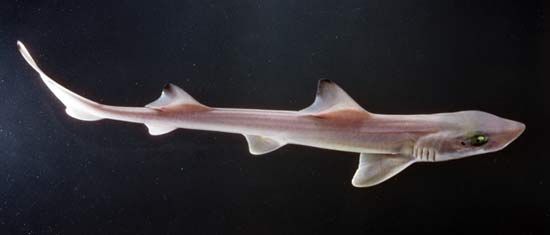
- Sharks and Rays: The majority of sharks and rays (excluding skates) are ovoviviparous. In many of these species, the embryo remains in the oviduct nourished by its yolk sac. In some sharks, such as the porbeagle, mako, and sand shark, embryos may even consume other eggs or embryos within the mother once their own yolk supply is exhausted.10
- Amphibians: While rare, some amphibians display this behavior. For example, the anuran Gastrotheca marsupiata is known to be ovoviviparous.9
- Squamates: Many lizards and snakes have evolved various forms of live-bearing, ranging from simple egg retention to more complex placental development. This transition is often seen as an evolutionary progression from egg-laying to live birth.911
How do heat-sensing pits help snakes find food in the dark?
Heat-sensing pits, also known as pit organs, serve as highly specialized infrared receptors that allow certain snakes, such as pit vipers, boas, and pythons, to hunt effectively in the dark.1314
These organs function as directional distance receptors by detecting thermal radiation emitted by warm-blooded prey. The structure consists of a thin, densely innervated membrane suspended within a cavity on the snake’s head. When infrared energy from a warm animal reaches this membrane, it triggers nerve impulses that the snake’s brain processes to create a “heat image” of its surroundings.151413
Because these snakes possess a pair of pits, they are able to utilize a form of binocular vision, which allows them to localize the position of their prey with remarkable precision. While other senses like smell and the detection of ground vibrations help the snake identify the presence of prey, the pit organs are essential for confirming the target’s location and accurately aiming a strike, even in total darkness.151413
Sources
- What are the differences between pythons and boa constrictors? — Encyclopædia Britannica
- constrictors — Merriam-Webster
- boa — Merriam-Webster
- python — Encyclopædia Britannica
- snake - Specializations for securing food — Encyclopædia Britannica
- snake - Skull and sense organs — Encyclopædia Britannica
- What are the differences between anacondas and boa constrictors? — Encyclopædia Britannica
- Viviparity — Encyclopædia Britannica
- chondrichthyan - Reproduction and development — Encyclopædia Britannica
- Animal reproductive system - Provisions for the developing embryo — Encyclopædia Britannica
- Oviparity — Encyclopædia Britannica
- reptile - Embryonic development and parental care — Encyclopædia Britannica
- reptile - Chemoreception — Encyclopædia Britannica
- Thermoreception - Reptiles and amphibians — Encyclopædia Britannica
- viper — Encyclopædia Britannica
Published on · 3 min read