Midwife Toad
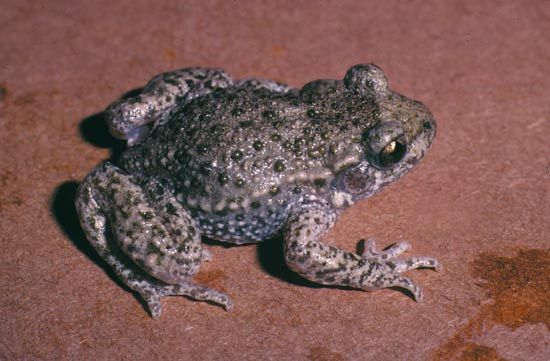
The midwife toad (Alytes obstetricans) is a terrestrial amphibian native to Western Europe, typically inhabiting forests near ponds and streams. While the…
What role do midwife toads play in their ecosystem, and how do they interact with other species?
The midwife toad (Alytes obstetricans) is a terrestrial amphibian native to Western Europe, typically inhabiting forests near ponds and streams. While the provided information details their unique reproductive behavior, it does not explicitly document their specific ecological roles or their interactions with other species beyond their reliance on moist environments for egg development.12
Midwife toads are notable for their parental care: males carry fertilized egg strings wrapped around their legs and waist, moving between land and water to prevent the eggs from dehydrating. This behavior allows them to utilize terrestrial habitats for breeding, reducing their immediate dependence on aquatic environments compared to other amphibians. Because these eggs lack protective shells or specialized membranes, they require the male to maintain them in damp conditions until they are ready to hatch in the water.12
Are there any conservation efforts in place to protect midwife toad populations, and what challenges do these efforts face?
While the provided information does not detail specific, species-targeted conservation programs for the midwife toad, it highlights the broader environmental threats facing amphibians that necessitate urgent protection efforts.
The primary challenges to these populations include:
- Habitat Destruction: The loss of natural environments remains a severe, long-term driver of population decline for many species.1
- Environmental Stressors: Factors such as acid rain, global warming, and ozone depletion contribute to the instability of amphibian populations.1
- Disease: The chytrid fungus (Batrachochytrium dendrobatidis) has been identified as a major cause of significant die-offs globally, including documented impacts in Europe.1
Because midwife toads rely on specific moist retreats and access to water for their unique reproductive cycle, they are particularly vulnerable to environmental changes that disrupt these habitats. Protecting these toads requires addressing these systemic ecological threats to ensure the survival of their specialized life cycle.3
How long do midwife toads typically live, and what is their life cycle from egg to adult?
The provided search results do not contain information regarding the typical lifespan of midwife toads. Therefore, I cannot provide an answer to that part of your query.
Regarding their life cycle, the midwife toad (Alytes obstetricans) follows a unique developmental process:
- Mating and Fertilization: Mating occurs on land throughout the spring and summer. The female produces two rosary-like strands of 20 to 60 eggs, which the male fertilizes externally as they are extruded.12
- Parental Care: The male wraps the egg strings around his legs and waist. He carries them in terrestrial environments, periodically visiting moist retreats to prevent the eggs from dehydrating.12
- Hatching: After approximately three weeks, when the eggs are ready to hatch, the male enters a pond or stream. The larvae, measuring slightly over 1.3 cm (0.5 inch), emerge from the gelatinous capsules into the water.1
- Development: The larvae complete their development in the water before undergoing metamorphosis into adult toads.12
Are there any interesting folklore or cultural references associated with midwife toads in the regions where they are found?
The provided search results do not contain information regarding specific folklore or cultural references associated with the midwife toad (Alytes obstetricans). While there is historical lore surrounding “toadstones”—fossilized teeth from extinct fish that were once erroneously believed to be jewels found inside a toad’s head—this belief was generally applied to toads in a broad sense rather than specifically to the midwife toad.
The midwife toad is primarily recognized in scientific contexts for its unique reproductive behavior, where the male carries the eggs on his back until they are ready to hatch, a trait that earned the species its common name.
Sources
- midwife toad — Encyclopædia Britannica
- frog and toad - Egg laying on land — Encyclopædia Britannica
- amphibian - Distribution and abundance — Encyclopædia Britannica
- midwife frog — Merriam-Webster
- toad — Merriam-Webster
- 9 Words from the Magical Realm | Toadstone — Merriam-Webster
Published on · 3 min read