Notoungulata
The Notoungulata were a diverse group of extinct hoofed mammals that exhibited a wide range of body sizes throughout their existence, which spanned from the…
How did the size of Notoungulata species vary throughout their existence?
The Notoungulata were a diverse group of extinct hoofed mammals that exhibited a wide range of body sizes throughout their existence, which spanned from the late Paleocene Epoch to the early Pleistocene Epoch.1
Rather than following a single size trend, the group occupied various ecological niches, leading to significant morphological variation:
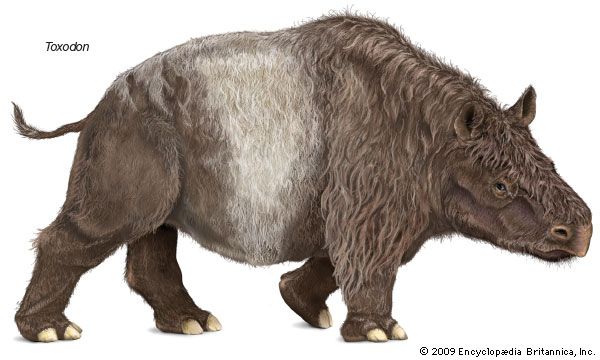
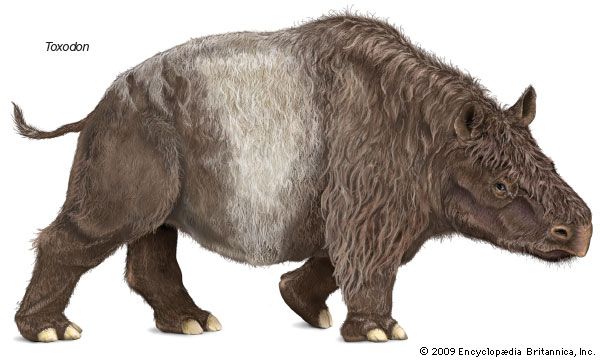
- Massive forms: Some groups, such as the toxodonts, were notably large and heavily built. For example, the genus Toxodon reached heights of approximately 1.5 meters (5 feet) at the shoulder.1
- Small-bodied forms: Other notoungulates evolved along lines that paralleled the body plans of smaller animals, such as rabbits and rodents.1
This diversity in size and form allowed them to fill various roles in South American ecosystems while evolving in isolation for millions of years.1
How did Notoungulata evolve and what led to their eventual extinction?
Notoungulata were a diverse group of hoofed mammals that originated in East Asia before flourishing primarily in South America. Living from the late Paleocene Epoch to the early Pleistocene Epoch, they evolved in geographic isolation for millions of years, allowing them to develop specialized forms that paralleled the evolution of mammals elsewhere, such as rodents and rabbits.1
Their decline and eventual extinction were driven by significant environmental and biological shifts:
- Climate and Geography: By the Pliocene Epoch, their diversity began to wane due to changing climate and geography.1
- The Great American Biotic Interchange: The reestablishment of a land bridge between North and South America approximately 3.5 million years ago allowed for a massive migration of northern placental mammals. These northern invaders, including carnivores and highly adaptable herbivores, outcompeted the endemic South American fauna for resources, ultimately contributing to the extinction of the notoungulates.123
How did Notoungulata relate to other South American mammals during their time?
During their existence, the Notoungulata evolved in geographic isolation within South America, a continent that remained separated from North America for millions of years. This isolation allowed notoungulates to undergo adaptive radiation, resulting in a diverse array of forms that occupied ecological niches similar to those filled by mammals on other continents.14
Their relationship to other South American mammals was defined by this independent evolutionary path:
- Parallel Evolution: Notoungulates developed body plans that mirrored those of unrelated mammals elsewhere, such as rodents and rabbits.1
- Endemic Diversity: Because South America was isolated during the Paleogene and Neogene periods, the continent’s fauna became highly distinct, with a high percentage of endemic groups.5
- Competition with Invaders: When the land bridge between North and South America was reestablished approximately 3.5 million years ago, notoungulates faced competition from northern placental mammals that migrated south. While some endemic groups had successfully radiated and competed with these invaders, the notoungulates ultimately declined and became extinct following this biotic interchange.14
What significant fossil discoveries have contributed to our understanding of Notoungulata?
While the provided search results confirm that Notoungulata are known primarily through the fossil record, they do not detail specific, individual fossil discoveries or particular sites that have advanced our understanding of this group.
The available information establishes that these hoofed mammals existed from the late Paleocene Epoch through the early Pleistocene Epoch. Fossils have revealed a wide range of body types, including the massive, clumsily built toxodonts—such as the genus Toxodon, which stood approximately 1.5 meters high at the shoulder—as well as smaller forms that evolved along lines similar to modern rodents and rabbits.1
Because the current knowledge base lacks specific data regarding landmark fossil finds or excavation histories for this order, I cannot provide a list of significant discoveries.
Sources
- Notoungulata — Encyclopædia Britannica
- plate tectonics - Evolution — Encyclopædia Britannica
- Tertiary Period - Mammalian migration between North and South America — Encyclopædia Britannica
- South America - Animal life — Encyclopædia Britannica
- mammal - Diversity — Encyclopædia Britannica
- South America - The Argentinian Pampas — Encyclopædia Britannica
- artiodactyl - Annotated classification — Encyclopædia Britannica
- notoungulate — Merriam-Webster
Published on · 3 min read