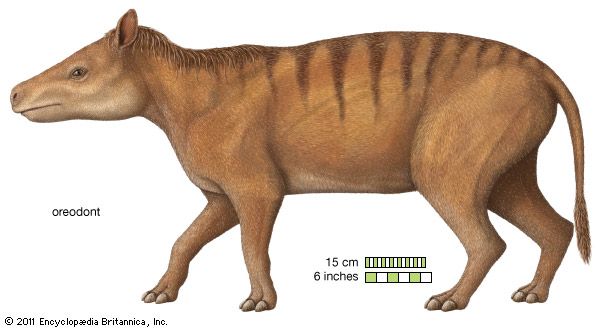
Oreodont
Oreodonts were a diverse group of extinct herbivorous artiodactyls that possessed several unique anatomical features distinguishing them from other mammals.
What unique anatomical features did oreodonts possess that distinguished them from other prehistoric mammals?
Oreodonts were a diverse group of extinct herbivorous artiodactyls that possessed several unique anatomical features distinguishing them from other mammals.1
Unlike living artiodactyls, which are typically unguligrade (walking on their toes), oreodonts exhibited a digitigrade stance, meaning their limb structure was more similar to that of dogs or cats. Additionally, their skeleton and dentition were unlike any other living mammal group.1
Another notable specialization appeared in some Oligocene species, which featured extremely large chambers in their middle ears. These structures are believed to have been specialized for hearing low-frequency sounds. Furthermore, while early oreodonts were browsers, later members of the family Merycoidodontidae evolved higher-crowned teeth, allowing them to adapt to tougher diets.1
What methods do paleontologists use to study and reconstruct oreodont fossils?
Sorry, the Britannica knowledge base does not contain information regarding the specific methods paleontologists use to study and reconstruct oreodont fossils.
How were oreodonts related to modern mammals, and what was their evolutionary significance?
Oreodonts were a diverse group of extinct herbivorous artiodactyls that lived in North America from the Middle Eocene to the early Pliocene.13
Relationship to Modern Mammals
Taxonomically, oreodonts are frequently classified within the suborder Tylopoda, the group that includes modern camels, though some researchers place them outside this lineage. While they are often compared to sheep due to their size and shape, their anatomy was distinct from any living mammal group. They possessed pig-like proportions, short faces, and specialized dentition, including large upper canines and selenodont molars.13
Evolutionary Significance
Oreodonts are significant for their role in the North American Paleogene and Neogene ecosystems. They flourished as the Earth’s climate cooled, reaching their peak diversity during the Oligocene Epoch. Their evolution reflects a transition in dietary adaptation; early forest-dwelling forms were replaced by later merycoidodonts that developed higher-crowned teeth to consume tougher vegetation in savanna-like environments consume tougher vegetation in savanna-like environments.1
What types of habitats did oreodonts likely inhabit based on fossil evidence?
Based on the fossil record, oreodonts occupied a range of environments that shifted alongside the changing climate of North America between the Middle Eocene and the early Pliocene.1
- Forest Environments: The earliest oreodonts, belonging to the family Agriochoeridae, were primarily browsing, forest-dwelling mammals that reached their peak diversity during the late Eocene. During this epoch, North America was characterized by warm, humid conditions with widespread temperate and subtropical forests.14
- Savanna-like Environments: As the Earth’s climate cooled, particularly during the Oligocene Epoch, forested regions dwindled and grasslands expanded. Fossil evidence, such as that found in the Brule Formation of the White River Badlands, indicates that later oreodonts—specifically members of the family Merycoidodontidae—inhabited savanna-like environments. These later forms developed higher-crowned teeth, an evolutionary adaptation that allowed them to consume the tougher vegetation typical of these more open, grassy landscapes.15
Sources
- oreodont — Encyclopædia Britannica
- perciform - Annotated classification — Encyclopædia Britannica
- artiodactyl - Evolution and paleontology — Encyclopædia Britannica
- Oligocene Epoch — Encyclopædia Britannica
- Eocene Epoch — Encyclopædia Britannica
- oreodont — Merriam-Webster
Published on · 2 min read