Neospirifer
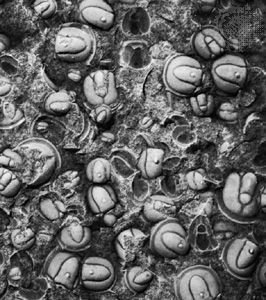
Neospirifer is a genus of extinct brachiopods, commonly known as lamp shells, that lived during the Late Carboniferous to Permian periods, approximately 318…
What is Neospirifer?
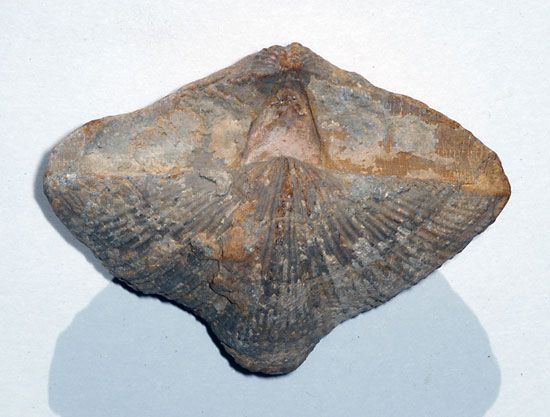
Neospirifer is a genus of extinct brachiopods, commonly known as lamp shells, that lived during the Late Carboniferous to Permian periods, approximately 318 million to 251 million years ago.1
These organisms are characterized by robust, well-preserved shells featuring a prominent central furrow, known as a sulcus, and a corresponding ridge, or fold. Due to their distinct morphology and widespread presence in marine rock formations from that era, Neospirifer serves as a valuable index fossil for geologists performing stratigraphic correlations. They belong to the broader group of spiriferids, which are noted for internal, spirally coiled supports for their feeding structures.12
What are index fossils and why are they important?
An index fossil is any plant or animal preserved in the Earth’s rock record that serves as a diagnostic marker for a specific environment or span of geologic time.4
To be considered a useful index fossil, a specimen must meet several criteria:
- Distinctiveness: It must be easily recognizable.4
- Abundance: It should be found in large numbers.4
- Geographic Range: It must have a wide distribution, allowing for correlation across different regions.4
- Temporal Range: It must have a short existence through time, which helps pinpoint specific geological intervals.4
These fossils are essential because they provide the foundation for defining boundaries within the geologic time scale and enable the stratigraphic correlation of rock layers globally. While organisms like trilobites are often used for regional dating, pelagic species like Agnostida or conodonts are particularly prized for their ability to correlate strata between continents due to their rapid evolution and widespread distribution.45
How do brachiopods differ from modern clams?
Although brachiopods (lamp shells) and bivalve mollusks like clams both possess two-part shells, they are biologically distinct and unrelated groups.67
The primary differences include:
- Anatomy: Brachiopods possess a unique feeding organ called a lophophore—a tentacle-bearing structure used for filter feeding. In contrast, clams use their gills for both respiration and filter feeding.86
- Symmetry: Clam shells are typically symmetrical across the plane between the two valves, meaning each half is a mirror image of the other. Brachiopod shells are generally symmetrical across the midline of each individual valve, but the two valves themselves are often unequal in size and shape.
- Evolutionary Lineage: While both are coelomates, they belong to entirely different phyla. Clams are mollusks, whereas brachiopods belong to their own distinct phylum, Brachiopoda.7
- Lifestyle: Many clams are mobile, using a muscular foot to burrow into sediment. Brachiopods are typically sessile, often attaching themselves to hard surfaces via a fleshy stalk called a pedicle.6
What defines the Carboniferous and Permian periods?
The Carboniferous Period and the Permian Period represent the final two intervals of the Paleozoic Era.
The Carboniferous Period (358.9–298.9 million years ago)
The Carboniferous is the longest period of the Paleozoic and is named for the extensive coal-bearing strata formed during this time. It is divided into the Mississippian and Pennsylvanian subperiods.1011
- Environment: The period featured diverse marine and continental settings, including vast coal swamps. High atmospheric oxygen levels supported the growth of giant insects, such as large dragonflies.1211
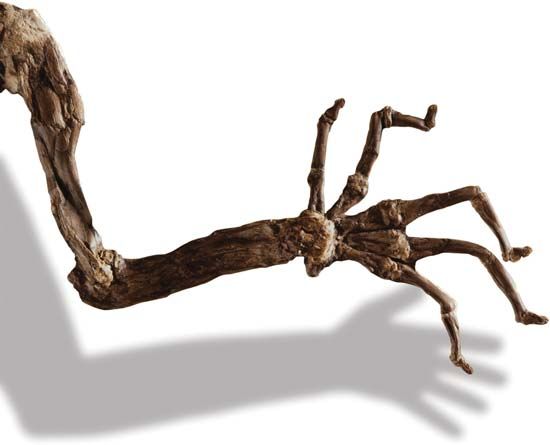
- Life: Marine ecosystems were dominated by crinoids, bryozoans, and brachiopods. On land, vascular plants flourished, amphibians reached their peak development, and the first reptiles emerged.1211
The Permian Period (298.9–252.2 million years ago)
The Permian marks the conclusion of the Paleozoic Era and is named after the Perm region in Russia16.
- Geography: This era was defined by the assembly of the supercontinent Pangea, surrounded by the Panthalassa ocean.1314
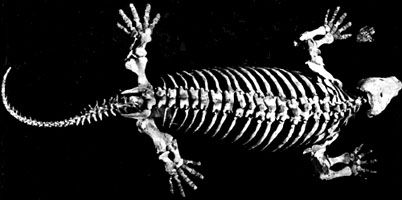
- Climate and Life: The period began with widespread glaciation but warmed significantly, leading to hot, arid conditions. Terrestrial plants and insects diversified, and important reptile lineages appeared that would eventually lead to mammals.1315
- Extinction: The period ended with the largest mass extinction in Earth’s history, which eliminated over 90 percent of existing species.1315
Sources
- Neospirifer — Encyclopædia Britannica
- spirifer — Merriam-Webster
- sponge - Distinguishing taxonomic features — Encyclopædia Britannica
- index fossil — Encyclopædia Britannica
- Cambrian Period - Correlation of Cambrian strata — Encyclopædia Britannica
- What’s the difference between clams, mussels, and oysters? — Encyclopædia Britannica
- lophophore — Merriam-Webster
- skeleton - Calcareous structures — Encyclopædia Britannica
- Circulatory system - Brachiopoda — Encyclopædia Britannica
- Carboniferous Period — Encyclopædia Britannica
- A Journey Through Time Since the Precambrian - Permian Period: 298.9 million to 252.2 million years ago — Encyclopædia Britannica
- Permian Period - The Permian environment — Encyclopædia Britannica
- Carboniferous Period - Distinctive features — Encyclopædia Britannica
- A Journey Through Time Since the Precambrian - Carboniferous Period: 358.9 million to about 298.9 million years ago — Encyclopædia Britannica
- Permian Period - Temperature crises — Encyclopædia Britannica
- Permian Period — Encyclopædia Britannica
Published on · 3 min read