Mucrospirifer
Mucrospirifer is a genus of extinct brachiopods, commonly known as lamp shells, that lived during the Middle and Upper Devonian Period, which began…
What is Mucrospirifer?
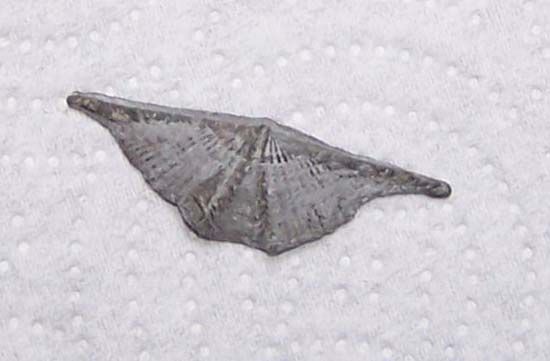
Mucrospirifer is a genus of extinct brachiopods, commonly known as lamp shells, that lived during the Middle and Upper Devonian Period, which began approximately 416 million years ago.1
These organisms are characterized by two distinct features:
- Extended Hinge Line: The two valves, or shells, of the brachiopod feature a notably elongated hinge line.1
- Fold and Sulcus: They possess a prominent fold (a bow-shaped ridge) and a sulcus (a depressed trough) on their shells.1
As abundant fossils from the Devonian era, Mucrospirifer species are frequently studied by paleontologists to understand evolutionary trends within the genus and its related forms. They belong to the broader group of spiriferids, which are articulate brachiopods often referred to as “spire-bearers” because their internal feeding structures are supported by spirally coiled supports called spiralia.12
What are the main differences between brachiopods and mollusks?
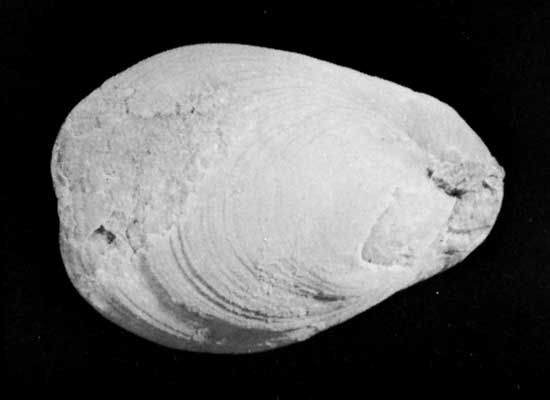
While brachiopods (lamp shells) and mollusks (such as bivalves) may superficially resemble one another due to their hard, two-part shells, they are biologically distinct and unrelated groups.4
The primary differences between them include:
- Symmetry: In bivalve mollusks, the two shell valves are typically mirror images of each other (left and right). In contrast, brachiopod shells are usually asymmetrical between the two valves (dorsal and ventral), but each individual valve is symmetrical along its own midline.567
- Feeding Structures: Brachiopods possess a lophophore—a specialized, often horseshoe-shaped organ with ciliated tentacles used for feeding and respiration. Mollusks, such as bivalves, utilize ctenidia (gills) and labial palps to filter food particles from the water.6857
- Anatomy: The internal organization differs significantly. Brachiopods have a body cavity divided into a posterior visceral cavity and an anterior mantle cavity, and their digestive system is often U-shaped and may lack an anus, with waste excreted through the mouth. Mollusks possess a distinct mantle, a muscular foot, and a more complex digestive tract that typically includes an anus.67
- Musculature: Brachiopods use a complex set of muscles to open and close their valves, often involving diductor muscles to pull the shell open. Bivalves rely on one or two adductor muscles to close their shells, with the hinge ligament providing the tension to open them.657
How do scientists use fossils to determine the age of rock layers?
Scientists determine the relative age of rock layers using fossils primarily through the law of faunal succession, which observes that fossilized plants and animals appear in the rock record in a predictable, non-repetitive order over time. Because specific species evolved, thrived, and went extinct at known intervals, the presence of these fossils allows geologists to correlate rock layers found in different geographic locations.131415
Key methods include:
- Index Fossils: These are the most useful tools for dating. An ideal index fossil is easily recognizable, abundant, widely distributed, and existed for only a short span of geologic time. Finding these in a rock layer acts as a “time stamp” for that specific interval.1613
- Biostratigraphic Correlation: By identifying unique assemblages of fossils, geologists can match strata from separated outcrops, effectively piecing together a composite history of Earth’s geologic time.1314
- Calibration with Absolute Dating: While fossils provide relative ages, they are often calibrated using radiometric dating. By measuring the decay of radioactive isotopes in associated volcanic minerals, scientists can assign precise numerical ages to the fossil-bearing layers.1317
What other types of marine life lived during the Devonian Period?
The Devonian Period, often called the “Age of Fishes,” hosted a vast array of marine life beyond its famous vertebrate inhabitants. The oceans, which covered approximately 85 percent of the globe, supported diverse invertebrate communities that occupied both shallow and deep-water niches.192021
Invertebrate Diversity
- Reef Builders: Shallow seas were dominated by corals—including tabulate and rugose (horn) corals—and stromatoporoids, which were sponge-like organisms that built massive reef structures.22
- Filter Feeders: Brachiopods were exceptionally diverse, with spire-bearing spiriferoids serving as important index fossils. Crinoids and bryozoans (specifically netted fenestellids) were also common in shelf environments.22
- Mollusks: Bivalves and gastropods were well-established, while the Scaphopoda (tusk shells) made their first appearance. Notably, ammonites emerged from nautiloid ancestors during this period.22
- Arthropods: Trilobites remained significant, though many groups declined toward the end of the period. Giant eurypterids (sea scorpions) and abundant ostracods were also prominent.22
Other Marine Organisms
Sources
- Mucrospirifer — Encyclopædia Britannica
- spirifer — Merriam-Webster
- fungus - Annotated classification — Encyclopædia Britannica
- bivalve - Internal features — Encyclopædia Britannica
- lamp shells - Form and function — Encyclopædia Britannica
- lophophore hypothesis — Encyclopædia Britannica
- skeleton - Calcareous structures — Encyclopædia Britannica
- lophophorate — Encyclopædia Britannica
- mollusk - External features — Encyclopædia Britannica
- branchiopod - Evolution and paleontology — Encyclopædia Britannica
- crustacean - Evolution and paleontology — Encyclopædia Britannica
- Circulatory system - Brachiopoda — Encyclopædia Britannica
- index fossil — Encyclopædia Britannica
- dating - Principles and techniques — Encyclopædia Britannica
- law of faunal succession — Encyclopædia Britannica
- geologic time — Encyclopædia Britannica
- dating - Distinctions between relative-age and absolute-age measurements — Encyclopædia Britannica
- Tertiary Period - Correlation of Tertiary strata — Encyclopædia Britannica
- A Journey Through Time Since the Precambrian - Devonian Period: 419.2 million to about 359 million years ago — Encyclopædia Britannica
- Devonian Period - Invertebrates — Encyclopædia Britannica
- Devonian Period - Vertebrates — Encyclopædia Britannica
- Devonian Period — Encyclopædia Britannica
- Devonian Period - Devonian life — Encyclopædia Britannica
Published on · 3 min read