Pond Turtle
Pond turtles have evolved several specialized adaptations to thrive in aquatic environments:
How do pond turtles adapt to their aquatic environment?
Pond turtles have evolved several specialized adaptations to thrive in aquatic environments:
- Locomotion: Unlike terrestrial turtles, freshwater species possess webbed feet, which they use as paddles to navigate through the water.1
- Respiration: While they rely on lungs for gas exchange, aquatic turtles can hold their breath for long periods during dives. Their respiratory efficiency is aided by the pressure of water on their limbs, which assists in the expiration process.2
- Vision: Their eyes are anatomically adapted to adjust quickly, allowing them to see clearly both underwater and in the air.3
- Sensory Perception: Many aquatic species feature tubercles and papillae on their chins, which serve as tactile or chemosensory organs to help them navigate and find food.3
- Feeding: Pond turtles are often omnivorous, consuming a mix of vegetation and small aquatic animals. Some species exhibit specialized feeding behaviors, such as the gape-and-suck mechanism used by certain turtles to draw prey into their mouths.453
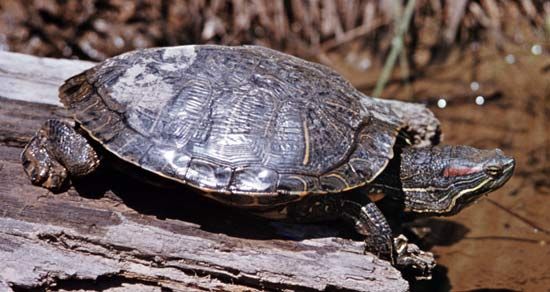
- Behavior: They frequently engage in basking on logs or banks, a behavioral mechanism used to regulate body temperature by absorbing solar radiation.657
What are some common species of pond turtles found around the world?
Pond turtles belong primarily to the families Emydidae and Geoemydidae, with species distributed across various freshwater habitats globally. Some notable examples include:48
- Pacific Pond Turtle (Clemmys marmorata): Native to western coastal North America, this highly aquatic reptile is found from southern Canada to California, typically inhabiting quiet waters like ponds.4
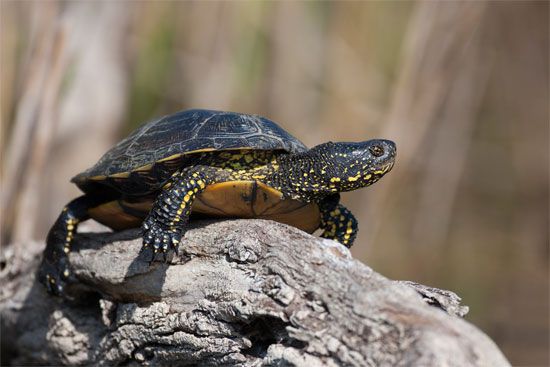
- European Pond Turtle (Emys orbicularis): Also known as the swamp turtle, this species ranges from the Ural Mountains through Europe and into northwestern Africa.4
- Asian Box Turtles (genus Cuora): These species are generally more aquatic than their American counterparts, frequently residing in forest ponds and streams.8
- Asian River Turtles: Large species such as the Asian river turtle (Batagur baska) and the painted terrapin (Callagur borneoensis) are tidal river dwellers that can tolerate brackish water.8
While these are specific examples, the greatest diversity of aquatic turtle species is found in southeastern North America and South Asia, where they occupy diverse environments ranging from small bogs to large rivers.89
What are the differences between pond turtles and sea turtles?
Pond turtles and sea turtles are both members of the order Testudines, but they have evolved distinct physical and behavioral adaptations to suit their respective environments.
Habitat and Morphology
- Environment: Pond turtles are freshwater species found in habitats ranging from small bogs and ponds to large rivers. In contrast, sea turtles are marine reptiles that inhabit tropical and temperate oceans worldwide.410
- Shell Structure: Aquatic turtles, including pond turtles, often have streamlined shells to aid in swimming, but this trait is most highly developed in sea turtles.2
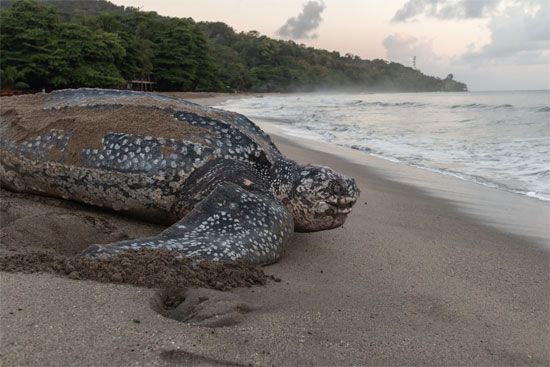
- Limbs: While pond turtles possess webbed feet for navigating quiet waters, sea turtles have limbs modified into flippers, which are specialized for efficient, long-distance swimming in open ocean environments.11
Reproduction and Migration
- Nesting: Females of all aquatic species must leave the water to lay eggs. Pond turtles typically nest on banks adjacent to their home waters. Sea turtles are highly migratory, often traveling hundreds of kilometers from feeding grounds to return to the specific beaches where they hatched.8
- Egg Cycles: Sea turtles generally nest in three- to four-year cycles, laying multiple clutches per season. Pond turtles typically nest annually.8
- Hatching: Sea turtle hatchlings require a collective effort to dig out of the nest, as a single individual lacks the energy to reach the surface alone.12
Dietary Habits
- Feeding: Many pond turtles are omnivorous, consuming a mix of vegetation and small aquatic animals like fish, snails, and insects. Sea turtles have varied diets; for example, green sea turtles are primarily herbivorous, preferring marine grasses and algae, while leatherback sea turtles are specialized carnivores that feed on gelatinous prey like jellyfish.31
How do aquatic turtles use their shells for camouflage?
Aquatic turtles utilize their shells for camouflage primarily through their physical form and surface texture, rather than through active color-changing mechanisms. While many aquatic turtles, such as sea turtles, have evolved streamlined shells to aid in efficient swimming, other groups—particularly bottom-dwelling species like snapping turtles and the matamata—possess less streamlined, ridged carapaces.1
These ridges and irregularities in the shell’s surface help the turtle blend into its environment by mimicking the appearance of rocks, debris, or submerged vegetation found on the bottom of ponds and rivers. This type of concealing coloration allows these turtles to remain inconspicuous to both potential predators and unsuspecting prey as they wait or move along the substrate. By integrating into the visual texture of their surroundings, these turtles effectively use their anatomy as a tool for survival in their freshwater habitats.1
Sources
- turtle - Form and function — Encyclopædia Britannica
- What do turtles eat? — Encyclopædia Britannica
- turtle - Feeding behaviour — Encyclopædia Britannica
- pond turtle — Encyclopædia Britannica
- Respiratory system - Reptiles — Encyclopædia Britannica
- reptile - Swimming — Encyclopædia Britannica
- Biosphere - Temperature — Encyclopædia Britannica
- turtle - Habitats — Encyclopædia Britannica
- turtle: Top Questions — Encyclopædia Britannica
- turtle - Classification — Encyclopædia Britannica
- turtle - Nesting and egg laying — Encyclopædia Britannica
- turtle - Egg development and hatching — Encyclopædia Britannica
- Why are turtles so slow? — Encyclopædia Britannica
- coloration - Background matching — Encyclopædia Britannica
- gastropod - Features of defense — Encyclopædia Britannica
- What are turtle shells made of? — Encyclopædia Britannica
Published on · 4 min read