Why Are Turtles So Slow?
Turtles are not inherently "slow" in all environments; their reputation for sluggishness primarily stems from their movement on land, which is a trade-off…
Why are turtles so slow?
Turtles are not inherently “slow” in all environments; their reputation for sluggishness primarily stems from their movement on land, which is a trade-off for their unique evolutionary strategy of prioritizing defense over speed.1
The turtle’s shell, consisting of a rigid carapace and plastron, provides essential protection against predators but adds significant weight and restricts the range of motion in their limbs. Because many turtles are herbivores or scavengers, they do not require high-speed locomotion to capture prey, allowing them to thrive with this defensive adaptation.12
Furthermore, many species are aquatic or semi-aquatic, where water buoyancy mitigates the weight of their shells, enabling more efficient movement than they exhibit on land. Their overall pace of life is also influenced by a slow metabolism, which helps conserve energy and contributes to their remarkable longevity.12
How does a turtle’s metabolism contribute to its long lifespan?
A turtle’s slow metabolism is a key factor in its remarkable longevity. By maintaining a reduced metabolic rate, turtles limit the physical strain on their bodies, which helps slow the cumulative effects of aging and wear over time.2
This efficient use of energy allows turtles to survive longer periods without food and minimizes cellular damage, both of which contribute to a longer life. Furthermore, because their metabolic rates are significantly lower—often about 10 times lower than those of mammals of comparable size—their total lifetime energy expenditure remains relatively low. This lower rate of living is inversely correlated with lifespan; as the rate of energy consumption decreases, the potential for a longer life increases.25
By prioritizing survival through these biological adaptations, alongside physical defenses like their shell, turtles are able to reach ages that far exceed many other animal species.26
What are the main differences between the carapace and the plastron?
The carapace and the plastron are the two primary components of a turtle’s shell, forming a rigid skeletal box that protects the animal’s internal organs.7
Key Differences
- Position: The carapace is the top, or dorsal, portion of the shell, while the plastron is the underside, or ventral, portion.7
- Composition:
- Development: Both structures are formed from a combination of dermal bones (developing in the skin) and endochondral bones (developing from cartilage), but they serve different structural roles within the turtle’s body.7
These two sections are joined along the sides of the body, creating a permanent, non-sheddable structure that is essential for both protection and movement.7
How do aquatic turtles move differently than land-dwelling turtles?
Aquatic and land-dwelling turtles exhibit distinct locomotor strategies shaped by their environments. While land-dwelling turtles are generally characterized by slow, quadrupedal movement on solid ground, aquatic turtles have evolved specialized adaptations to navigate water efficiently.9
Aquatic Locomotion
The movement of aquatic turtles varies significantly by species:
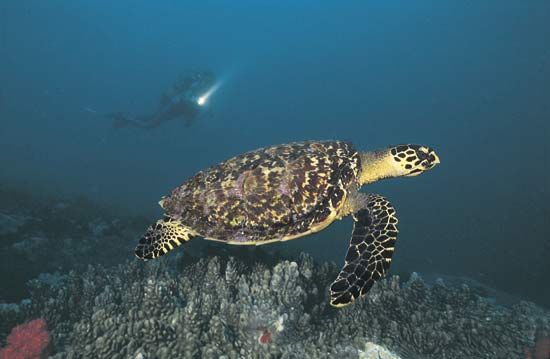
- Sea Turtles: These animals have evolved forelimbs into bladelike flippers. They propel themselves by rotating these flippers in a figure-eight pattern, which provides both lift and thrust, functioning similarly to the aerial flight of birds.101
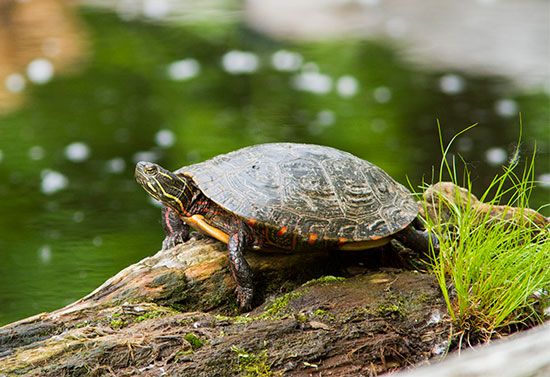
- Freshwater Turtles: Most freshwater species possess elongated, strongly webbed feet used as paddles. Unlike sea turtles, their limb movements typically alternate during swimming.101
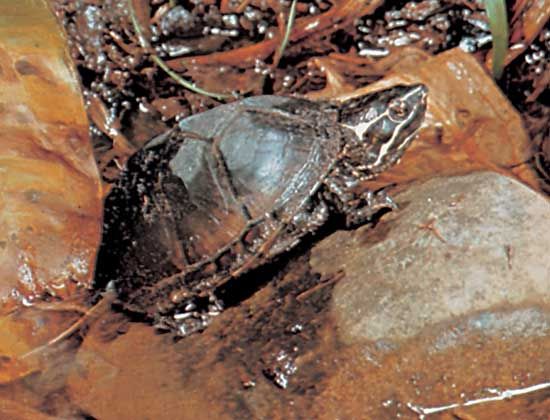
- Bottom-Walkers: Certain groups, such as snapping, mud, and musk turtles, are poor swimmers. They move along the bottom of water bodies using limb movements that are essentially identical to their terrestrial walking patterns, though they can often achieve higher speeds in water than on land.1011
Terrestrial Locomotion
On land, the turtle’s movement is constrained by its heavy, rigid shell, which limits limb range and speed. This slow pace is an evolutionary trade-off, prioritizing defense over rapid movement.9
Sources
- Why are turtles so slow? — Encyclopædia Britannica
- Why do turtles live for so long? — Encyclopædia Britannica
- reptile - Walking and crawling — Encyclopædia Britannica
- turtle - Habitats — Encyclopædia Britannica
- aging - Species differences in longevity and aging — Encyclopædia Britannica
- turtle - Longevity — Encyclopædia Britannica
- What are turtle shells made of? — Encyclopædia Britannica
- crustacean - General features — Encyclopædia Britannica
- Locomotion - Tetrapodal vertebrates — Encyclopædia Britannica
- turtle - Form and function — Encyclopædia Britannica
- reptile - Swimming — Encyclopædia Britannica
Published on · 3 min read