Rollinia
Rollinia is a genus of approximately 65 species of tropical American trees and shrubs within the family Annonaceae (order Magnoliales). These plants are…
What is Rollinia?
Rollinia is a genus of approximately 65 species of tropical American trees and shrubs within the family Annonaceae (order Magnoliales). These plants are characterized by flowers featuring three spurlike or wing-appendaged outer petals and three minute inner petals.12
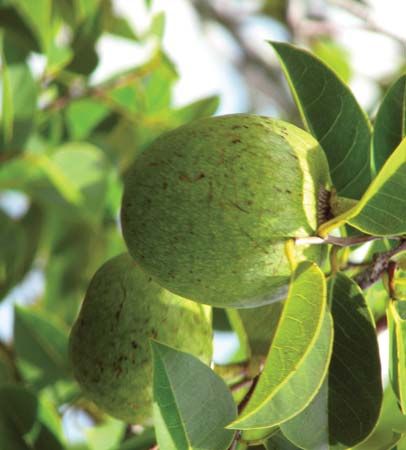
Many species in this genus produce edible fruits that are similar in flavor and appearance to those of the related genus Annona. These fruits are typically green-skinned, segmented or spined, and measure about 7.6 cm (3 inches) in diameter. Two notable species, R. mucosa and R. pulchrinervis, are cultivated for their fruit and are commonly referred to as biriba. The genus was named in honor of the French educator Charles Rollin.12
What is the biriba fruit?
The biriba is a tropical fruit produced by trees in the genus Rollinia, specifically Rollinia mucosa (sometimes classified as Rollinia deliciosa). Belonging to the family Annonaceae, it is closely related to the custard apple and shares a similar flavor and appearance.13
Key characteristics of the biriba include:
- Appearance: The fruit is typically green-skinned, segmented or spined, and measures approximately 7.6 cm (3 inches) in diameter.1
- Cultivation: It is primarily cultivated for its edible fruit, which is valued for its sweet, custard-like pulp.13
- Etymology: The name “biriba” is derived from the Portuguese biribá, which originates from the Tupi language.3
The genus Rollinia itself consists of about 65 species of trees and shrubs native to the tropical Americas, named in honor of the French educator Charles Rollin.1
What are other plants in the Annonaceae family?
The Annonaceae family, also known as the custard apple family, is the largest family within the order Magnoliales, comprising approximately 110 genera and 2,430 species of trees, shrubs, and woody climbers. While primarily found in tropical regions, some species extend into temperate areas.4
Beyond the well-known Annona genus—which includes the cherimoya, soursop, and sweetsop—the family includes many other diverse genera:45
- Large Genera: Uvaria (approx. 200 species), Xylopia (approx. 180 species), Guatteria (177 species), and Monoon (approx. 60 species).4
- Ornamental and Notable Plants: The American pawpaw (Asimina triloba) is a notable species native to the eastern United States, known for its sweet, custard-like fruit. The weeping form of the mast tree (Monoon longifolium) is a popular ornamental in Sri Lanka and India, where its leaves are used for temple decorations.4
- Other Genera: The family also includes Goniothalamus, Artabotrys, Duguetia, Monanthotaxis, Polyalthia, Miliusa, Fissistigma, Orophea, Pseuduvaria, Mitrephora, Unonopsis, Isolona, and Piptostigma.4
- Unique Species: Porcelia saffordiana, a South American tree, is notable for producing immense fruits that can weigh 18 kg (40 pounds) or more.4
How do tropical trees adapt to their environment?
Tropical trees have evolved a variety of sophisticated adaptations to thrive in the intense competition and unique environmental conditions of their habitats. These adaptations primarily address the challenges of securing light, accessing nutrients, and managing water in complex ecosystems like the tropical rainforest.
Competition for Light
Because only about 1 percent of sunlight reaches the forest floor, plants have developed diverse strategies to reach the well-lit canopy:
- Growth Strategies: Some species are “pioneer” trees that grow rapidly in high-light canopy gaps, while others are shade-tolerant and persist for years as slow-growing saplings until a gap forms.910
- Mechanical Dependence: To avoid the energy cost of building massive trunks, many plants use others for support. Lianas climb using grapnel-like hooks, while stranglers (such as Ficus) begin life as epiphytes before sending roots to the ground to eventually encase and replace their host.9
- Epiphytes: These plants grow on other trees to access sunlight, deriving water and nutrients from the air and rain rather than the soil.911
Nutrient and Water Management
Tropical soils are often nutrient-poor due to heavy leaching, leading to specialized root and leaf adaptations:
- Root Systems: Most trees have shallow root systems to capture nutrients from the surface humus layer. To stabilize themselves in shallow, saturated soils, many develop buttress roots—planklike extensions that provide structural support.912
- Hydrophytic Adaptations: Trees in waterlogged environments, such as mangroves, use pneumatophores (specialized roots) for aeration and may possess stilt roots for stability.12
- Leaf Modifications: Leaves are highly responsive to environmental signals. In drier or more stressful conditions, trees may develop thicker cuticles, smaller stomates, or specialized hairs to minimize water loss, whereas plants in supermoist environments often have thinner leaves with more intercellular spaces to facilitate gas exchange.13
Sources
- Rollinia — Encyclopædia Britannica
- Rollinia — Merriam-Webster
- biriba — Merriam-Webster
- Annonaceae — Encyclopædia Britannica
- cherimoya — Merriam-Webster
- custard apple — Encyclopædia Britannica
- Annonaceae — Merriam-Webster
- Soursop — Encyclopædia Britannica
- Tropical rainforest - General structure of the rainforest — Encyclopædia Britannica
- tree - Tree roots — Encyclopædia Britannica
- tree - Leaf adaptations — Encyclopædia Britannica
- Tropical rainforest - Environment — Encyclopædia Britannica
- Tropical rainforest - Biological productivity — Encyclopædia Britannica
- Rainforest regeneration in PanamaRegeneration in Panama — Encyclopædia Britannica
- angiosperm - Leaf modifications — Encyclopædia Britannica
Published on · 3 min read