Sabre-toothed Cat
Sabre-toothed cats were a diverse group of extinct carnivores that existed from the Eocene through the Pleistocene Epoch, spanning a period from…
When did sabre-toothed cats live and what was their geographical distribution?
Sabre-toothed cats were a diverse group of extinct carnivores that existed from the Eocene through the Pleistocene Epoch, spanning a period from approximately 56 million to 11,700 years ago.1
Their geographical distribution evolved significantly over time:
- Miocene and Pliocene Epochs: These cats were established in North America and Europe. By the Pliocene, their range had expanded to include Asia and Africa.1
- Pleistocene Epoch: During this time, their presence extended into South America.1
The group included two distinct lineages: the Nimravidae, which were extant from about 37 million to 7 million years ago, and the subfamily Machairodontinae, which persisted from about 12 million to less than 10,000 years ago. The most famous genus, Smilodon, was a prominent predator in both North and South America throughout the Pleistocene.12
How did sabre-toothed cats use their elongated canine teeth for hunting?
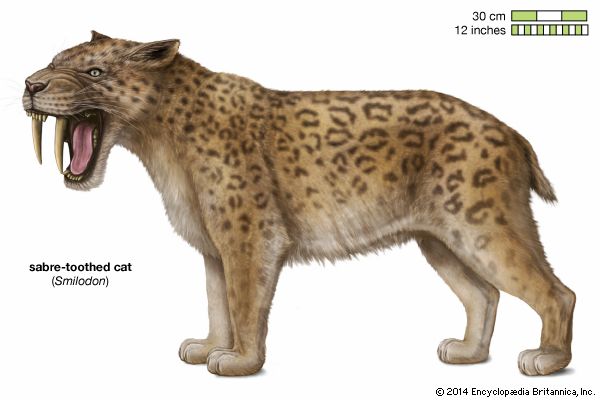
The elongated canine teeth of Smilodon, which could reach lengths of up to 20 cm (8 inches), were specialized tools for stabbing and slashing attacks against large herbivores.32
Several physical adaptations supported this hunting style:
- Jaw Mechanics: The jaw could open to a 90° angle, which cleared the way for the upper canines to strike. However, some researchers note that this wide gape would have required the jaw muscles to stretch significantly, likely resulting in a weaker bite force compared to modern cats.32
- Musculature: The skull was modified to allow for the attachment of powerful neck muscles, which provided the force necessary to drive the head downward during an attack.32
- Dental Structure: The lower canines were reduced, and the molars functioned as shearing blades rather than grinding surfaces, further specializing the animal for a diet of flesh.2
Unlike modern cats that rely on speed, Smilodon utilized its robust, muscular build and powerful forelimbs to grapple and ambush prey.1
What different species of sabre-toothed cats existed throughout history?
Sabre-toothed cats were not a single species but a diverse group of extinct carnivores categorized into two main groups: the family Nimravidae and the subfamily Machairodontinae.1
The Nimravidae
These animals were only distantly related to modern cats and lived from approximately 37 million to 7 million years ago. Notable genera include:1
- Hoplophoneus
- Nimravus
- Dinictis
- Barbourofelis
The Machairodontinae
This subfamily of the cat family (Felidae) existed from about 12 million to less than 10,000 years ago. Members of this group are often referred to as machairodonts. Key genera include:14
- Smilodon: The most famous genus, known for its robust build and massive 20 cm (8-inch) canine teeth.1
- Homotherium: A widespread genus that persisted into the Pleistocene Epoch.1
- Meganteron: An early member of the subfamily.1
- Machairodus: A genus similar to Smilodon but typically possessing slightly smaller canine teeth.5
While often called “sabre-toothed tigers” or “lions,” these animals are distinct from modern lions and tigers, which belong to the subfamily Felinae.1
How do modern big cats compare to sabre-toothed cats in terms of evolution and hunting strategies?
Modern big cats and sabre-toothed cats represent distinct evolutionary paths shaped by different environmental pressures. While they share a common ancestry within the family Felidae, their physical forms and hunting strategies diverged significantly.26
Evolutionary Differences
Modern big cats, such as lions and tigers, belong to the subfamily Pantherinae. They evolved for a combination of speed, stealth, and agility, characterized by elongated bodies and limbs that allow them to pursue prey in diverse environments like forests and grasslands.21
In contrast, sabre-toothed cats—specifically the genus Smilodon—evolved into robust, stocky predators. Their anatomy was not optimized for sprinting but for grappling and ambush tactics, utilizing powerful forelimbs to secure large Ice Age herbivores.26
Hunting Strategies
- Modern Big Cats: These predators rely on a combination of speed and a powerful bite. Their jaw structure is designed for high bite force, allowing them to deliver lethal, sustained bites to their prey.
- Sabre-toothed Cats: Smilodon utilized specialized stabbing and slashing attacks. Their skulls were modified to accommodate massive neck muscles that drove their elongated canine teeth downward. While their jaws could open to a 90° angle to facilitate these strikes, this adaptation likely resulted in a weaker bite force compared to modern cats.263
Sources
- sabre-toothed cat — Encyclopædia Britannica
- How big were saber-toothed cats compared to tigers? — Encyclopædia Britannica
- How big was a saber-toothed tiger? — Encyclopædia Britannica
- machairodont — Merriam-Webster
- Machairodus — Merriam-Webster
- feline - Evolution and classification — Encyclopædia Britannica
Published on · 3 min read