Sap
Sap is the watery fluid found in plants, serving various physiological roles depending on its location and composition. It is generally categorized into two…
What is Sap?
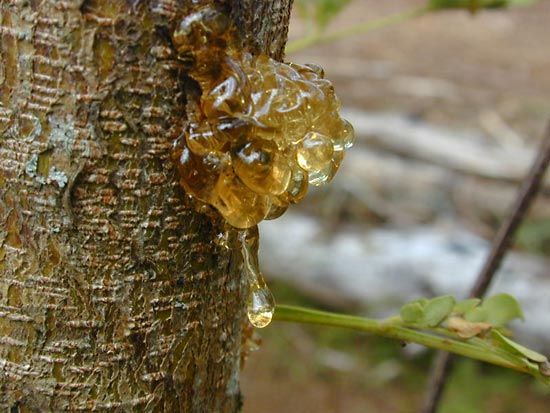
Sap is the watery fluid found in plants, serving various physiological roles depending on its location and composition. It is generally categorized into two primary types:1
- Cell sap: A fluid contained within the vacuoles of living cells, which stores food, waste materials, inorganic salts, and nitrogenous compounds.12
- Circulatory sap: Fluids transported through specialized vascular tissues for long-distance movement. This includes xylem sap, which carries water and dissolved minerals from the roots to the leaves, and phloem (or sieve-tube) sap, which transports sugars from the leaves to other parts of the plant.21
In some species, such as the sugar maple, a specific “sweet-water” sap flows from the sapwood during periods of freezing and thawing while the tree is dormant. Similarly, the sap tapped from the flower stalks of various palms is a traditional source of sugar, alcohol, and vinegar.34
How does the process of transpiration help move sap through a tree?
The movement of sap through a tree is primarily driven by transpiration, a process where water evaporates from the leaves through small pores called stomata.56
As water evaporates, it creates a negative pressure, or “tension,” that pulls the water column upward through the xylem from the roots to the crown. This mechanism is explained by the cohesion hypothesis, which relies on two critical factors:57
- Cohesion: Water molecules are attracted to one another, allowing them to form a continuous, unbroken column that can be pulled upward without snapping, even in very tall trees.57
- Adhesion: Water molecules are attracted to the walls of the xylem vessels and tracheids, which helps support the column against gravity.57
Because of these forces, the tension generated by transpiration at the leaf surface is transmitted all the way down to the roots, effectively “pulling” the sap upward. While root pressure can sometimes push water upward, transpiration pull is the dominant force for most of a tree’s life.57
What is the difference between xylem and phloem in terms of their structure?
Xylem and phloem are specialized vascular tissues with distinct structural adaptations for their respective roles in long-distance transport.2
Xylem: Water Conduction and Support
Xylem is designed for the rapid transport of water and minerals. Its primary conducting cells—tracheids and vessel elements—are characterized by thick, lignified (woody) walls that provide structural support. Crucially, these cells are dead at functional maturity; their protoplasts dissolve, leaving hollow tubes that allow water to flow with minimal resistance. In angiosperms, vessel elements are arranged end-to-end with perforated end walls, forming efficient, long capillaries.28
Phloem: Nutrient Transport
Phloem is responsible for transporting sugars and metabolic products. Unlike xylem, its conducting elements—sieve elements—remain alive at maturity, though they often lack a nucleus. These cells are organized into sieve tubes, which feature specialized “sieve plates” with pores that facilitate the movement of food between cells. Because they lack a nucleus, sieve elements are typically accompanied by companion cells, which manage their metabolic functions. Phloem also contains flexible fibers that provide tensile strength, contrasting with the rigid, woody structure of xylem.29
How do plants use osmosis to regulate their internal water pressure?
Plants use osmosis to regulate their internal water pressure and maintain structural rigidity through a process involving the vacuole and the cell wall.1011
The Role of the Vacuole
Most plant cells contain a large central vacuole that stores a solution of salts and sugars. By using active transport to maintain high concentrations of these solutes and protons within the vacuole, the cell creates an osmotic gradient that draws water into the organelle. As water enters, the vacuole expands, exerting a hydrostatic pressure known as turgor against the cell membrane and the surrounding cell wall.101112
Structural Support and Turgor
This turgor pressure is essential for the plant’s physical structure. It acts much like air pressure in a pneumatic tire, providing the necessary force to keep non-woody tissues rigid and upright. When a plant has sufficient water, this internal pressure keeps the cells firm. Conversely, if water is scarce, the plant experiences hyperosmotic pressure, causing water to leave the cells. This loss of turgor leads to a decrease in rigidity, which is observed as the wilting of leaves and flowers.131415
Sources
- Sap — Encyclopædia Britannica
- Angiosperm - Structural basis of transport — Encyclopædia Britannica
- Palm - Economic importance — Encyclopædia Britannica
- sugar maple — Encyclopædia Britannica
- Angiosperm - Process of xylem transport — Encyclopædia Britannica
- Cohesion hypothesis — Encyclopædia Britannica
- Transpiration — Encyclopædia Britannica
- Xylem — Encyclopædia Britannica
- Phloem — Encyclopædia Britannica
- Osmosis — Encyclopædia Britannica
- cell - The vacuole — Encyclopædia Britannica
- vacuole: Top Questions — Encyclopædia Britannica
- Turgor — Encyclopædia Britannica
- Cell wall - Mechanical properties — Encyclopædia Britannica
- vacuole — Encyclopædia Britannica
- Osmotic pressure — Encyclopædia Britannica
- cell - Mechanical properties of wall layers — Encyclopædia Britannica
Published on · 3 min read