Sapsucker
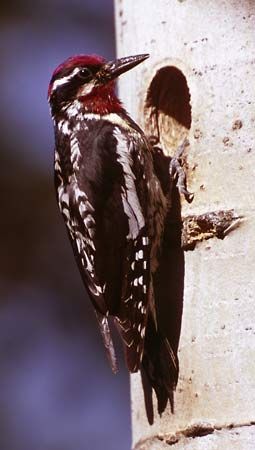
A sapsucker is any of the North American woodpeckers belonging to the genus Sphyrapicus. These birds are distinct for their habit of drilling neat, close…
What is Sapsucker?
A sapsucker is any of the North American woodpeckers belonging to the genus Sphyrapicus. These birds are distinct for their habit of drilling neat, close rows of holes into tree bark to feed on sap and insects, though they are also known to catch insects in midair.12
There are two primary species:
- Yellow-bellied sapsucker (Sphyrapicus varius): Measuring about 20 cm (8 inches) long, this species breeds in northern regions and migrates as far as the West Indies and Central America. Its range includes red-breasted and red-naped races found west of the Rocky Mountains.1
- Williamson’s sapsucker (S. thyroideus): This species is found in high pine forests of the western United States, though it remains uncommon throughout its range.1
How do sapsuckers help other animals in the forest?
Sapsuckers, like other woodpeckers, play a vital role in forest ecosystems by excavating nesting and roosting holes in trees. Once these birds abandon their excavations, these holes provide essential homes for countless other bird species that are unable to create their own cavities.3
While sapsuckers are primarily known for drilling rows of holes to feed on sap and insects, their activity can occasionally create openings in trees. Although these wounds generally heal quickly in healthy trees, they can sometimes allow disease agents to enter, which is a notable interaction between these birds and their environment. By consuming insects, sapsuckers and other piciform birds also help control insect populations, which can assist in protecting trees from the spread of certain diseases.31
What are the main differences between woodpeckers and sapsuckers?
It is a common misconception that sapsuckers and woodpeckers are entirely separate groups; in fact, sapsuckers are a specialized genus (Sphyrapicus) within the woodpecker family, Picidae1.1
The primary differences lie in their feeding habits and behaviors:
- Feeding Strategy: While most woodpeckers forage by probing bark for insects or chiseling into wood for larvae, sapsuckers are uniquely adapted to drill neat, close rows of holes into tree bark to feed on sap and the insects attracted to it. Sapsuckers also supplement their diet by catching insects in midair.42
- Dietary Variety: Many woodpeckers focus on insects, fruits, or berries. Sapsuckers are distinguished by their specialized reliance on tree sap during certain seasons.25
- Migration: Most woodpeckers are permanent residents in their habitats. In contrast, the yellow-bellied sapsucker is notable for being highly migratory, traveling long distances between its breeding grounds and wintering areas in the West Indies and Central America.246
Why do sapsuckers migrate such long distances?
Sapsuckers, such as the yellow-bellied sapsucker, migrate long distances primarily as part of a complex annual life cycle driven by internal biological rhythms and external environmental factors.17
While the pituitary gland prepares these birds physiologically for migration—often through metabolic changes like fat deposition—the actual initiation of flight is heavily influenced by ecological conditions. For species like the sapsucker, the availability of food is a critical factor. As northern regions experience seasonal changes that limit the accessibility of sap and insects, the birds move toward more hospitable climates in the West Indies and Central America to ensure their survival. Additionally, sudden shifts in weather, such as the onset of cold temperatures during autumn, can act as a trigger for their departure.71
Sources
- Sapsucker — Encyclopædia Britannica
- sapsucker — Merriam-Webster
- Piciform - Importance to humans — Encyclopædia Britannica
- Woodpecker — Encyclopædia Britannica
- yellow-bellied sapsucker — Merriam-Webster
- Piciform - Distribution and ecology — Encyclopædia Britannica
- Migration - Physiological stimulus of migration — Encyclopædia Britannica
Published on · 2 min read