Sea Fan
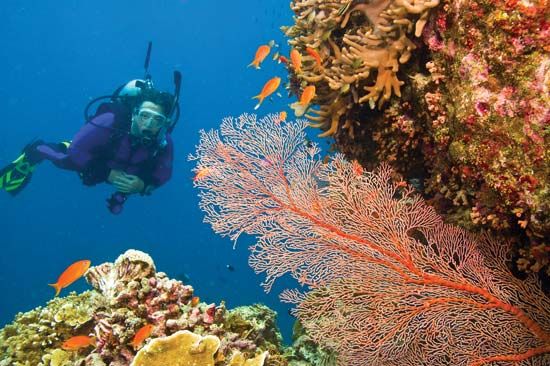
Sea fans, members of the genus Gorgonia, are distinct from many other coral species primarily due to their unique structural composition and growth pattern.
How do sea fans differ from other coral species in structure and appearance?
Sea fans, members of the genus Gorgonia, are distinct from many other coral species primarily due to their unique structural composition and growth pattern.12
Structural Differences
Unlike stony corals, which possess a hard, external skeleton made of calcium carbonate, sea fans feature a flexible, internal skeleton. This central support structure is composed of a horny scleroprotein known as gorgonin. While other corals may be solitary or form massive, rock-like reef structures, sea fans are colonial animals that grow in a specific, flattened, fanlike arrangement.13
Appearance and Adaptation
- Form: Sea fans grow in a branching, fan-shaped pattern, often oriented across water currents to maximize their ability to capture [plankton].12
- Polyps: Each polyp in the colony is equipped with eight feathery tentacles, a characteristic shared with other horny and soft corals but distinct from the simple tentacles found on stony, black, or thorny corals.13
- Coloration: The living tissues covering the skeleton are frequently vibrant, appearing in shades of red, yellow, or orange.1
What are sea fans and which phylum do they belong to?
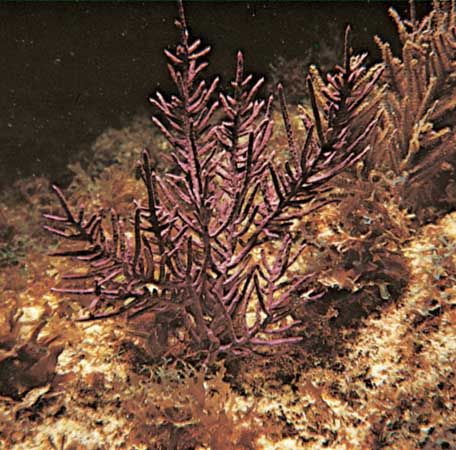
Sea fans are invertebrate marine animals belonging to the genus Gorgonia. They are a type of coral composed of numerous polyps that grow together in a distinct, flat, fanlike pattern.1
These organisms belong to the phylum Cnidaria and the class Anthozoa. Each colony is supported by a flexible, internal skeleton made of a horny scleroprotein called gorgonin, which allows them to withstand water currents while capturing [plankton] with their eight-tentacled polyps.1
What role do sea fans play in marine ecosystems?
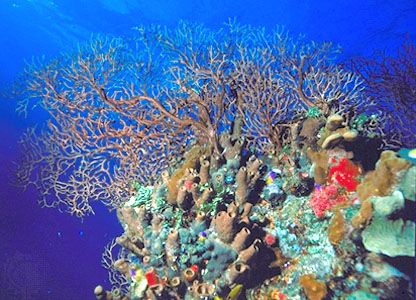
Sea fans play a vital role in marine ecosystems primarily as efficient predators and structural contributors. By growing in flat, fan-shaped colonies oriented across water currents, they function as a living net that captures plankton from the passing water column.1
Beyond their role in the food web, sea fans contribute to the complexity of their environment. As sessile invertebrate colonies, they provide physical structure in the shallow waters of oceans worldwide, particularly in regions like the Atlantic coasts of Florida, Bermuda, and the West Indies. Their presence adds to the biodiversity of these habitats, offering potential shelter or surfaces for other small marine organisms.1
The life cycle of the sea fan—beginning as a microscopic, free-swimming planula larva before settling and developing into a colony through budding—ensures the continued colonization of these marine spaces.1
We could dive deeper into the specific threats facing these colonies or explore how they interact with other reef-dwelling species.
How do sea fans reproduce and grow?
Sea fans reproduce through both sexual and asexual processes. In sexual reproduction, fertilized eggs develop into microscopic, ciliated larvae known as planulae. These larvae disperse from the parent colony into the water column, where they eventually settle on a solid surface and metamorphose into a primary polyp.14
Once established, the colony grows through asexual budding. In this process, new polyps develop from the original individual and remain attached to it. As the colony expands through the constant addition of these new buds, it forms its characteristic flat, fanlike pattern. The entire structure is supported by a central internal skeleton composed of a flexible, horny scleroprotein called gorgonin, which allows the colony to maintain its shape while growing across water currents to capture plankton.142
Sources
- sea fan — Encyclopædia Britannica
- coral — Encyclopædia Britannica
- sea fan — Merriam-Webster
- echinoderm - Reproduction and life cycle — Encyclopædia Britannica
- cnidarian - Support mechanisms and skeletons — Encyclopædia Britannica
Published on · 3 min read