Snowdrop
The snowdrop (genus Galanthus) is a small perennial herb belonging to the amaryllis family. These plants are recognized for being among the earliest to bloom…
What are the distinctive features of a snowdrop flower?
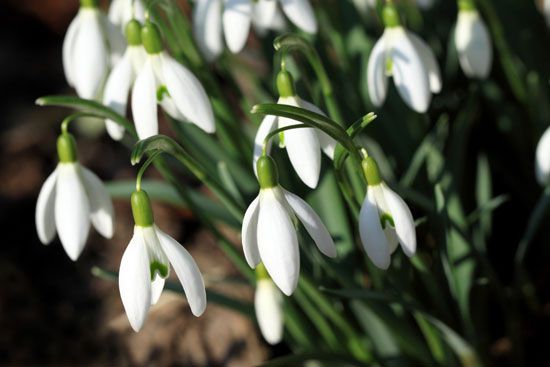
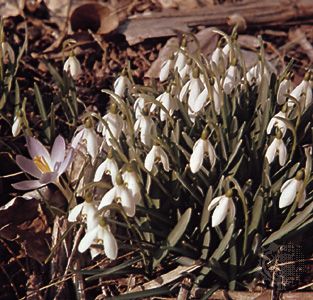
The snowdrop (genus Galanthus) is a small perennial herb belonging to the amaryllis family. These plants are recognized for being among the earliest to bloom in late winter or early spring, often appearing while snow is still on the ground.1
Key physical features include:
- Flowers: The nodding, sometimes fragrant flowers consist of six white tepals. The three outer tepals are long and curved, while the inner three are smaller and notched.1
- Growth Habit: They grow from bulbs and feature basal, linear leaves.1
- Reproduction: The plant produces a capsule fruit containing seeds. These seeds possess hook-shaped elaiosomes—fatty structures that attract ants to assist in seed dispersal.1
The plant typically dies back shortly after its fruits have opened.1
What are some common species of snowdrops, and how do they differ?
The genus Galanthus comprises approximately 20 species of white-flowered plants, with several being popular in cultivation. While all share the characteristic nodding, six-tepaled flowers and bulbous growth, they vary in their specific traits and conservation status.
Two of the most common species cultivated as ornamentals include:
- Common snowdrop (Galanthus nivalis): Widely recognized for its early blooming, often appearing in late winter or early spring. It is a staple in gardens and has become naturalized in parts of the U.K. and North America.1
- Giant snowdrop (G. elwesii): Another popular ornamental species, known for its larger stature compared to the common snowdrop.1
Beyond these common varieties, the genus includes species with varying levels of rarity and vulnerability. For instance, Galanthus trojanus is considered critically endangered and is endemic to a small region in northwestern Turkey. Other species, such as Queen Olga’s snowdrop (G. reginae-olgae), Koenen’s snowdrop (G. koenenianus), G. peshmenii, and G. ikariae, face significant population declines due to threats like habitat loss, climate change, and overcollection.1
How are snowdrops cultivated in gardens, and what care do they require?
Snowdrops are popular ornamental plants valued for being among the first to bloom in late winter or early spring. While the provided information details their biological classification and conservation status, it does not contain specific horticultural instructions regarding their cultivation or care requirements in garden settings.
Because the Britannica knowledge base does not currently provide specific gardening guidelines for Galanthus species, I cannot offer advice on planting depths, soil preferences, or maintenance practices.
What other early-blooming flowers are often associated with snowdrops?
Snowdrops are frequently associated with other early-blooming plants that share the ability to emerge during the late winter or early spring, often while snow is still present on the ground.
One notable companion is the winter aconite (Eranthis), a member of the buttercup family. Like snowdrops, these perennial herbs are widely cultivated for their early appearance and are known for their solitary yellow or white flowers that arise on short stalks from tuberous roots.13
Another closely related group is the snowflake (Leucojum). Also belonging to the amaryllis family, snowflakes are physically similar to snowdrops, featuring nodding, bell-shaped flowers with six white tepals. They are often distinguished by the green or yellow spots found at the tips of their tepals.4
These plants are often grouped together in garden settings because they share similar growth habits, such as emerging from bulbs and dying back after their relatively short flowering periods.514
Sources
- snowdrop — Encyclopædia Britannica
- Galanthus — Merriam-Webster
- winter aconite — Encyclopædia Britannica
- winter aconite — Merriam-Webster
- snowflake — Encyclopædia Britannica
Published on · 3 min read