Jonquil
The jonquil (Narcissus jonquilla) is a bulbous perennial herb belonging to the amaryllis family. Native to the Mediterranean region, it is widely cultivated…
What is Jonquil?
The jonquil (Narcissus jonquilla) is a bulbous perennial herb belonging to the amaryllis family. Native to the Mediterranean region, it is widely cultivated globally as a popular garden flower.123
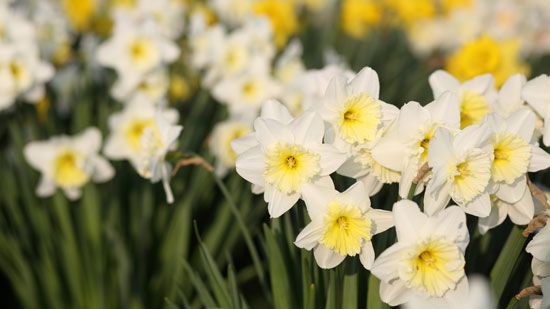
Physically, the jonquil is characterized by long, linear leaves that emerge from underground bulbs each spring. It is closely related to the common daffodil, though it is distinguished by its clustered, fragrant, and short-tubed flowers, which are typically yellow or white. Beyond its ornamental value, the plant produces an oil that is utilized in the production of perfumes. Like other members of the narcissus genus, its bulbs are poisonous.132
What are the main differences between jonquils and other types of daffodils?
While the term “daffodil” is often used as a general name for many plants in the narcissus genus, jonquils (Narcissus jonquilla) possess distinct characteristics that set them apart from the common daffodil (Narcissus pseudonarcissus), also known as the trumpet narcissus.13
The primary differences include:
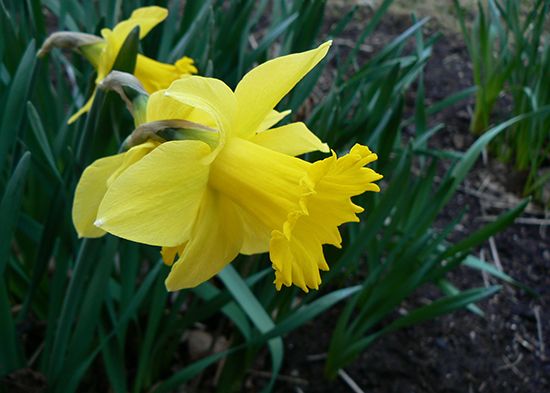
- Flower Structure: Jonquils are characterized by short-tubed flowers, whereas the common daffodil is defined by a prominent, trumpet-shaped central crown (corona).13
- Growth Habit: Jonquil flowers typically grow in clusters on the stem, while many other common daffodils bear a single flower per stem.13
- Fragrance: Jonquils are noted for being particularly fragrant, a trait that makes them valuable for the production of perfume oils.13
- Foliage: Jonquils are distinguished by their long, linear, rush-like leaves, which differ from the broader, flattened foliage often seen in other Narcissus species.13
Both plants are bulbous perennials in the amaryllis family and share similar spring-blooming cycles, but these morphological details help distinguish the jonquil within the broader group of garden ornamentals.13
How do bulbous plants like the jonquil survive through the winter?
Bulbous plants, such as the jonquil, survive through the winter by entering a state of dormancy, which allows them to endure periods when environmental conditions are unfavorable for growth.45
The key to this survival is the bulb, a modified stem that functions as a specialized storage organ. These structures contain fleshy scales or leaves packed with essential reserves, including starch, sugar, and proteins. By storing these nutrients underground, the plant can sustain itself while dormant and then utilize this energy to fuel rapid growth when favorable conditions return in the spring.45
This evolutionary adaptation is common among many perennial monocotyledons, enabling them to thrive in climates characterized by cold winters or long, dry summers. While the term “bulb” is sometimes used broadly in horticulture, it technically refers to these modified shoots that protect the plant’s vital resources until the environment is once again suitable for development.45
What other plants belong to the Amaryllidaceae family?
The Amaryllidaceae family is a diverse group of perennial herbs containing 73 genera and at least 1,600 species. These plants are categorized into three main subfamilies, each featuring distinct varieties:78
Subfamily Amaryllidoideae
This is the largest subfamily and includes many popular garden ornamentals:
- Amaryllis: Includes the belladonna lily and the showy Hippeastrum species.78
- Narcissus: The genus containing daffodils and jonquils.7
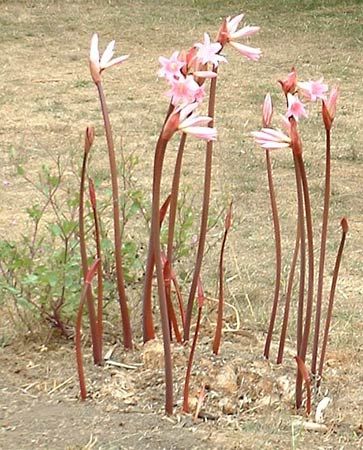
- Other Ornamentals: Includes the snowdrop, snowflake, Cape tulip, Cornish lily, winter daffodil, and Natal lily.78
Subfamily Allioideae
This group is notable for its significant food crops, all belonging to the genus Allium:
Subfamily Agapanthoideae
This subfamily consists of a single genus, Agapanthus, which includes the African lily (Agapanthus africanus), a common ornamental in warm climates.78
Sources
- jonquil — Encyclopædia Britannica
- jonquil — Merriam-Webster
- narcissus — Encyclopædia Britannica
- Bulb — Encyclopædia Britannica
- gardening - Bulbous plants — Encyclopædia Britannica
- Seed - Afterripening, stratification, and temperature effects — Encyclopædia Britannica
- list of plants in the family Amaryllidaceae — Encyclopædia Britannica
- Amaryllidaceae — Merriam-Webster
- Amaryllidaceae — Encyclopædia Britannica
Published on · 3 min read