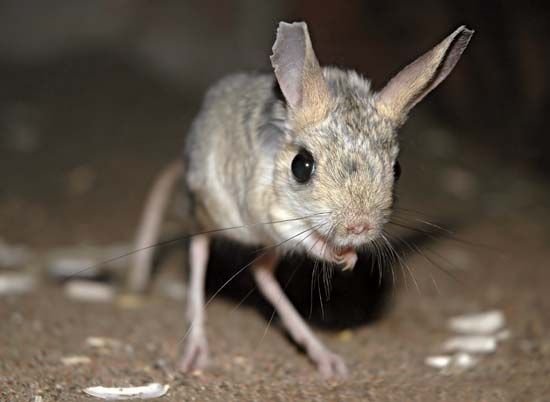
Spring Hare
The spring hare (Pedetes capensis) is a bipedal rodent native to Africa that functions primarily as a grazer within its ecosystem.
What role do spring hares play in their ecosystem?
The spring hare (Pedetes capensis) is a bipedal rodent native to Africa that functions primarily as a grazer within its ecosystem.1
By consuming various parts of grasses, including roots, these animals play a role in the vegetation dynamics of open, arid habitats such as grasslands, dry riverbeds, and sparse scrub. Their foraging habits extend to cultivated areas, where they may consume crops, and they occasionally supplement their diet with locusts.1
Beyond their dietary impact, spring hares influence their environment through their burrowing behavior. They excavate dens in well-drained, hard-packed sandy soils, using specialized claws on their forefeet and hind feet to move significant amounts of earth. These burrows provide essential shelter and are typically located in flat, open land near reliable food sources. While they are often compared to rabbits due to their size and movement, they are not members of the order Lagomorpha and occupy a unique evolutionary position as the sole living member of the family Pedetidae.1
What is a spring hare, and why is it called that despite not being a hare?
The spring hare (Pedetes capensis) is a bipedal rodent native to Africa that is roughly the size of a rabbit. Despite its common name, the spring hare is not a true hare or rabbit; those animals belong to the distinct mammalian order Lagomorpha.12
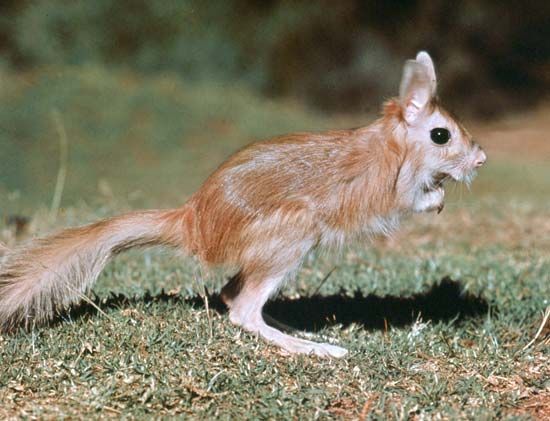
The name “spring hare” is a translation of the Afrikaans word springhaas, which combines the Dutch terms springen (to jump) and haas (hare). This name was likely inspired by the animal’s physical appearance and its method of locomotion. Like a jerboa, the spring hare has short forelegs and powerful hind legs used for jumping, allowing it to move in erratic leaps of 2 to 3 meters when alarmed.31
While it shares a superficial resemblance to rabbits and hares, the spring hare is the sole living member of the family Pedetidae and is not closely related to any other living group of rodents.1
How do spring hares’ diet and foraging habits differ from other rodents?
The spring hare (Pedetes capensis) is a specialized bipedal rodent that functions primarily as a grazer. Unlike many other rodents that may have more varied or opportunistic diets, the spring hare’s foraging is focused heavily on grasses, consuming all parts of the plant, including the roots, depending on the season. While they are primarily herbivorous, they are known to supplement their diet with locusts and may also forage on cultivated crops.1
In contrast, the order Lagomorpha—which includes true hares—consists of animals that are almost exclusively herbivorous. While both groups can impact vegetation and crops, the spring hare’s foraging is uniquely tied to its burrowing lifestyle in arid, open habitats, where it relies on its specialized claws to access food sources near its den.14
Because the provided search results do not contain a comprehensive comparative analysis of the foraging behaviors of all rodent species, I cannot provide a broader comparison between the spring hare and other specific rodent families.
What physical characteristics distinguish spring hares from other rodents?
The spring hare (Pedetes capensis) possesses several distinct physical characteristics that set it apart from other rodents. While it is often compared to a rabbit due to its size, its anatomy is more closely aligned with a giant jerboa.1
Key physical features include:
- Locomotion and Limbs: It features short forelegs and powerful, elongated hind legs designed for jumping. When moving, it stands on its hind feet and uses its tail as a brace. It possesses sharp, curved claws on its forefeet for digging and large, flattened claws on its hind feet for clearing soil.1
- Head and Sensory Organs: The spring hare has a short, round head, a thick muscular neck, and very large eyes. Its ears are long, narrow, and upright, featuring a small skin flap (the tragus) that can fold over the ear opening to exclude sand and dust. Additionally, its nostrils can be closed to protect against debris.1
- Tail and Fur: Its tail is roughly equal to its body length and terminates in a dark brown or black brush of thick hair. The body is covered in long, soft, straight fur ranging from sandy to reddish-brown.1
Sources
Published on · 3 min read