Teasel
The genus Dipsacus, commonly known as the teasel, comprises about 15 species of prickly, coarse biennial herbs native to Europe, the Mediterranean, and…
Are there any notable species within the teasel genus?
The genus Dipsacus, commonly known as the teasel, comprises about 15 species of prickly, coarse biennial herbs native to Europe, the Mediterranean, and tropical Africa. Notable species include:1
- Fuller’s teasel (Dipsacus sativus): This species is historically significant for its hooked bracts, which were used since Roman times in a process called fulling to raise the nap on woolen fabrics.12
- Common teasel (D. fullonum): Similar in appearance to Fuller’s teasel, it features upright bracts that are not suitable for fulling and is often considered a weed in North America and Europe.13
- Small teasel (D. pilosus): Also known as shepherd’s rod, this European native is distinguished by its globe-shaped flower heads and white blooms with violet anthers.1
- D. inermis: A species native to the Himalayas that produces white flowers and leaves divided into numerous segments.1
These plants are often grown as ornamentals or to support local bird populations, as their dried seeds serve as an important food source.1
Where are teasel plants typically found in nature?
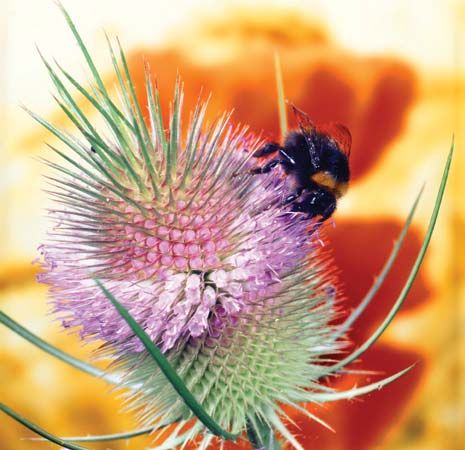
Teasel plants (genus Dipsacus) are native to Europe, the Mediterranean region, and tropical Africa. Within the broader Dipsacus clade, species are primarily Eurasian or African in origin.13
While they are native to these Old World regions, some species—such as the common teasel—have been introduced to North America, where they are often treated as weeds. In their natural habitats, these plants are typically found in various environments, including meadows and other open areas.13
What are the distinctive features of the teasel flower head?
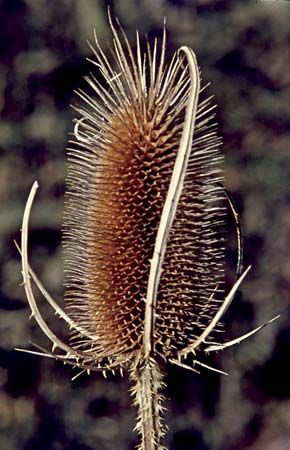
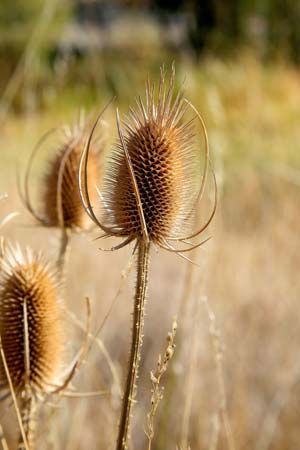
The flower head of the teasel is a distinctive, tall-domed inflorescence composed of numerous small, four-lobed flowers.1
Key features of these flower heads include:
- Structural Support: The heads are surrounded by a crownlike circle of spiny, narrow bracts (leaflike structures) that provide a rigid base.1
- Reproductive Strategy: To encourage cross-pollination, the male parts of the flowers mature before the female parts.1
- Variability: While many species feature tall, domed heads, others like the small teasel (D. pilosus) possess a distinct globe-shaped head.1
- Bract Morphology: The bracts vary significantly between species; for example, Fuller’s teasel features hooked bracts, whereas the common teasel has upright, straight bracts.1
- Persistence: After the flowering period concludes, the dried, spiny fruiting heads remain on the plant, serving as a vital food source for birds.1
Are there any medicinal uses for teasel plants?
The provided search results do not contain information regarding medicinal uses for teasel plants. The available documentation focuses on the plant’s physical characteristics, its historical role in the fulling of woolen fabrics, and its use in the floral industry.51
Sources
- Teasel — Encyclopædia Britannica
- Dipsacus — Merriam-Webster
- Dipsacales — Encyclopædia Britannica
- teasel — Merriam-Webster
- teaselwort — Merriam-Webster
Published on · 2 min read